Tuesday, April 25, 2006

Voyage

As I've mentioned before, the Aerostich folks put out a great catalog. Their focus is gear for motorcycle adventures but a lot of gear in their catalog also comes in handy for human powered adventures as well. But the great thing about their print catalog is that it isn't just a listing of shiny dodads and geegaws, they intersperse the product descriptions and pictures with quotes from folks who actually go out and do stuff. Their latest catalog has quotes from such bike people as Grant Petersen and Maynard Hershon but my favorite quote is this one from Sterling Hayden:

To be truly challenging, a voyage, like a life, must rest on a firm foundation of financial unrest... "I've always wanted to sail to the South Seas, but I can't afford it." What these men can't afford is not to go. They are emmeshed in the cancerous discipline of security. And in the worship of security we fling our lives beneath the wheels of routine. And before we know it our lives are gone.

What does a man need, really need? A few pounds of food each day, heat and shelter, six feet to lie down in -- and some form of working activity that will yield a sense of accomplishment. That's all, in a material sense, and we know it. But we are brainwashed by our economic system until we end up in a tomb beneath a pyramid of time payments, mortgages, preposterous gadgetry, playthings that divert our attention from the sheer idiocy of the charade.

The years thunder by. The dreams of youth grow dim where they lie caked in dust on the shelves of patience. Before we know it, the tomb is sealed.

Where, then, lies the answer? In choice. Which shall it be: bankruptcy of purse or bankruptcy of life?

-
- Sterling Hayden, Voyage, 1976 (Thanks Doug Hackney)


Monday, April 24, 2006

Bicycle Commuter Act

There are versions of bike commuter incentive legislation proposed in both the house and the senate now. Maybe something will actually get passed someday. Read more about it here:

http://www.bta4bikes.org/btablog/2006/04/24/sen-wyden-introduces-bicycle-commuter-act/

Thursday, April 20, 2006

Commuter Bike Considerations

I've been giving a series of talks about bike commuting. This is pretty much what I said at today's talk at the Seattle Bikestation.

Commuter Bike Considerations: Riding to Work is Not the Tour de France

By Kent Peterson, Bicycle Alliance of Washington

I’m going to start by talking not about bikes, but about shoes. I’m guessing here but I’ll bet that the odds are pretty good that you own more than one pair of shoes. If you go to a fancy party you probably wear different shoes than you would to go hiking on Mount Si. If you are going to jog around Green Lake, you’ll probably choose shoes that are designed for running.

Well, bikes are like shoes, there are different kinds of bikes and some kinds are better for some things than others. And like shoes, the single most important thing with a bike is fit. Bikes come in different sizes and if your bike doesn’t fit you, you’ll never get comfortable. So the first thing I tell people about bikes is to go to a good bike shop, talk to somebody who knows bikes and get a bike that fits.

A bike not only has to be a good fit for you, it should be a good fit for the riding you are planning on doing. If you are planning on using your bike for commuting, riding back and forth from home to work or school, you should get a good commuting bike. Unfortunately much of the bike business is geared around racing bikes or extreme downhill mountain bikes or various things other than commuting, so as a customer, you may have to do some digging to find the right kind of bike. Remember riding to work is not the Tour de France. The bike that is right for Lance Armstrong probably isn’t the best bike for your trip to work.

Let’s start at the bottom and talk about tires. Lance rides really skinny, really high pressure racing tires. Lance rides on really smooth roads in France, roads that have been swept and fans write his name on the road. When Lance has a flat tire, there is a car right there with a spare wheel and a mechanic to swap in the new wheel. When you ride to work, the road probably has potholes. Fans probably don’t write your name on the road but people may yell things at you as you ride. If you have a flat tire, you are the person who has to deal with it.

So a commuter bike should probably have bigger, tougher tires than what Lance has on his bike. Some people commute on “mountain” bikes, some people commute on “road” bikes, but the important thing is that your bike has tires appropriate to the task. Returning to the idea of shoes, tires are like the shoes for your bike.

Lance knows that higher pressure tires roll easier and lighter tires roll better than heavy ones. The important thing is to find the right tire for the job. If you are riding a mountain bike on the road big, knobby, low-pressure tires are probably slowing you down. You can probably fit your bike with a slicker, high-pressure tire that is still tough enough for the potholed streets. On the other hand, if you have very skinny, very light racing tires on your road bike, you may pinch flat on the edge of a pothole or be undone by a patch of broken glass, so you probably want to look at getting a tougher road tire. There are a variety of good, tough tires out there and two that I’ve used and like are the Specialized Armadillo and the Schwalbe Marathon XR.

Some road bikes have better clearance than others for running fatter tires. A lot of modern “racing” bikes can only fit tires that are about 23 mm wide and such a bike probably isn’t as well suited to commuting as something with more tire clearance like a “touring” or “sport touring” bike. Tire clearance doesn’t just give you room to run different size tires, it also gives you room to mount fenders on your bike.

Most bikes are sold without fenders but it rains a lot around here and fenders really do a lot to keep you dry. Lance doesn’t have to worry about fenders, when he’s done with his ride; he’s done with his work. When you are done with your ride, you are at work. It’s better if you’re dry when you get there.

Lance’s job is to go fast and everything on his bike is made to help him go fast. Riding your bike fast is not your job, you are riding to your job and some parts of your bike are there to help you be safe and comfortable. Lance has his handlebars lower than his saddle so he can crank out a lot of power and be lower and more aerodynamic. You might be more comfortable with your handlebars somewhat higher so you have less pressure on your hands. It might be better for you to be more upright. You may be less aerodynamic but you might find it easier to look around.

Speaking of looking around, I’m a big fan of the bicycle mirror. Some people have mirrors mounted on their handlebars, some people have mirrors mounted on their helmets. Some people don’t use mirrors at all but you probably wouldn’t drive a car that didn’t have rear view mirrors and I’ve found that a bike mirror is a very handy bit of gear.

Lance doesn’t have to worry about carrying as much stuff as you do. Lance maybe has to carry a water bottle and a Powerbar. Those are good things for you to carry but Powerbar doesn’t sponsor you so maybe you’ll carry tastier snacks. You don’t have that handy team mechanic so you probably want to carry a tire pump and a spare tube and a few other tools. You may want to carry a change of clothes, a rain jacket and maybe you need to carry some other stuff for work as well.

There are various ways to carry stuff. Some folks use a backpack and some use a messenger bag. A lot of people use a rack and some kind of luggage like a trunk bag or panniers. Other options are a handlebar bag, baskets or a bag that attaches to the bike saddle. A commuting bike doesn’t just carry you, it also carries your stuff. Figure out what you need to take and figure out a solution that works for you.

One item that you’ll probably be carrying is a good bike lock. When Lance finishes his ride, somebody makes sure his bike is safe. When you finish your ride, you are the one who makes sure your bike is safe. A good lock is essential and so is good locking technique. Different areas have different problems with crime but in general it’s up to you to make sure your bike and its various parts stay in your possession. Some commuters avoid lugging a huge lock with them by leaving the big lock attached to the bike rack at their office but if you opt for this technique you want to be certain that you never, ever leave your unlocked bike “just for a minute” to dash into a store. A minute is all it takes to lose your bike.

When Lance is racing, he knows everyone is looking to see where he is. When you are commuting it’s safest to assume people aren’t looking for you. So it’s best to do what you can to make yourself seen and heard. For riding at night, lights and reflectors are essential. Any time, day or night, bright light colored clothing is a good idea. Lance has to earn his yellow jersey but bright yellow vests are available at almost any bike shop. A bell or a horn is another thing that Lance would never have on his bike but it might be very handy item to have on yours.

So far I’ve mostly talked about things that you might want that a racer like Lance won’t need, but now I’d like to flip things around a bit. There are some things that make sense on a racing bike that might not make sense on a commuting bike.

Almost all bicycle racers use clipless pedals and special shoes. Lance rides in shoes with very stiff soles and cleats that stick out. Great for racing but bad for walking around. Now a lot of “serious” cyclists will tell you how much more efficient you are with clipless pedals and fancy shoes but maybe you don’t need all that for commuting. Many mountain bike shoes are almost as stiff as road shoes but they have recessed cleats so you can actually walk like a human while wearing those shoes. Other options are old-fashioned toe clips or Power Grips. With toe clips or Power Grips you can ride in more “normal” shoes.

Racing bikes may be geared for going fast but for commuting with a load of stuff you want to make sure you have gears that are low enough to get you up whatever hills you’ll encounter. Lance can climb big mountains with racing gearing. The odds are pretty good you’ll want lower gears than what Lance uses. Again, a good bike shop can give you guidance about selecting the proper gears. Don’t get caught up in having a lot of gears, some folks commute on one speed or three speed bikes and do fine. The key is having the right gearing for your commute.

As I mentioned earlier, some people commute on “road” bikes and some on “mountain” bikes and there are a lot of different kinds of bikes. If you are looking at commuting on a mountain bike, complex suspension systems are probably not going to do much but slow you down. In the case of a mountain bike, gearing that comes in handy for climbing a steep rock-strewn slope may be too low for your commute.

My favorite commute bikes are simple. No fancy suspensions. No super expensive carbon bits that cost twice as much because they are three grams lighter than last year’s bits. A good frame with good clearances for sensible tires and fenders. A good way to carry stuff. A bike that isn’t too pretty so thieves might take the nicer looking bike parked next to mine.

Bike commuting is not the Tour de France. You are not Lance Armstrong. You don’t need to be. All you need is a good bike and I hope I’ve helped you understand a little more about what to look for in a good commuting bicycle.

Friday, April 14, 2006

Flèche NW

Last weekend I rode the Flèche NW with a few of my shiftless friends. You can read all about it and see pictures at:

http://www.carsstink.org/peterson/Fleche2006/FlecheNW.html

Keep 'em rolling,

Kent

Thursday, April 13, 2006

Busy, busy

I'm sure keeping busy, but one of the things I haven't been keeping busy with is updating the blog. Soon I'll be posting a story that will give some context to the above photo, but for now you folks can keep busy by inventing your own captions.

Kent

Tuesday, April 04, 2006

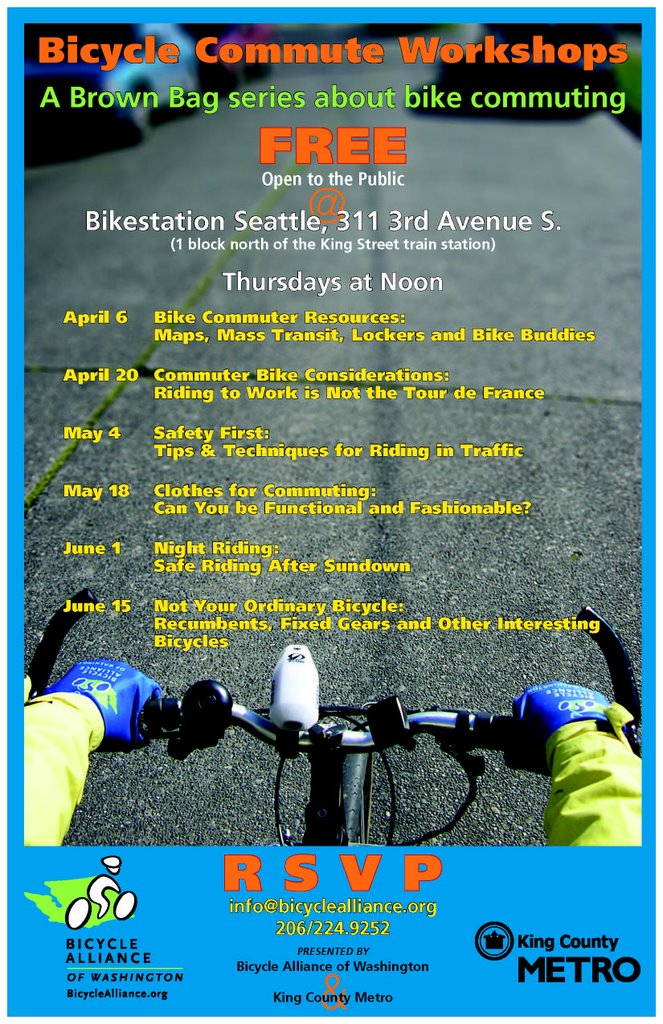
Bicycle Commute Workshops

Starting this Thursday I'll be giving a series of talks about bicycle commuting. The talks are free but space is limited so we're asking that folks RSPV to info@bicyclealliance.org. I'd like to stack the audience with at least a few of my pals, so if you're in the Seattle area and are free from noon to one on a Thursday, come on by. Here's the schedule:

April 6 - Bike Commuter Resources: Maps, Mass Transit, Lockers and Bike Buddies

April 20 - Commuter Bike Considerations: Riding to Work is Not the Tour de France

May 4 - Safety First: Tips and Techniques for Riding in Traffic

May 18 - Clothes for Commuting: Can You be Functional and Fashionable?

June 1 - Night Riding: Safe Riding After Sundown

June 15 - Not Your Ordinary Bicycle: Recumbents, Fixed Gears and Other Interesting Bicycles

Monday, April 03, 2006

The Ghost Town of Monte Cristo

I mentioned this trip on a couple of email lists last fall but I figure I might as well link this into the blogosphere. Some pics from at trip my pal Mark Vande Kamp and I took to Monte Cristo last September are here:

http://www.carsstink.org/peterson/Monte/MC.html

Saturday, April 01, 2006

And I think to myself, what a wonderful world

Not every day is about big adventures. Some days I just do simple stuff like go to the bank, have a cup of coffee with my beautiful wife, catch up on some paper work, listen to the radio, feed the cat, watch too much South Park with the kids (I am not a parental role model), read a book, do laundry and other things that don't make for really exciting blog entries. It's been the kind of damp day that's good for doing things like this.

They say that there is a pot of gold at the end of the rainbow. I don't think that's true but I don't have to go far to look for treasure. I've known for quite some time that it's all right here. The photo above is the view out the door of my apartment this evening.

Monday, March 27, 2006

Law and Order: Bike Theft Victims Unit

In Seattle's war on greenhouse gases, the public is served by two separate but equally important agencies: King County Metro who run the buses that let many people travel together to their homes and offices, and the Bicycle Alliance of Washington who help people commute via the most efficient single passenger vehicles ever devised by human minds. These are their stories.

The buses in King County have bike racks on the front of them that enable cyclists to combine bus riding and bicycling. Multi-modal commuters use these racks daily while other cyclists use the racks to transport their bikes to the locales they favor for recreational cycling. Every day hundreds of riders use these racks. And almost every day at least a few riders forget their bikes on the bus. You wouldn't think this would happen, but it does. Almost every day. I know. The lost bikes wind up with me.

General lost and found items wind up at Metro's General Lost and Found Department, but bicycles are a special case and the Bicycle Alliance of Washington has a contract with King County Metro to handle the lost bikes. We track the route information, make detailed descriptions of the bikes, log them in a database and store them at the bike station for up to two months. The Metro Bike Lost and Found number rings through to my desk. Often when I answer my phone "Metro Lost Bikes" a voice on the other end says "Dude, I can't believe I spaced out. I left my bike on the bus!" I talk to a lot of spaced out dudes.

I also talk to people who got distracted, people whose routines were disrupted in some way, friends who borrowed bikes and then spaced out, parents of kids who forgot their bikes and other people who each have some story ending with "and that's how I forgot the bike."

For about half the bikes, I don't get the story. No one calls and I don't have enough clues to track down an owner. A trashed Magna probably doesn't have an interesting back story and a distraught owner. Some bikes are stolen, joy-ridden and then for reasons I don't understand, ditched on the bus. Those wind up with me. Some obviously loved bikes pass my way as well but they remain mysteries I can't solve. We don't have infinite space or infinite time and at the end of two months unclaimed bikes get donated to charities like Bike Works or the Salvation Army.

But sometimes I get to be a detective.

The bike that came in last week was not a typical lost bike. A compact Giant Carbon TCR1. Full Ultegra kit. Look pedals. You don't spend something in the neighborhood of three grand on a bike and then forget it on the bus. You don't clomp your way off the bus with your big Look cleats clicking on the floor and the street and forget your bike on the bus. It doesn't happen. If I was a wagering man, I'd bet that I was looking at a stolen bike.

The bike has a Velo Bike Shop sticker on it and a serial number. I talk to a helpful guy named Chuck at the Velo shop and he digs through their records and comes up with an owner's name and number. I make a call and talk to a machine. The message on the machine matches the name Chuck gave me. I leave my number and message explaining who I am, the bike I have and what I suspect.

This morning I get the call. Janine Pyle is ecstatic. She tells me the story. Two months ago her bike had been stolen from the storage unit in her building. She'd been on vacation last week when I called. Until she heard my message on her machine, she'd figured her bike was gone forever.

You don't have to be clever to be a bike thief. You can be a spaced out dude.

Janine has her bike back. The Bicycle Alliance has a new, very grateful contributor (hey we're a non-profit and she asked what she could do!). And she brought us donuts. That made me feel even more like a cop. I've got a great job. Some days I even get to fight crime.

Sunday, March 26, 2006

SIR 300K Brevet

Yesterday I rode the 300K brevet with the Seattle International Randonneurs. The story and pictures are here:

http://www.carsstink.org/peterson/300K2006/SIR300K.html

Keep 'em rolling,

Kent

Monday, March 20, 2006

Ride to Carbon River


The Seattle International Randonneurs have a series of routes called "permanents" that can be ridden at any time, unlike brevets which are ridden on specific dates. If you fill out the right pieces of paper, you can get credit for doing the ride. I don't really care about getting credit, but the 200K Carbon Glacier Permanent route passes within two blocks of my house. When I found out the Kevin Humphreys and Mike Richeson were going to ride the Carbon Glacier route on Sunday March 19th, 2006, I decided I'd meet them in Issaquah and tag along for a bit over one hundred miles of the 200 kilometer route.

Kevin and Mike left Redmond at 7:00 AM and I met them at 7:52 AM as they rolled by the Issaquah Public Library. The picture below shows my Kogswell parked in front of the library.


The morning temperature was in the upper thirties but the road out of Issaquah climbs gradually as it rolls southward and we were pretty comfortable. My main goal today was to make certain that I had my bike position dialed-in for next weeks 300K brevet and to test out one new bit of gear, a Marmot DriClime Windshirt.

The three of us formed an interesting slice of the randonneuring spectrum. We were all riding lugged steel bikes. Two of us, Mike and myself, were on Kogswells while Kevin was riding a Mercian. Kevin and I were riding fixed gears while Mike's bike had shifty bits. Kevin had those fancy pedals that go click while Mike and I were riding Power Grips.

The first control point was the store at Cumberland where we all grabbed snacks. I had a pint of milk and a couple of Peanut Butter Cups while Kevin snacked on a Clif Bar and Mike had some Beer Nuts.


By the way, shouldn't the sign on the ice box read "Purer than the water you drink"?


A big sharp chunk of glass punctured my rear tire just before Buckley but once that was repaired we continued onward. It was still fairly cool as we climbed up toward the Carbon River Ranger Station and there was some snow on the roadside and dusting the mountains that rose above the Carbon River.


Kevin and I were at the Ranger Station by noon and Mike rolled in a few minutes later.


I took off ahead for the descent back home but stopped in Wilkeson to snap a photo that I figure the Cars-R-Coffins folks will appreciate.


I stopped again in Burnett for some ice tea and a really good slice of pizza. While I was eating I saw Kevin and Mike roll by.

I meandered back home, taking the somewhat more scenic detour along Mud Mountain Road.

I caught up with Kevin and Mike while they were snacking at Cumberland but I was on a roll and kept rolling.

Temps were up in the fifties now, with blue skies. The Marmot windshirt had been the perfect garment all day. I had it layered on over a wool base layer and in the cool times I'd had it zipped up and as things warmed I opened up the zipper to let air circulate in at the neck and out through the underarm vents. At ten ounces, a lot of ultra-light backpackers had recommended the shirt and I was happy to see it works well on the bike. My windshirt is black, so I supplemented it with my yellow Canari vest to give that proper eye-searing "hey there's a biker here" effect.

The paragliders were enjoying the thermals off Tiger Mountain and I stopped and took a couple of pictures.


I was back home at 3:47 PM with 106 miles on the odometer. Not at all an epic ride, but a great day on the bike.


Sunday, March 12, 2006

SIR 200K Brevet

Yesterday I rode the SIR 200K Brevet. You can read a brief ride report and see pictures from the ride at:

http://www.carsstink.org/peterson/200K2006/200K.html

Keep 'em rolling,

Kent

Thursday, March 09, 2006

Hokus Pokus


As much as I like my gear to be simple, I'm also drawn to clever things that serve a couple of needs. I've always been a sucker for Swiss Army Knives even though my dad pointed out years ago that a Swiss Army Knife really isn't much of a knife and I am one of those guys who Robin Williams was talking about when he said "Many of you men have never opened Chardonnay under fire." Still, I quested until I found a Swiss Army Knife that really is a pretty decent knife and that lacks a corkscrew while sporting some tools that I actually use.

The Deuter Hokus Pokus is my latest two-trick pony. I like being able to carry some stuff on my person rather than on the bike and I've never been big on stuffing my jersey pockets. I've tried various backpacks and little fanny bags and other things. Most of the time a lumbar bag is just about right, but sometimes I get the call from my wife to pick up something at the store or I have to run a couple of packages to the post office. I don't need a huge bag for those tasks, but something bigger than a lumbar bag is called for. That something is the Hokus Pokus.


Most of the time I use the Hokus Pokus as a lumbar pack. It's big enough to hold my wallet, some snacks, a notebook, and other daily odds-and-ends. But when I need a bit more carrying capacity, I unzip a big wrap-around zipper and like magic the bag transforms into a day-pack. What I like about the Hokus Pokus is that it's a really good lumbar pack. It's a good size, with a good layout and it's very comfortable. The fold-away backpack tucks really nicely into the padded lumbar section and when it's packed away it doesn't poke or feel awkward in any way. When the pack is deployed, it's a pretty normal looking daypack with two side-mesh pockets, lightweight shoulder-straps and a good-sized main compartment.

I've customized my Hokus Pokus with a Nathan rear reflective triangle and a Blackburn Mars 2.0 triangular flasher. If your local bike or sporting goods shop carries Deuter gear they should have or be able to order the Hokus Pokus. If you can't find one locally, you can order one from Amazon. Clicking the link below will take you to Amazon and if you do buy it via the link, I get a little cash kickback.


Just a little side note on the power of the internet and online marketing. Enough of you folks bought Princetontec EOS lights via a link I included in my review of that light to actually cover what I originally paid for the light. To date that's been the most successful link. I'm not getting rich of this, but it is slowing the rate at which I'm going broke buying stuff!

Wednesday, March 08, 2006

Kids, Don't Try This At Home

After I wrote The Way of the Mountain Turtle, my friend and fellow divide racer Alan Tilling commented that while he enjoyed my version of events, he thought that maybe I didn't devote enough attention to the difficulty of the ride or the time and effort that goes into preparing for an event such as the Great Divide Mountain Bike Race. While it was never my intention to minimize the preparation or the difficulty, my narratives tend to flow with the moment and the prologue efforts are, in fact, minimized. And because I do put a lot of effort into preparation, I sometimes don't encounter as many difficulties in the course of events as some of my fellow competitors. It really doesn't occur to me to talk about problems that I have avoided. While I do document many of my preparations on the web, the nature of the web and search engines like Google mean that people sometimes only get one glimpse into a race and a single view can and will be skewed. Condensed stories like articles in magazines also sometimes give people the wrong idea about what is involved in actually having an adventure.

This point was driven home to me by the following email that I received. I believe it's genuine, but perhaps it is only the electronic equivalent of Bart Simpson calling Moe's Tavern. In any case, it gives me a chance to talk more about the role preparation plays in successful endurance riding. I have removed the name and other identifying info but I've kept the spelling and text basically intact.

--------------------------------------------

Kent,

My name is ******* & I have been reading your web page on the great the great race. A friend of mine has talked me in to doing this race. I am not a mountian bike rider tho I clock 2 to 3000 a year on the road. I know nothing about single speed bikes tho it seems to be the way to go "Less to contend with" but is it harder less choices. I am 50 yrs old with some bumed up legs and hips, but as you can tell it doesn't stop me. The boy's at ******** Bike Shop here in ********, ** told me they would sponser me with a Kona Unit with what they called a flip sprocket "High gear on one side then turn the wheel over when you need a lower gear." what gear raito did you use?.Should I use a bike with gears?. I Just have a lot of questions that the majority of the folk's can not answer because I have more road miles than anybody that I know that rides, except for the bro's that I ride with, & they know less than I do. We have came to the same conclusion that it has to be a diffrent breed of riding. The reason I chose to email you is because you seemed to be more or a fly by the seat of your pant's rider. any help will be appreciated. you can call me any time at ***-***-**** at night after 8 or before 8 am I will be riding the Blue Ridge Park Way 3 weeks before this race & I do these rides on my 18 speed Treck double sproket

Best Reguards,

*******

-------------------------

My response is as follows:

Dear *******,

I do believe that with proper preparation, people can do remarkable things. I also know that the Great Divide Mountain Bike Route comprises 2500 miles of very challenging terrain. Just to ride the GDR requires quite a bit stamina and preparation, racing the route demands even more effort. It is not my place to tell you what you can and cannot do, but from your note it seems that you are underestimating both the scope of the ride and the level of preparation required to race the Divide successfully.

You write that you ride between 2,000 and 3,000 miles per year on the road. While that is certainly a significant number of miles, more than most people ride, you must consider that the racing the GDR means riding 2500 miles, off-pavement, in less than one month. While I can't speak for certain about the miles logged by other GDR racers in preparation, I can tell you a bit about my preparations for the ride.

I average about 12,000 miles per year on my bike. On normal days, when I'm just riding back and forth to work, I log 35 miles per day. This isn't training, it's just riding.

At the time I decided to race the GDR, I was already a veteran of many long distance events including Paris-Brest-Paris, Boston-Montreal-Boston, London-Edinburgh-London, The Rocky Mountain 1200, and the Raid Californie-Oregon. All of these events are significantly easier than racing the GDR, yet most riders log far more than 3,000 miles per year in training for these rides. Stories of most of these rides and the shorter rides leading up to these rides can be found at my randonneuring page at:

http://www.carsstink.org/peterson/rando.html

I decided to race the GDR a full year before I actually raced the Divide. I obtained a Redline Monocog and rode it exclusively in the year prior to the race. Many of my experiences with that bike are recorded in the Monocog Log which can be read here:

http://www.carsstink.org/peterson/MonoLog/MonocogLog.html

From December of 2004 through July of 2005, I rode the Monocog with all the gear I figured I'd be using on the GDR. I did various shakedown trips with my camping gear, seeking out snow, mountain passes, bad weather and anything else I thought I might encounter on the GDR. I spent the days prior to the race riding to the race starting line from my home in Issaquah.

I think you'll find that successful endurance racers prepare for their endeavors. What may appear to be "seat of the pants riding" has a lot of miles and years and experience behind it.

To answer your specific questions, my Monocog has 32*17 gearing. At the time I got the Monocog I had already ridden many thousands of fixed and single speed miles. I would never recommend that anyone who has never ridden single speed commit to racing the GDR on a single speed bike.

I would also never recommend that anyone with no off-pavement experience and a 3,000 mile annual mileage base to commit to racing the GDR. However, as I said earlier, it is not my place to tell you what you can and cannot do. But my advice is to invest at least a year and something like 10,000 mountain bike miles into preparation.

Kent Peterson
Issaquah WA USA
http://kentsbike.blogspot.com/

Monday, March 06, 2006

No Simple Highway


Over on the SIR list, one of this year's new riders wrote:

"Alright, the rookie has another question. This one might seem a little ridiculous but how do I get faster? In my "training plan" I am suppossed to ride brisk on Wednesdays."

(She actually wrote more than this, but I edited for space. If you are interested, the full post is here.)

This is my reply:

OK this is the second time you've asked about getting faster and at least the second time you've expressed anxiety about sticking to your training plan. My question to you is this: Was your training plan handed to you on stone tablets or did a voice from a burning bush set forth exactly how much thou shall and shall not ride?

Only you can really know if you are training or slacking. I know people who have ridden a full series where their longest non-brevet ride has been 30 miles. I know a guy who rode PBP while sick as a dog, subsisting on soda crackers and flat Sprite. I also know many folks who've quit brevets and many others who've stuck it out.

Most DNFs come not from a lack of speed but a lack of conviction. If you think you're not prepared, the odds are much greater that doubt will overwhelm you. Nobody KNOWS they can ride a given brevet on a given day. We think we can. We ride the brevets to find out if we are right.

My advice is this: Think less about training and more about preparation. Miles don't count as much as knowing what your body does on those miles. A perfectly tuned racecar doesn't go anywhere without gas in the engine and air in the tires. Do you know how to fuel your engine? Do you know how to fix flats? Do you know how your bike handles in the rain? Do you know what it's like to ride at night? Most importantly do you have a flexible mind, can you deal with that which you didn't anticipate?

I can tell you this: your brevets will probably not go as planned. They might, but that's not the way to bet. Be ready to make new plans and execute those.

You seem to be freaking out that your training isn't meeting some plan. Get past that freak out. Adapt. Make new plans. That's what you'll need to do on the road anyway.

A disproportionate number of randonneurs are fans of the Grateful Dead. I have no idea why that is but I think I'm right about this. I also think Robert Hunter was right when he wrote:

"There is a road, no simple highway,
Between the dawn and the dark of night,
And if you go no one may follow,
That path is for your steps alone."

and

"If you should stand then who’s to guide you?
If I knew the way I would take you home."

Kent Peterson
Issaquah WA USA
http://kentsbike.blogspot.com/

Friday, March 03, 2006

C-KAP, Ken Bonner and the VanIsle 1200K

I'm a member of a very loosely-knit cycling club called C-KAP, the Canadian Kilometer Achiever Program. You don't have to be Canadian to be a member of C-KAP, all you really have to do is ride your bike and keep track of how many kilometers you ride in a year. My pal Ken Bonner is Canadian and he rides his bike a lot. Some folks think that I ride my bike a lot, but Ken logs a lot more kilometers than I do. Ken runs marathons in his spare time. Ken is also a super nice guy.

This July Ken is organizing a 1200 kilometer ride on Vancouver Island. I've already sent in my registration.

Wednesday, March 01, 2006

Not a Role Model?

Over the years I've commented that "I am not a nutritional role model." I even sell shirts featuring words to that effect. Today David, one of my SIR pals, sent me the link to this story:

http://www.post-gazette.com/pg/05278/582437.stm

David says that he's still holding out for a study of Little Debbie Oatmeal Creme Pies.

Sunday, February 26, 2006

Friday, February 24, 2006

Icy Commute

Here in the Puget Sound the winters are usually wet and the temps are above the freezing point. On the rarer times when it's below freezing, it's usually the result of a cool, dry, high pressure system. So mostly the roads are either warm and wet or cold and dry. But in the transistion points, when a cold high flows in to replace a warm low. the streets can become icy.

Last night it was 38 degrees and raining when I rode home. This morning it was 28 degrees and clear when I rode in to work.

Newport Way was icy. The hill down to Factoria was icy. The trail across the Bellevue Slough was icy. Mercer Island was pretty much one big sheet of ice. The I-90 floating bridge was, you guessed it, icy. The streets of Seattle were semi-icy.

I saw lots of cars, some sliding, some slid. I saw various bicyclists walking alongside their bikes. I saw various cautious pedestrians walking their remarkably sure-footed pets. I saw interesting tracks in the frost.

I never fell down. I spent an extra fifteen minutes being cautious. I was riding my fixed gear Kogwell model G. I knew exactly when the 28 mm Specialized Armadillos were and were not grabbing the road. With a fixed gear you feel what you have in terms of traction through your feet and legs. The second the rear tire slips, the pedals move a bit more than they should. It's instant feedback and it's a big advantage that a fixed gear bike has on the ice.

And the Kogswell is wonderfully well mannered. I liked the handling of this bike the first time I rode it and the past thousand miles have only increased my fondness for the geometry. When a bike works with your reflexes, you don't have to think about it. On a good day, you don't think about it at all. On a bad day, when the roads are slick, it's good to just think about the hazards and not about the bike.

Keep 'em rolling,

Kent

Thursday, February 23, 2006

Gary's Arizona Trail Trip


My pal Gary Blakley recently spent about a week bikepacking on the Arizona Trail. You can read about it here and see pictures here.

Gary lives in the little town of Del Norte, Colorado and he's got awesome country right out his backdoor. He makes the following observation contrasting Arizona and Colorado:

"In Arizona you climb up into the trees, in Colorado you climb up out of the trees. One thing about living in Colorado is that I have learned to love climbing. It's not the climbing itself that's so rewarding but the dividend it pays; the views and the ability to go somewhere new and the feeling of accomplishment."

Thanks for the ride story, Gary.

Monday, February 20, 2006

Jim Langley's Bike Repair Site

The first sentence on Jim Langley's Bike Repair site Wrench reads: "One of the coolest things about bicycles is that they’re darn easy to fix; fun to fix, too." Jim's right and his site is a great place to go for practical, how-to advice on a range of various bike repair tasks. There are a variety of good sources of technical bike repair info on the web, but Jim's site is very clean, friendly and straightforward. If you are looking for step-by-step instructions on how to fix a flat, adjust a derailler, silence strange squeaks or do a wide range of other bike repairs, check out Jim's site at:

http://www.jimlangley.net/wrench/wrench.html

Keep 'em rolling,

Kent

Friday, February 17, 2006

My Famous Friend Dustin

The Seattle PI wrote a good article about my pal Dustin and his Urban Cycling and Bicycle Commuting classes.

Tuesday, February 14, 2006

Battery-Free LED Pedals

OK, these are cheap plastic pedals that probably won't hold up to any serious use. But when I saw this $17 pair of pedals at my local Target store I just had to buy them. And in case you are wondering, no I usually don't buy bike stuff at Target but I just can't resist cruising the aisle devoted to what my friends at Dirt Rag refer to as "bike-shaped objects."

Here's the deal, these pedals have a little built-in generator that makes six red LEDs light up each time the pedal goes around. They look really cool in the dark, cooler than having $17 in my wallet. So far I can't figure out how to attach Power Grips to these pedals and I don't think they'll replace my MKS Touring Pedals. I'll probably wind up putting them on my son's bike or the loaner bike at the Bike Alliance.

Sunday, February 12, 2006

Bike Buddy

A couple of weeks ago I met Koya Tsukiji, an intern working at the Port of Seattle. The Port was having a transit fair for their employees and I was there to answer questions and provide information about bicycle commuting. Koya asked me about commuting from Bellevue to the Seattle waterfront. "It's kind of tricky to figure out the first time," I told him. I started to sketch out the route, asking him questions about where he lived and if he knew the locations of various local landmarks. Koya is new to the area (I think he's fairly new to the country as well) so we didn't have much to work with but I assured him he could do this. "You should have a buddy show you the way. My pal Andy showed me the route when I first started riding from the Eastside to downtown." I then told Koya about the Bike Alliance Bike Buddy program, where we pair up new commuters with experienced riders. I gave Koya my card and told him to email me his home address and some more specific information. Back at the office I had more routing info and my buddy list so I could make a good match for him.

Over the next few days Koya and I worked out the details. It turned out that my daily commute passes fairly close to Koya's home and much of our routes would overlap. We figured out our schedules and set up a meeting place. I would be Koya's Bike Buddy.

We'd planned on meeting up on Wednesday for Koya's first commute but Wednesday was a wet morning and rather than subject him to a soaking on his first commute, we rescheduled for Friday morning. Interestingly, that Wednesday I did happen to meet a couple of other commuters at the very spot Koya and I had picked as our meeting place. That was the first commute day for one of the riders and his pal was showing him the route. This Bike Buddy idea has caught on!

Friday was clear and cool. I left my house at 6:15 AM so I'd be sure to be at our meeting spot by 7:00, as always budgeting my flat tire buffer into the time calculation. As usual, I didn't flat and Koya was a little more than punctual as well. I'd quizzed Koya about lights and knew that he didn't have any, so I'd brought along some of my spare lights for him to borrow. Even though it's getting light by 7:00 AM, I explained that it's best to be prepared. You never know when you will wind up working late and in the dim morning or evening LED lights can do a lot to increase your visibility.

Koya's bike was far less than fancy, he'd probably spent more on his messenger bag than his bike, but he had a willing spirit. The bike had an alarming bit of play in the rear hub and while I travel with a fair number of tools, cone wrenches aren't part of my regular kit. I told Koya that I couldn't do much about the wheel right there but that once we got to the Bikestation, I'd be able to adjust his rear hub.

With morning temps in the mid-thirties I was glad to have my gloves and fleece earband and even though Koya lacked these handy items, he didn't complain about the cold. Once we'd fastened the lights to Koya's bike, we set off down the hill to Factoria.

The route is hard to explain and much easier to show. I punctuated my various hand signals with comments as we went through intersections, cautioning Koya about the hazards of turning cars and a section of the Bellevue trail that tends to be icy even if the air temperatures are a few degrees above freezing.

The trail crosses under I-90 several times and we stopped at the small info kiosk on the Bellevue side of the bridge to Mercer Island. I grabbed a Bellevue Bicycle Map and handed it to Koya, showing him where we'd come and where we were going.

We followed the trail across Mercer Island and I showed him the the handy water fountain. Koya had a bottle rack on his bike but no bottle. I told him that the first time I did my commute I wound up stopping a lot to eat and drink. "The first time is the toughest," I assured him as he gulped water from the fountain.

Koya did fine crossing the big floating bridge. I rode a bit ahead and took his picture as he came off the bridge. He handed me his camera and I took another shot where he did his best to look very tired. I could tell he was having fun.

We rode through the bike tunnel and I guided Koya through the tricky forks in the trail and the bits of urban navigation along Hiawatha, Dearborn and the International District. While we were stopped at a light another cyclist blew right through the red light. "Can we do that?" Koya asked. I quickly and firmly informed him that we could not. I didn't get into the legal, the safety or the bad example parts of it, I just showed him where the sensors were in the road and how to trigger the light with the pedestrian toggle if needed.

We stopped at the Bikestation and Koya scarfed down an apple while I adjusted the rear hub on his bike. I also gave Koya a water bottle from my stash of Bike Alliance commuter swag. Another commuter was at the station with a flat tire, so rather than continue with Koya the next few blocks to his office I sent him off with a quick, "follow this road till you you hit the water, then take a right."

Koya was leaving work early, so I wouldn't be riding with him on his return trip, but I sent him links to the Gmaps Pedometer layout of my commute, which would give him the info he'd need for his return trip.

Some jobs are just jobs and all you get is a paycheck. Some jobs are a lot more than that. I'm lucky enough to have one of those great jobs. Here's the note I got from Koya later on Friday.

-----------------

Kent,

Thank you very much for showing me the route, loaning lights, giving me a water bottle, and fixing my rear wheel! I deeply appreciate it! I enjoyed riding a bike with you.

I found the gmap-pedmeter wonderful. It helped me a lot find the reversed route! Thank you very much.

I will continue to ride a bike for work periodically unless it rains! I will return the lights when I buy new ones.

Thank you again. Have a nice weekend!

Koya Tsukiji


--------------------

If you're interested in bicycle commuting and you live in Washington state, drop me a note at bikebuddy@bicyclealliance.org. If you either want to help new commuters or you want to be a commuter, we're working to link up those who ride with those who want to ride. If you live elsewhere, check around. With luck your state will have something like the Bicycle Alliance.

Here are a few handy links for King County commuters:

Seattle Bicycle Map

King County Bicycle Map

Washington State Bicycle Commute Guide

Keep 'em rolling,

Kent

Thursday, February 09, 2006

Kogswell Model G


I finally borrowed Mark Vande Kamp's camera and took a not very good picture of my Kogswell Model G.

Noteable features:

Clipped & flipped bars.

The brake levers are Shimano 105.

Coroplast fenders.

Note how nicely the duct tape top tube protector blends with the bike.

The trunk is a Rubbermaid tote.

The headlight is a cheapo Bell with a really nice pricey EverLED and an external NiMH battery pack that sits in the Rubbermaid trunk. The speaker wire connecting the battery pack to the light runs under the duct tape top tube protector.

That's a silver bell on the top of the stem.

Those are Power Grips on the MKS touring pedals.

The crank is an old 170 mm DuraAce.

The gearing is 42/16.

Those are Phil Wood hubs laced to Campy rims.

The tires are 700*28 Specialized Nimbus. The front is a plain Nimbus, the rear is a Nimbus Armadillo.

The saddle is a WTB Rocket V, the cheap CroMo railed one. It looks reddish in this shot but that's just a reflection from the OPEN sign. It's really black and grey and silver.

I scavenged the ugly bar tape from the garbage at Sammamish Valley Cycle.

I've got the bike dialed in now and it's quick and comfy, even with the garden-hoseish tires. Mark expressed amazement that I can ride Armadillos and I told him that I do it just to show how tough I am!

Kent Peterson
Issaquah WA USA
http://kentsbike.blogspot.com/

Wednesday, February 08, 2006

This is my office


My pal Bob stopped by my office yesterday and we went out for coffee. He'd never been to the Bikestation before and in the email he sent me setting up our meeting he innocently asked "can I leave my bike in the office while I'm there?" I told him that we could probably find a place for him to park.

Monday, January 30, 2006

Riding Faster Brevets

On the SIR List on of the newer members of the Seattle International Randonneurs was concerned about her average riding speed on brevets and asked:

Does anybody have any tips on getting faster? Right now I kind of feel like I'm not really progressing much. Any tips or feedback would be greatly appreciated! Thanks so much!

Various folks posted a range of good advice. My contribution to the thread (slightly edited to allow for the lack of context here) was this:

You do have more options [on a brevet] if you can learn to go faster, so here are some thoughts about that.

My main approach is not to worry about going fast, I worry about not going slow. These are two different things. For example, there is no speed slower than stopped. Let's say you opt for a "fast" light, relatively fragile tire. That would make sense if you want to go "fast" but it makes very little sense if you want to avoid going slow. One flat tire and you are not going fast. But with a somewhat beefier tire, the odds improve that you will keep going.

One big difference between the experienced randos and the new folks can be seen at the controls, when they are off the bike. The more experienced folks tend to be quicker through the controls. Some times you do need to take a break but the more you are on the bike, the further you get down the road. Jan Heine, a fast and experienced fellow, advocates eating while riding and many, many randos do that. Again, moving is faster than not moving.

To really go faster, you need to turn the pedals faster. Years ago, back when I raced, my coach locked us into using our small chain rings for the spring training rides before the races. We learned to spin, training our bodies toward higher RPMs. As we got stronger, then we'd get to use the big ring and we found we'd still turn those higher RPMs. Net result: we actually were faster.

Another way to actually develop speed is to do intervals, short bursts of speed. They are a pain in the butt, but you will develop speed. Most people tend to use the multiple gears on their bikes to try to maintain a constant cadence or effort, in interval training you don't do that, you train to put out higher efforts for short bursts. That's important for racing and much less so for randonneuring but as a training technique it will help you build speed.

I do most of my riding on fixed gear bikes which tend to make any non-flat ride into a form of interval training. I have to apply a lot of power on the climbs and I have to spin fast on the descents. The bike can't coast or downshift, so my body must adapt to the terrain. Fixed riding certainly isn't for everyone but various people have found it to be an enjoyable and useful alternative to riding a geared, coasting bike.

I'd also advise you to work on climbing hills and night riding. Rando events certainly include hills and the longer rides almost always involve night riding (unless you are really, really fast!). I never worry about descending fast (I suck on descents) but I try to work on not letting climbs slow me down too much. And night riding, like any skill, is something you get better at the more you do.

Have a friend look at you riding at night with your lights and gear so you know what really shows up. Good lights and reflective gear do a lot to help increase your safety and confidence on the road.

Finally, yeah some folks are always going to be faster. Some folks are always going to make it look easy. Some day or some night you'll feel like crap. Everybody does at sometime. Don't worry about that. Don't even worry that much about the big goal. Focus on the next thing to get you the next kilometer down the road.

Nobody has lights that will reach 1200 kilometers down the road. At best, your light illuminates a little patch of the road in front of you. Ride into that patch of light and you'll see the patch of light is a little further down the road. Ride into that patch. Repeat as necessary.

Have fun and keep rolling,

Kent Peterson
Issaquah WA USA
http://kentsbike.blogspot.com/

Three Dumb Guys Riding in the Rain

Back in November I posted a lovely photo of my Peugeot PX-10 on a sunny day with blue sky. I titled that entry "It Doesn't Always Rain." Since that day, it's been raining damn near every day and night. We had some kind of record going for most days of continuous rain but then we had one freakish rain-free day to ruin the new record but it's pretty safe to say that it's been quite damp here for the past couple of months.

You can get used to rain and it can even be nice to ride in light rain. Much of the time we don't get really heavy rain in the Puget Sound area. If you're a bike commuter in this part of the country, you get pretty good at dealing with rain.

But when it's a day when you don't have to go anywhere and it's cold and windy and raining heavily, well that is the time when a sane person or a smart person would stay inside where it's warm and dry. And any individual sane, smart person would do that. But as my wife will tell you "the three of you together are way dumber than you are on your own." In this case the three were myself, Mark Vande Kamp and Ken Krichman. The day was yesterday, Sunday January 29th, 2006. And the rain was not fun.

The rain was heavy and wet and the wind was just enough to make things nasty. And this wasn't an epic trip, a trip to make folks think "man, those guys are tough." It wasn't even enough to make us think anything of the sort. It was just a trip to make us think "man, we're not that bright."

The mission wasn't even much of a mission. Ken wanted to ride my old PX-10 to see if it was right for him. I wanted to see Mark's prototype Kogswell Porteur. Mark and Ken wanted to see my new Kogswell Model G. We could have done all those things and not left Issaquah but instead we rode out in the rain, up and over the Issaquah Plateau, out to Carnation to have coffee at Sandy's Espresso. And then we rode back. Twenty-nine miles of stupidity.

Now I could say that the part of the ride where we were not riding, where we were sitting in Sandy's drinking lattes and mochas was pleasant, but honestly damply drinking coffee while wringing the water out of your gloves probably isn't as pleasant as just staying dry at home and drinking coffee.

And no, there are no pictures. My camera is still on vacation, Mark left his camera at home and I've never seen Ken with a camera in my life. Mark's super-secret prototype Kogswell Porteur is the ugliest shade of blue I've ever seen (I think the prototypes are purposely ugly so no-one will confuse them with the real thing.) The bike looks like it handles really well and Mark had lots of good off-the-record things to say about the bike. The Porteur is designed handle best with a load up front and even with a good-sized handlebar bag Mark could pretty much ride no-handed at will. My model G is similarly well-behaved but I carry the main load on a rear rack.

Ken didn't bond with the PX-10. He hasn't ridden fixed in quite some time so the hills were a bit more exciting than he'd prefer. Also the handling of the PX-10, which you could call responsive if you like it or twitchy if you don't, wasn't to his liking on this wet and windy day.

So I still have one too many bikes at my place and it's still raining.

There is no moral to this story. Just three dumb guys riding in the rain.

Sunday, January 22, 2006

Kogswell Model G Impressions

Product reviews are always subjective. If you've bought something, you have an ego invested interest in somehow showing that you are not a fool who has recently parted with your money. If the item in question was given to you, the question must always be asked as to how much you are biased by the gift. You can try to fill your review with objective facts but at some point there will be some subjectivity. But, of course, we experience the world subjectively. We bring ourselves into the process and if we are fond of numbers or think in terms of metaphors, those things come out in our discussions. We are not just talking about the object of our review, we are talking about our relationship with the object.

I don't know enough to review the Kogswell Model G. I own one now. The frame and a few other key bits were a gift from Matthew Grimm. I was able to put it together with some other bike parts I'd accumulated and saved over the years. The only new part I added to the bike was a single speed chain. I've invested this machine with gratitude and time, a tiny bit of money and a sense of what my bike should be. I can't review it, but I can consider it. I've only got about 70 miles on the bike so far, so at best these are initial impressions.

The Kogswell is solid. I know that solid is not a very sexy adjective but when I pulled the frame out of the box and put the whole thing together my thought wasn't "wow, this is light" or "wow, this is pretty". It's not the lightest frame out there and yeah it's got some decent looking lugs and the powdercoat finish looks quite good but the overall impression is one of strength. And when the whole bike came together, it didn't build up as a super light bike. I don't know what the whole thing weighs but I'm pretty sure it's heavier than my old PX-10.

Speaking of my PX-10, that's the bike from which I took measurements to guide my in putting the Kogswell together. Then I tweaked a few things. On my first test ride the Kogswell's saddle felt a bit high and the stem felt a bit long. Going back and rechecking the numbers it turns out that my impressions were right and my measurements had been slightly off. I did have the saddle a bit high and the bars were just a bit too far forward. The bikes aren't identical but my bikes all tend toward very similar layouts in terms of the relationship between bars, pedals and saddle. When it's right I know it and when it's off I feel it.

In terms of gearing, the Kogswell and the PX-10 are the same: 170 mm cranks with a 42 tooth chainring and a 16 tooth rear fixed cog and both bikes have decent wheels shod with heavy, flat-resistant Specialized Armadillo tires. But the two bikes feel different.

The PX-10 feels quicker. It feels more lively. It seems like I can feel the frame flex more over bumps. The Kogswell, on the other hand, feels solid. Not at all uncomfortable, it actually feels very comfortable and if anything I think I'm less aware of road shock than I am on the PX-10. But the PX-10 feels faster.

Climbing, the PX-10 feels quick. Descending, it feels a little racier. The Kogswell just doesn't feel as fast.

But here's the thing: I like the ride of the Kogswell better. It's like when you have a good mattress you don't think about it, you just sleep. If you have a mattress with a lump, you learn to move around so you don't sleep on the lump. So I'm thinking that the Kogswell is my lump-free mattress. Once again, not a really sexy description. I've got a bike that's solid and comfortable.

And I like the ride. I mean I really like the ride. It's just right. I almost wrote predictable, but that's not right. You don't predict the way you like your morning coffee, you just know it. If it is off you know it and if it is right, it is just right. The Kogswell rides right.

Now I haven't weighed my Kogswell but I'm pretty sure it's heavier than some other bikes. I have not weighed it because there isn't much I'd be willing to do to change the weight. I know what wheels, tires, saddle, bars, and so on work for me. Knowing what all that plus the frame weighs isn't a number that is of any real use to me. But I'm pretty sure it is heavier than the PX-10. And the PX-10 feels faster.

So just when I figure that I'm OK with having this solid, comfortable, right bike and that Ghandi was correct when he said that "there is more to life than increasing it's speed," I found the most interesting thing.

The Kogswell seems to go up the hills just fine. That solid feeling seems to translate whatever I'm putting into the pedals into moving the bike up the hill. Downhills I don't feel that the bike is getting away from me but it's easy to spin the pedals as fast as I need to go.

I don't feel fast, but I sure don't feel slow. And the numbers on my cycle computer look perfectly fine. Oddly, they look better than fine.

I commuted to the Bike Alliance on Friday on the Kogswell and I got there a few minutes earlier than usual. Probably a fluke.

I rode home Friday night and again I'm a little quicker than I thought I would be.

Yesterday, I rode up to my weekend job at Sammamish Cycle. Again on the Kogswell, again quicker that I thought I would be. Going home, the same thing.

Once could be a fluke. I suspect that four fast times is not a fluke. It's a pattern.

The Kogswell doesn't feel as fast as the PX-10 and it's not.

It's faster.

-----

My friend Ken has a fondness for old French bikes and shares my belief that life is simpler with fewer gears and less stuff. Ken also has an old Compte bike that has various dire problems including a headset with a deathwish. Even Ken has finally admitted that his Compte is too hazardous for him to ride.

Ken needs a bike and I've got at least one bike too many right now.

He's picking up the PX-10 on Wednesday.

-----

Keep 'em rolling folks. Maybe I'll see you on the road someday. I'll be the guy on the Kogswell Model G with coroplast fenders and a powdercoat finish the color of duct tape. The guy on the solid, comfortable, right bike.

Kent

PS. For those of you waiting for pictures of my new machine, you will have to wait a while longer. I loaned my camera to a friend who was headed off to research and write a book on chocolate. I don't have a pressing need to photograph the world right now and it's always good to have a semi-pro chocolate dude owe you a favor.

Thursday, January 19, 2006

If this isn't nice, I don't know what is

In his article Knowing What's Nice, Kurt Vonnegut urges us to follow his Uncle Alex's example and to notice when we are happy and exclaim or murmur or think at some point, "if this isn't nice, I don't know what is."

There is always much we can rage against in this world, the stupid and the evil, but there is also much that is good. We can rage against corporate greed but also see that it is possible to be in business and still do good. Folks like Gary Erickson, Yvon Chouinard and Grant Petersen each have managed to create businesses that remain true to their visions of a better world.

Matthew Grimm is a similarly practical dreamer. While it's fashionable these days to rage against globalization, Matthew saw that the problem isn't one of geography, it's one of greed. Things like a global economy and the information age are not the sole province of the super rich or the mega greedy. Little guys can have a vision and a voice and make things and send them out in the world.

Matthew designs and builds bicycles. Actually that's not quite true. Matthew designed and built a company called Kogswell Cycles. Matthew's customers and Matthew design bicycles. Matthew and folks with factories in places like Taiwan build Kogswells. Matthew's vision is simple: lever the power of a global economy and the power of an interactive electronic forum to make good bicycles at affordable prices.

The results are amazing. Very nice frames at very nice prices. Really interesting products in the world now, really nice things coming down the pipe and a small but growing legion of happy customers.

I'd seen Kogswells around for a year or so but I didn't need a bike and I didn't think that much about them. But a while back I got an email from Matthew Grimm saying basically "great job on the Great Divide Race, I want to give you a bike for your next adventure." I wrote him back basically saying "thanks, but no thanks." I explained that I really had no idea what my next adventure would be. "It doesn't matter," Matthew insisted, "I know you'll be doing something interesting. Go to my website and see if there is something you can use."

So I went and I looked and I found a Model G. Fixed gear with relaxed angles for road riding. A tough, powdercoat finish. Big clearances to run fat tires.

Damn...

My kind of bike.

Tuesday night a 54 cm Model G was waiting for me when I got home: frame, fork, headset and big clearance brakes. Silver, the color of duct tape.

I already had pretty much all the other parts I needed to build up the G: wheels, crankset, pedals, seatpost, saddle, stem, bars, brake levers. So far the only new part on the bike that I had to pay for was a chain. I made a set of coroplast fenders from a campaign sign I'd harvested last November.

I got the bike together last night. It's not quite right yet and still needs a little dialing in. I'm going to swap the stem for one that's a little shorter and a little lower. I need to find a cycle computer so I can follow cues on brevet route sheets and there will be other tweaks I'll make as the miles tell me what I need to know.

But I know this now. As I was riding in the darkess, I had this thought, "If this isn't nice, I don't know what is."

Saturday, January 14, 2006

Heart Rate Monitor

(Pulled from the archives of the Monocog log)

Date: Mon, 11 Apr 2005 6:28 AM
From: "Kent Peterson"
To: "Michael Rasmussen"
Subject: Re: Advice from other randos

On Sun, 10 Apr 2005 17:22:02 -0700, "Michael Rasmussen" said:

> This is something I think you'll appreciate.
>
> For the first time ever I"ve received unsolicited advice about riding
> with a heart rate monitor.
>
> Dave said "You should use one. You'll know when you're slacking and can
> ride faster. If you're riding along and your heart is only at 120 you
> know you can speed up."
>
> Susan said "Use one to control yourself. Set a max and don't exceed it.
> When I do this I finish the ride with plenty of energy left."
>
> Seemingly at odds. But I know there's a central truth. Both use the
> tool to meet their goals. Dave, though I've only met him this once,
> seems to be in it for the challenge of performance. Besides, he's pretty
> fast, in a native talent sense. Susan is a slow, extremely steady, ride
> on and on and on type.
>
> --
> Michael Rasmussen, Portland Oregon
> Be appropriate && Follow your curiosity
> http://www.patch.com/words/

Probably both valid points. I haven't used a heart monitor in years and I've often said that it either is telling me info I already know or telling me things I don't want to know. But then as near as I can tell I'm much more driven by internal cues than external devices. For example, alarm clocks always struck me as an awful assault on the body, so I trained myself to wake via internal cues. Thoreau wrote "We must learn to reawaken and keep ourselves awake, not by mechanical aids, but by an infinite expectation of the dawn, which does not forsake us in our soundest sleep." That always made sense to me. And the late Marco Pantani once said, while speaking of heart monitors, "I can think of no device which has done more to remove the poetry from our sport."

Heart monitors can be valuable devices, but I've seen many, many people become slaves to the numbers. The heart monitor can tell you how fast your heart is beating, but it knows nothing of the desire that is in your heart. And that desire is what sends you out to train in the rain, to continue when you feel down, to ride the ride that ultimately is yours alone.

Kent Peterson
Issaquah WA USA

And now a word from our sponsor...

A week or so ago I wrote a blog entry about the Princeton Tec EOS light. In that entry I included a link to Amazon.com via their Associates program. It looks like a few people bought themselves an EOS by following that link. I don't want to clutter this blog with a lot of commercial stuff but I'm not adverse to making a little money either. My solution to this can be seen in a couple of links on the right panel of this blog:

Mountain Turtle Market will take you to a page I made of books and other mostly bike-related items. OK, there is a bit of general adventure and philosophy stuff there as well, but the underlying theme is stuff that I use and like. My Cafe Press store still sells T-shirts and other items with the "Any Distance Is Biking Distance", "Not A nutritional Role Model", "Shiftless Bum" and "Hasten Slowly" designs. Proceeds from both of these stores go to financing my various adventures.

My intent is to keep giving away the bulk of what I write. Stories and articles like "The Way of the Mountain Turtle" can reach much farther via the web than they can as books or magazine articles and on the web I can shape them exactly the way I like.

On this blog I'll continue to talk about things I use and like but I don't want the blog to become overwhelmed with product reviews and commercial stuff. This blog is about biking, having adventures and rolling through the world on two wheels

Keep 'em rolling folks

Kent

Tuesday, January 10, 2006

Best Lightbulb Ever

My wife will tell you that I have a real obsession with lighting. I just like tinkering around with various lights. For Christmas I got the most expensive little lightbulb I've ever seen, an EverLED. ($40 and no, I'm not getting any kickback from the EverLED people.)

Like the Princeton Tec EOS I blogged about last week, this is a 1 Watt Luxeon LED plus some circuitry but the EverLED crams all the smarts into a little package the size of a conventional PR flange bulb. So I get to mess around with putting the bulb in various housings, trying out various beam patterns and battery packs. The EverLED can run on anything from one to six batteries and it regulates the voltage and current to draw the most from your batteries while giving nice, white light of a constant brightness. When it's drained the batteries, it just winks out and you really don't get any warning, so you want to make sure you've got backup batteries and something handy like a helmet light but this really is a nifty device. Some pretty cheap flashlights and inexpensive halogen bike lights actually have pretty good reflectors and this very expensive bulb lets you tinker to your hearts content.

Memoirs of an Invisible Man

The other night as I was riding home in the dark rain, a woman's voice called out to me from within her SUV. "Those are very nice lights. Thank you," the voice said. I responded with a quick "thanks" of my own and we both proceeded on our respective journeys.

I do try to be visible and vigilant and with my bright yellow jacket, reflective tape, glow gloves, 4 rear lights, front bike and helmet lights. I like to think that I mostly succeed. But at best all these attempts at conspicuity only partially counteract the one amazing super power I possess. This super power isn’t super because it’s rare or because it’s a really cool like the ability to fly. Unfortunately my super power is far too common and it’s a curse.

 I am invisible.

 At some points every day we all are invisible. We are trees falling in the forest but no one is listening. We are clad in bright yellow and we have flashing lights and we signal and make eye contact and all the rest of the things we are supposed to do and yet somehow someone does not see us. And it’s easy to think that the people who don’t see us are idiots or evil. And while there certainly are idiots and evil people in this world, there are far more people who are simply harried human beings.

I know I am not one hundred percent focused one hundred percent of the time. I am human. I make mistakes. I try to hold myself in the moment to be here now, to pay attention to what is going on. I try to be the traveler I'd like to encounter, to be the calm and not the storm. But I know that I do not succeed one hundred percent of the time.

As a cyclist, I have many advantages. I am traffic. I am small and vulnerable and my bike has no illusion that it is a place. And I’m rolling through the world at a pace that is slower than most of my fellow travelers. I have more time to think and react. My brain and body know I am small and vulnerable. My ingrained instincts view cars and their ilk as big metal monsters. I try to keep track of those monsters. My life does depend on it.

I know that drivers are not monsters, they are humans like me, but the metaphor of cars as fast dangerous, dumb beasts is a handy one. I can feel empathy for the driver and still maintain a healthy fear of the vehicle. The car is not really a beast, but to its pilot it is a rolling illusion of place. It is a cocoon, a capsule insulating the driver from the outside world. And that outside world is encountered at in-human speeds. The human brain is a remarkable instrument, but it has limits. Add in a packed 24/7 schedule, a cell-phone or perhaps a screaming kid in the back and you have information overload. The brain can’t process all the signals fast enough, so some signals get lost. We don’t even know we are missing things but we are missing things. This happens to all of us. Even the best driver. Even the best cyclist. I’m not “here” 100% of the time and neither are you. But most of us are “here”, most of the time. Think about all the interactions you have with drivers every day. In general, things work. But sometimes they don’t. Whoever you are, wherever you travel, remember this. At some point you will be invisible to someone.

I don’t have a great recipe to cure this condition; I’m merely pointing it out. Never assume you are seen. Where bright yellow and deck yourself out in lights. But don’t think that will make everyone see you. It’s worth doing and it increases the odds but to someone you’ll still be invisible. But maybe that flash of yellow will break through and save you from a dicey situation. Or maybe remembering your own invisibility will help keep you alive.

Let me leave you with one more story. A few years ago I was retrieving my bike from a fire station. A van had turned in front of me in a sequence of events that led to my bike and I being taken away in an ambulance. I wound up at the hospital and my bike wound up at the fire station. While I was chatting with one of the fire fighters about my accident, I was brainstorming what else I could do to be more visible. The van driver, of course, had commented that he never saw me. While the fire fighter approved of my various schemes for brighter clothes, more lights and more reflective gear, he also cautioned me. “You’ll never make everybody see you. The other night we were out on a call in that,” he said pointing to a large, bright yellow hook and ladder truck. “It was parked in front of a burning house and a guy driving down the road slammed right into the back of it. When we pried him out of the car the first thing he said was ‘I never saw you.’”

Be careful out there. Keep ‘em rolling,


Kent "Mountain Turtle" Peterson 
Issaquah WA USA

Breezy on the Bridge

Every weekday morning and evening I ride across the I-90 floating bridge that connects Mercer Island to Seattle. I also ride across a smaller bridge that connects Mercer Island to south Bellevue, but the big bridge is the exciting one. On a day like today with 25 mile per hour gusts coming out of the south, it's quite exciting.

Sunday, January 08, 2006

Kelly Kettle

I don't actually have one of these, but ever since Dan Goldenberg raved about this on his year-end "tried and liked in 2005" posting over on the iBOB mailing list, I've wanted one. The Kelly Kettle is a modern, yet very traditional, recreation of the Irish fisherman's kettle. Their website explains how the kettle works. Essentially it's a double-walled flask that holds water. You build a tiny fire in the base and in about five or six minutes you've got boiling water for tea, cocoa, instant coffee or whatever.

For most of my fast and light bike trips, I've been going without cooking gear. But there is something very nice about firing up a quick hot beverage first thing in the morning or at a quick back-country lunch stop. The little one-pint version of the kettle weighs a bit over a pound, and that weight might be worth carrying around. It's definitely lighter than packing a separate stove, fuel and cooking pot.

Slogans for Bike Shirts

Thanks to local screen printers and services like Cafe Press, it's pretty easy to get any slogan you want onto a T-shirt. I recently found a wiki at:

http://viki.gedris.org/index.php/Slogans_For_Bike_Shirts


that is a collection of various bike-related slogans. A wiki is a publicly editibable page on the internet, kind of an electronic chalk board that anyone can edit. My favorite slogan on the list is:

This Vehicle Runs On Alternative Fuel (With A Picture Of A Donut Next To It)

I've never seen a shirt like that but I may have to spend a little time with some imaging software and make one up.

If you've got a great idea for a T-shirt slogan, stop on by the wiki and add your own.

Wednesday, January 04, 2006

My New Helmet Light


LED headlights are getting better all the time. This little guy is a one Watt Luxeon LED with very good power regulation. Regulation means that the light gets the most from a set of batteries and keeps the light at a given brightness instead of dimming as the batteries weaken. The Princeton Tec EOS has three brightness settings and a flash mode. I actually find the flash mode to be too slow to be useful on the bike and it flashes at full power but these are minor nits. I'd also prefer if the light used AA instead of AAA cells. So I guess there are two things I don't like about this light.

But the positives far outweigh the negatives. The light is small and is supposed to be waterproof to one meter. (I don't ride under water so I haven't tested that feature!) It's easy to operate and the batteries are easy to change. The light pattern seems to be just right for my riding. I use this light on my helmet but it also comes with a handlebar mount. I run the light at the lowest power setting most of the time and that's fine for reading my bike computer or cue sheets. The middle setting is better for general riding, spotting road signs and potholes and things like that. At the highest setting, you get the brightest beam but of course that eats through the batteries quicker.

I'm pretty sure the circuit in this light was designed by Willie Hunt, a real guru in bike lighting circles. And yes, I'm enough of a nerd that I actually keep track of things like that. Anyhow, the Princeton Tec EOS is my latest favorite bike toy.

The link at the top of this post will take you to Amazon and they have a good deal on this light now. In the interest of full disclosure, you should know that if you buy the light via the link, I get a little kick-back from Amazon. This internet stuff is wild. In the old days I'd just tell my buddies about stuff and that would be it. Now there are actually micro-revenue streams. But I really do like this light and I'm not writing about it because of the kick-back. I'm writing about it because it is a cool light (in a bike-nerdy sort of way!)

Keep 'em rolling,

Kent

Sunday, January 01, 2006

Numbers Game

Human beings like to measure the world. As near as I can tell, most creatures who live and die on this planet go through their given allotment of days without measuring their allotment of days. A cheetah can reach speeds in excess of 60 miles per hour without ever bothering with the concepts of either miles or hours. Monarch butterflies migrate between Canada and Mexico without the need of maps or borders or the reassuring signals beaming down from global positioning satellites. But we humans are a different breed. We are counting creatures armed with mathematics and maps and these tools help us find our way in the world. We live not just in the moment but we measure our moments. We have futures to foresee and pasts to ponder.

We attach numbers to our years and when those numbers change we tend to take stock of our progress and contemplate the next steps in our journeys. This is the season where my cycling friends and I tally up our past year's riding and plot out adventures for the coming year. Numbers help us do that. I have friends who get worked up over turning one more digit on an odometer and others who get equally worked up over proudly not knowing some stat. Whatever works. I try to stick to what works for me. When I started randonneuring, I tracked my distances and followed cues marked in kilometers. In 2005 my big ride down the Divide was mapped in miles, so I tracked in miles. It's just numbers, it doesn't matter. The metric fundamentalists will probably kick me out of their club for saying this, but I don't think the world cares if we measure it decimally or not. I could track my progress in furlongs per fortnight or angstroms per second but I don't think I love math quite that much.

I've got my little pile of year end numbers. I've got my map of days in the coming year. I've got ratios of gear teeth to inches traveled. I've got plans and equations. I've got places to go, people to see and lots and lots of numbers to keep me company. I'm a human being. I love numbers. I can't help it. Cheetahs chase, butterflies fly, I count.

We love our numbers. We want them to be happy. We name our years after them.

Have a happy 2006.

Keep those numbers rolling,

Kent