Monday, April 03, 2006

The Ghost Town of Monte Cristo

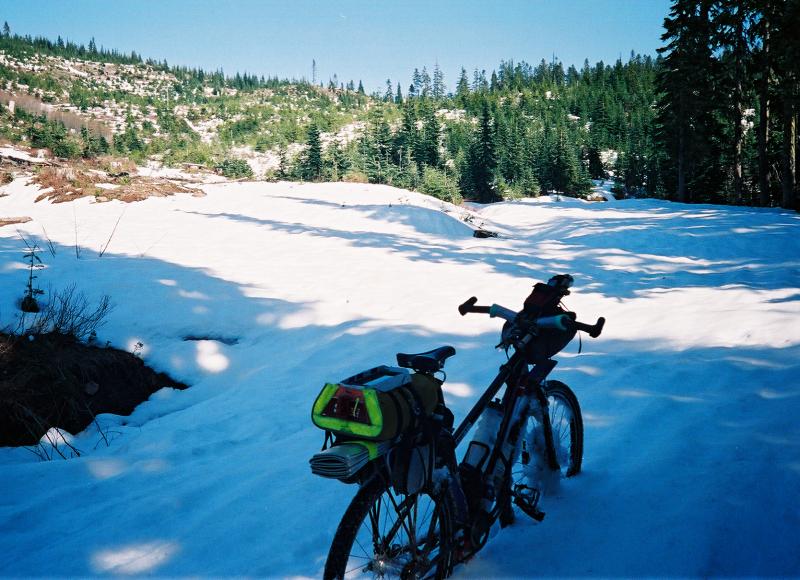
I mentioned this trip on a couple of email lists last fall but I figure I might as well link this into the blogosphere. Some pics from at trip my pal Mark Vande Kamp and I took to Monte Cristo last September are here:

http://www.carsstink.org/peterson/Monte/MC.html

Saturday, April 01, 2006

And I think to myself, what a wonderful world

Not every day is about big adventures. Some days I just do simple stuff like go to the bank, have a cup of coffee with my beautiful wife, catch up on some paper work, listen to the radio, feed the cat, watch too much South Park with the kids (I am not a parental role model), read a book, do laundry and other things that don't make for really exciting blog entries. It's been the kind of damp day that's good for doing things like this.

They say that there is a pot of gold at the end of the rainbow. I don't think that's true but I don't have to go far to look for treasure. I've known for quite some time that it's all right here. The photo above is the view out the door of my apartment this evening.

Monday, March 27, 2006

Law and Order: Bike Theft Victims Unit

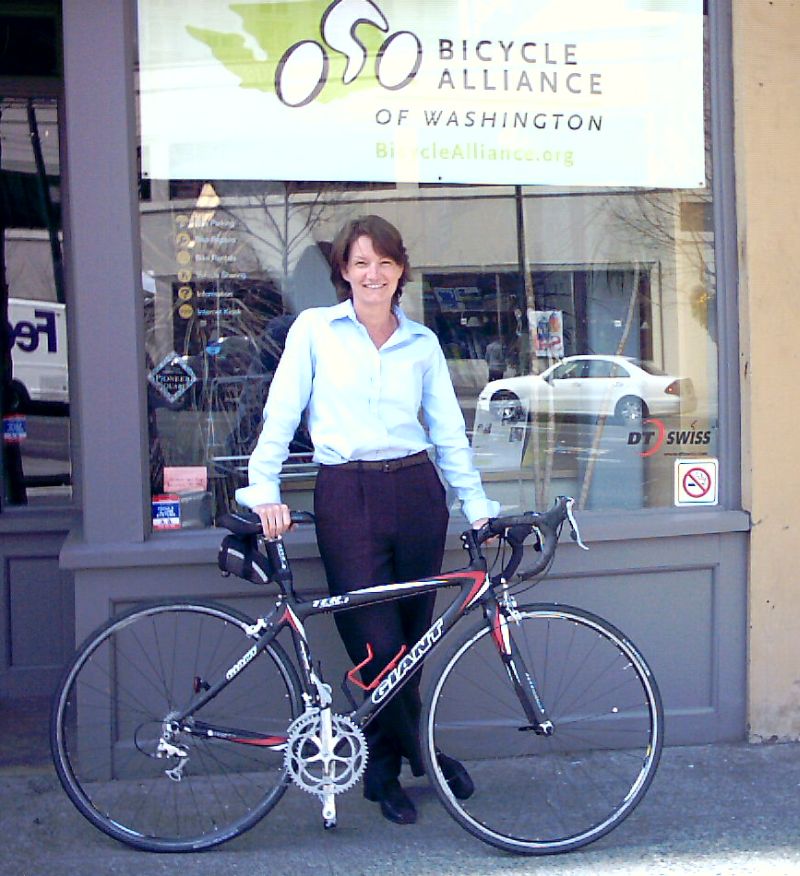
In Seattle's war on greenhouse gases, the public is served by two separate but equally important agencies: King County Metro who run the buses that let many people travel together to their homes and offices, and the Bicycle Alliance of Washington who help people commute via the most efficient single passenger vehicles ever devised by human minds. These are their stories.

The buses in King County have bike racks on the front of them that enable cyclists to combine bus riding and bicycling. Multi-modal commuters use these racks daily while other cyclists use the racks to transport their bikes to the locales they favor for recreational cycling. Every day hundreds of riders use these racks. And almost every day at least a few riders forget their bikes on the bus. You wouldn't think this would happen, but it does. Almost every day. I know. The lost bikes wind up with me.

General lost and found items wind up at Metro's General Lost and Found Department, but bicycles are a special case and the Bicycle Alliance of Washington has a contract with King County Metro to handle the lost bikes. We track the route information, make detailed descriptions of the bikes, log them in a database and store them at the bike station for up to two months. The Metro Bike Lost and Found number rings through to my desk. Often when I answer my phone "Metro Lost Bikes" a voice on the other end says "Dude, I can't believe I spaced out. I left my bike on the bus!" I talk to a lot of spaced out dudes.

I also talk to people who got distracted, people whose routines were disrupted in some way, friends who borrowed bikes and then spaced out, parents of kids who forgot their bikes and other people who each have some story ending with "and that's how I forgot the bike."

For about half the bikes, I don't get the story. No one calls and I don't have enough clues to track down an owner. A trashed Magna probably doesn't have an interesting back story and a distraught owner. Some bikes are stolen, joy-ridden and then for reasons I don't understand, ditched on the bus. Those wind up with me. Some obviously loved bikes pass my way as well but they remain mysteries I can't solve. We don't have infinite space or infinite time and at the end of two months unclaimed bikes get donated to charities like Bike Works or the Salvation Army.

But sometimes I get to be a detective.

The bike that came in last week was not a typical lost bike. A compact Giant Carbon TCR1. Full Ultegra kit. Look pedals. You don't spend something in the neighborhood of three grand on a bike and then forget it on the bus. You don't clomp your way off the bus with your big Look cleats clicking on the floor and the street and forget your bike on the bus. It doesn't happen. If I was a wagering man, I'd bet that I was looking at a stolen bike.

The bike has a Velo Bike Shop sticker on it and a serial number. I talk to a helpful guy named Chuck at the Velo shop and he digs through their records and comes up with an owner's name and number. I make a call and talk to a machine. The message on the machine matches the name Chuck gave me. I leave my number and message explaining who I am, the bike I have and what I suspect.

This morning I get the call. Janine Pyle is ecstatic. She tells me the story. Two months ago her bike had been stolen from the storage unit in her building. She'd been on vacation last week when I called. Until she heard my message on her machine, she'd figured her bike was gone forever.

You don't have to be clever to be a bike thief. You can be a spaced out dude.

Janine has her bike back. The Bicycle Alliance has a new, very grateful contributor (hey we're a non-profit and she asked what she could do!). And she brought us donuts. That made me feel even more like a cop. I've got a great job. Some days I even get to fight crime.

Sunday, March 26, 2006

SIR 300K Brevet

Yesterday I rode the 300K brevet with the Seattle International Randonneurs. The story and pictures are here:

http://www.carsstink.org/peterson/300K2006/SIR300K.html

Keep 'em rolling,

Kent

Monday, March 20, 2006

Ride to Carbon River


The Seattle International Randonneurs have a series of routes called "permanents" that can be ridden at any time, unlike brevets which are ridden on specific dates. If you fill out the right pieces of paper, you can get credit for doing the ride. I don't really care about getting credit, but the 200K Carbon Glacier Permanent route passes within two blocks of my house. When I found out the Kevin Humphreys and Mike Richeson were going to ride the Carbon Glacier route on Sunday March 19th, 2006, I decided I'd meet them in Issaquah and tag along for a bit over one hundred miles of the 200 kilometer route.

Kevin and Mike left Redmond at 7:00 AM and I met them at 7:52 AM as they rolled by the Issaquah Public Library. The picture below shows my Kogswell parked in front of the library.


The morning temperature was in the upper thirties but the road out of Issaquah climbs gradually as it rolls southward and we were pretty comfortable. My main goal today was to make certain that I had my bike position dialed-in for next weeks 300K brevet and to test out one new bit of gear, a Marmot DriClime Windshirt.

The three of us formed an interesting slice of the randonneuring spectrum. We were all riding lugged steel bikes. Two of us, Mike and myself, were on Kogswells while Kevin was riding a Mercian. Kevin and I were riding fixed gears while Mike's bike had shifty bits. Kevin had those fancy pedals that go click while Mike and I were riding Power Grips.

The first control point was the store at Cumberland where we all grabbed snacks. I had a pint of milk and a couple of Peanut Butter Cups while Kevin snacked on a Clif Bar and Mike had some Beer Nuts.


By the way, shouldn't the sign on the ice box read "Purer than the water you drink"?


A big sharp chunk of glass punctured my rear tire just before Buckley but once that was repaired we continued onward. It was still fairly cool as we climbed up toward the Carbon River Ranger Station and there was some snow on the roadside and dusting the mountains that rose above the Carbon River.


Kevin and I were at the Ranger Station by noon and Mike rolled in a few minutes later.


I took off ahead for the descent back home but stopped in Wilkeson to snap a photo that I figure the Cars-R-Coffins folks will appreciate.


I stopped again in Burnett for some ice tea and a really good slice of pizza. While I was eating I saw Kevin and Mike roll by.

I meandered back home, taking the somewhat more scenic detour along Mud Mountain Road.

I caught up with Kevin and Mike while they were snacking at Cumberland but I was on a roll and kept rolling.

Temps were up in the fifties now, with blue skies. The Marmot windshirt had been the perfect garment all day. I had it layered on over a wool base layer and in the cool times I'd had it zipped up and as things warmed I opened up the zipper to let air circulate in at the neck and out through the underarm vents. At ten ounces, a lot of ultra-light backpackers had recommended the shirt and I was happy to see it works well on the bike. My windshirt is black, so I supplemented it with my yellow Canari vest to give that proper eye-searing "hey there's a biker here" effect.

The paragliders were enjoying the thermals off Tiger Mountain and I stopped and took a couple of pictures.


I was back home at 3:47 PM with 106 miles on the odometer. Not at all an epic ride, but a great day on the bike.


Sunday, March 12, 2006

SIR 200K Brevet

Yesterday I rode the SIR 200K Brevet. You can read a brief ride report and see pictures from the ride at:

http://www.carsstink.org/peterson/200K2006/200K.html

Keep 'em rolling,

Kent

Thursday, March 09, 2006

Hokus Pokus


As much as I like my gear to be simple, I'm also drawn to clever things that serve a couple of needs. I've always been a sucker for Swiss Army Knives even though my dad pointed out years ago that a Swiss Army Knife really isn't much of a knife and I am one of those guys who Robin Williams was talking about when he said "Many of you men have never opened Chardonnay under fire." Still, I quested until I found a Swiss Army Knife that really is a pretty decent knife and that lacks a corkscrew while sporting some tools that I actually use.

The Deuter Hokus Pokus is my latest two-trick pony. I like being able to carry some stuff on my person rather than on the bike and I've never been big on stuffing my jersey pockets. I've tried various backpacks and little fanny bags and other things. Most of the time a lumbar bag is just about right, but sometimes I get the call from my wife to pick up something at the store or I have to run a couple of packages to the post office. I don't need a huge bag for those tasks, but something bigger than a lumbar bag is called for. That something is the Hokus Pokus.


Most of the time I use the Hokus Pokus as a lumbar pack. It's big enough to hold my wallet, some snacks, a notebook, and other daily odds-and-ends. But when I need a bit more carrying capacity, I unzip a big wrap-around zipper and like magic the bag transforms into a day-pack. What I like about the Hokus Pokus is that it's a really good lumbar pack. It's a good size, with a good layout and it's very comfortable. The fold-away backpack tucks really nicely into the padded lumbar section and when it's packed away it doesn't poke or feel awkward in any way. When the pack is deployed, it's a pretty normal looking daypack with two side-mesh pockets, lightweight shoulder-straps and a good-sized main compartment.

I've customized my Hokus Pokus with a Nathan rear reflective triangle and a Blackburn Mars 2.0 triangular flasher. If your local bike or sporting goods shop carries Deuter gear they should have or be able to order the Hokus Pokus. If you can't find one locally, you can order one from Amazon. Clicking the link below will take you to Amazon and if you do buy it via the link, I get a little cash kickback.


Just a little side note on the power of the internet and online marketing. Enough of you folks bought Princetontec EOS lights via a link I included in my review of that light to actually cover what I originally paid for the light. To date that's been the most successful link. I'm not getting rich of this, but it is slowing the rate at which I'm going broke buying stuff!

Wednesday, March 08, 2006

Kids, Don't Try This At Home

After I wrote The Way of the Mountain Turtle, my friend and fellow divide racer Alan Tilling commented that while he enjoyed my version of events, he thought that maybe I didn't devote enough attention to the difficulty of the ride or the time and effort that goes into preparing for an event such as the Great Divide Mountain Bike Race. While it was never my intention to minimize the preparation or the difficulty, my narratives tend to flow with the moment and the prologue efforts are, in fact, minimized. And because I do put a lot of effort into preparation, I sometimes don't encounter as many difficulties in the course of events as some of my fellow competitors. It really doesn't occur to me to talk about problems that I have avoided. While I do document many of my preparations on the web, the nature of the web and search engines like Google mean that people sometimes only get one glimpse into a race and a single view can and will be skewed. Condensed stories like articles in magazines also sometimes give people the wrong idea about what is involved in actually having an adventure.

This point was driven home to me by the following email that I received. I believe it's genuine, but perhaps it is only the electronic equivalent of Bart Simpson calling Moe's Tavern. In any case, it gives me a chance to talk more about the role preparation plays in successful endurance riding. I have removed the name and other identifying info but I've kept the spelling and text basically intact.

--------------------------------------------

Kent,

My name is ******* & I have been reading your web page on the great the great race. A friend of mine has talked me in to doing this race. I am not a mountian bike rider tho I clock 2 to 3000 a year on the road. I know nothing about single speed bikes tho it seems to be the way to go "Less to contend with" but is it harder less choices. I am 50 yrs old with some bumed up legs and hips, but as you can tell it doesn't stop me. The boy's at ******** Bike Shop here in ********, ** told me they would sponser me with a Kona Unit with what they called a flip sprocket "High gear on one side then turn the wheel over when you need a lower gear." what gear raito did you use?.Should I use a bike with gears?. I Just have a lot of questions that the majority of the folk's can not answer because I have more road miles than anybody that I know that rides, except for the bro's that I ride with, & they know less than I do. We have came to the same conclusion that it has to be a diffrent breed of riding. The reason I chose to email you is because you seemed to be more or a fly by the seat of your pant's rider. any help will be appreciated. you can call me any time at ***-***-**** at night after 8 or before 8 am I will be riding the Blue Ridge Park Way 3 weeks before this race & I do these rides on my 18 speed Treck double sproket

Best Reguards,

*******

-------------------------

My response is as follows:

Dear *******,

I do believe that with proper preparation, people can do remarkable things. I also know that the Great Divide Mountain Bike Route comprises 2500 miles of very challenging terrain. Just to ride the GDR requires quite a bit stamina and preparation, racing the route demands even more effort. It is not my place to tell you what you can and cannot do, but from your note it seems that you are underestimating both the scope of the ride and the level of preparation required to race the Divide successfully.

You write that you ride between 2,000 and 3,000 miles per year on the road. While that is certainly a significant number of miles, more than most people ride, you must consider that the racing the GDR means riding 2500 miles, off-pavement, in less than one month. While I can't speak for certain about the miles logged by other GDR racers in preparation, I can tell you a bit about my preparations for the ride.

I average about 12,000 miles per year on my bike. On normal days, when I'm just riding back and forth to work, I log 35 miles per day. This isn't training, it's just riding.

At the time I decided to race the GDR, I was already a veteran of many long distance events including Paris-Brest-Paris, Boston-Montreal-Boston, London-Edinburgh-London, The Rocky Mountain 1200, and the Raid Californie-Oregon. All of these events are significantly easier than racing the GDR, yet most riders log far more than 3,000 miles per year in training for these rides. Stories of most of these rides and the shorter rides leading up to these rides can be found at my randonneuring page at:

http://www.carsstink.org/peterson/rando.html

I decided to race the GDR a full year before I actually raced the Divide. I obtained a Redline Monocog and rode it exclusively in the year prior to the race. Many of my experiences with that bike are recorded in the Monocog Log which can be read here:

http://www.carsstink.org/peterson/MonoLog/MonocogLog.html

From December of 2004 through July of 2005, I rode the Monocog with all the gear I figured I'd be using on the GDR. I did various shakedown trips with my camping gear, seeking out snow, mountain passes, bad weather and anything else I thought I might encounter on the GDR. I spent the days prior to the race riding to the race starting line from my home in Issaquah.

I think you'll find that successful endurance racers prepare for their endeavors. What may appear to be "seat of the pants riding" has a lot of miles and years and experience behind it.

To answer your specific questions, my Monocog has 32*17 gearing. At the time I got the Monocog I had already ridden many thousands of fixed and single speed miles. I would never recommend that anyone who has never ridden single speed commit to racing the GDR on a single speed bike.

I would also never recommend that anyone with no off-pavement experience and a 3,000 mile annual mileage base to commit to racing the GDR. However, as I said earlier, it is not my place to tell you what you can and cannot do. But my advice is to invest at least a year and something like 10,000 mountain bike miles into preparation.

Kent Peterson
Issaquah WA USA
http://kentsbike.blogspot.com/

Monday, March 06, 2006

No Simple Highway


Over on the SIR list, one of this year's new riders wrote:

"Alright, the rookie has another question. This one might seem a little ridiculous but how do I get faster? In my "training plan" I am suppossed to ride brisk on Wednesdays."

(She actually wrote more than this, but I edited for space. If you are interested, the full post is here.)

This is my reply:

OK this is the second time you've asked about getting faster and at least the second time you've expressed anxiety about sticking to your training plan. My question to you is this: Was your training plan handed to you on stone tablets or did a voice from a burning bush set forth exactly how much thou shall and shall not ride?

Only you can really know if you are training or slacking. I know people who have ridden a full series where their longest non-brevet ride has been 30 miles. I know a guy who rode PBP while sick as a dog, subsisting on soda crackers and flat Sprite. I also know many folks who've quit brevets and many others who've stuck it out.

Most DNFs come not from a lack of speed but a lack of conviction. If you think you're not prepared, the odds are much greater that doubt will overwhelm you. Nobody KNOWS they can ride a given brevet on a given day. We think we can. We ride the brevets to find out if we are right.

My advice is this: Think less about training and more about preparation. Miles don't count as much as knowing what your body does on those miles. A perfectly tuned racecar doesn't go anywhere without gas in the engine and air in the tires. Do you know how to fuel your engine? Do you know how to fix flats? Do you know how your bike handles in the rain? Do you know what it's like to ride at night? Most importantly do you have a flexible mind, can you deal with that which you didn't anticipate?

I can tell you this: your brevets will probably not go as planned. They might, but that's not the way to bet. Be ready to make new plans and execute those.

You seem to be freaking out that your training isn't meeting some plan. Get past that freak out. Adapt. Make new plans. That's what you'll need to do on the road anyway.

A disproportionate number of randonneurs are fans of the Grateful Dead. I have no idea why that is but I think I'm right about this. I also think Robert Hunter was right when he wrote:

"There is a road, no simple highway,
Between the dawn and the dark of night,
And if you go no one may follow,
That path is for your steps alone."

and

"If you should stand then who’s to guide you?
If I knew the way I would take you home."

Kent Peterson
Issaquah WA USA
http://kentsbike.blogspot.com/

Friday, March 03, 2006

C-KAP, Ken Bonner and the VanIsle 1200K

I'm a member of a very loosely-knit cycling club called C-KAP, the Canadian Kilometer Achiever Program. You don't have to be Canadian to be a member of C-KAP, all you really have to do is ride your bike and keep track of how many kilometers you ride in a year. My pal Ken Bonner is Canadian and he rides his bike a lot. Some folks think that I ride my bike a lot, but Ken logs a lot more kilometers than I do. Ken runs marathons in his spare time. Ken is also a super nice guy.

This July Ken is organizing a 1200 kilometer ride on Vancouver Island. I've already sent in my registration.

Wednesday, March 01, 2006

Not a Role Model?

Over the years I've commented that "I am not a nutritional role model." I even sell shirts featuring words to that effect. Today David, one of my SIR pals, sent me the link to this story:

http://www.post-gazette.com/pg/05278/582437.stm

David says that he's still holding out for a study of Little Debbie Oatmeal Creme Pies.

Sunday, February 26, 2006

Friday, February 24, 2006

Icy Commute

Here in the Puget Sound the winters are usually wet and the temps are above the freezing point. On the rarer times when it's below freezing, it's usually the result of a cool, dry, high pressure system. So mostly the roads are either warm and wet or cold and dry. But in the transistion points, when a cold high flows in to replace a warm low. the streets can become icy.

Last night it was 38 degrees and raining when I rode home. This morning it was 28 degrees and clear when I rode in to work.

Newport Way was icy. The hill down to Factoria was icy. The trail across the Bellevue Slough was icy. Mercer Island was pretty much one big sheet of ice. The I-90 floating bridge was, you guessed it, icy. The streets of Seattle were semi-icy.

I saw lots of cars, some sliding, some slid. I saw various bicyclists walking alongside their bikes. I saw various cautious pedestrians walking their remarkably sure-footed pets. I saw interesting tracks in the frost.

I never fell down. I spent an extra fifteen minutes being cautious. I was riding my fixed gear Kogwell model G. I knew exactly when the 28 mm Specialized Armadillos were and were not grabbing the road. With a fixed gear you feel what you have in terms of traction through your feet and legs. The second the rear tire slips, the pedals move a bit more than they should. It's instant feedback and it's a big advantage that a fixed gear bike has on the ice.

And the Kogswell is wonderfully well mannered. I liked the handling of this bike the first time I rode it and the past thousand miles have only increased my fondness for the geometry. When a bike works with your reflexes, you don't have to think about it. On a good day, you don't think about it at all. On a bad day, when the roads are slick, it's good to just think about the hazards and not about the bike.

Keep 'em rolling,

Kent

Thursday, February 23, 2006

Gary's Arizona Trail Trip


My pal Gary Blakley recently spent about a week bikepacking on the Arizona Trail. You can read about it here and see pictures here.

Gary lives in the little town of Del Norte, Colorado and he's got awesome country right out his backdoor. He makes the following observation contrasting Arizona and Colorado:

"In Arizona you climb up into the trees, in Colorado you climb up out of the trees. One thing about living in Colorado is that I have learned to love climbing. It's not the climbing itself that's so rewarding but the dividend it pays; the views and the ability to go somewhere new and the feeling of accomplishment."

Thanks for the ride story, Gary.

Monday, February 20, 2006

Jim Langley's Bike Repair Site

The first sentence on Jim Langley's Bike Repair site Wrench reads: "One of the coolest things about bicycles is that they’re darn easy to fix; fun to fix, too." Jim's right and his site is a great place to go for practical, how-to advice on a range of various bike repair tasks. There are a variety of good sources of technical bike repair info on the web, but Jim's site is very clean, friendly and straightforward. If you are looking for step-by-step instructions on how to fix a flat, adjust a derailler, silence strange squeaks or do a wide range of other bike repairs, check out Jim's site at:

http://www.jimlangley.net/wrench/wrench.html

Keep 'em rolling,

Kent

Friday, February 17, 2006

My Famous Friend Dustin

The Seattle PI wrote a good article about my pal Dustin and his Urban Cycling and Bicycle Commuting classes.

Tuesday, February 14, 2006

Battery-Free LED Pedals

OK, these are cheap plastic pedals that probably won't hold up to any serious use. But when I saw this $17 pair of pedals at my local Target store I just had to buy them. And in case you are wondering, no I usually don't buy bike stuff at Target but I just can't resist cruising the aisle devoted to what my friends at Dirt Rag refer to as "bike-shaped objects."

Here's the deal, these pedals have a little built-in generator that makes six red LEDs light up each time the pedal goes around. They look really cool in the dark, cooler than having $17 in my wallet. So far I can't figure out how to attach Power Grips to these pedals and I don't think they'll replace my MKS Touring Pedals. I'll probably wind up putting them on my son's bike or the loaner bike at the Bike Alliance.

Sunday, February 12, 2006

Bike Buddy

A couple of weeks ago I met Koya Tsukiji, an intern working at the Port of Seattle. The Port was having a transit fair for their employees and I was there to answer questions and provide information about bicycle commuting. Koya asked me about commuting from Bellevue to the Seattle waterfront. "It's kind of tricky to figure out the first time," I told him. I started to sketch out the route, asking him questions about where he lived and if he knew the locations of various local landmarks. Koya is new to the area (I think he's fairly new to the country as well) so we didn't have much to work with but I assured him he could do this. "You should have a buddy show you the way. My pal Andy showed me the route when I first started riding from the Eastside to downtown." I then told Koya about the Bike Alliance Bike Buddy program, where we pair up new commuters with experienced riders. I gave Koya my card and told him to email me his home address and some more specific information. Back at the office I had more routing info and my buddy list so I could make a good match for him.

Over the next few days Koya and I worked out the details. It turned out that my daily commute passes fairly close to Koya's home and much of our routes would overlap. We figured out our schedules and set up a meeting place. I would be Koya's Bike Buddy.

We'd planned on meeting up on Wednesday for Koya's first commute but Wednesday was a wet morning and rather than subject him to a soaking on his first commute, we rescheduled for Friday morning. Interestingly, that Wednesday I did happen to meet a couple of other commuters at the very spot Koya and I had picked as our meeting place. That was the first commute day for one of the riders and his pal was showing him the route. This Bike Buddy idea has caught on!

Friday was clear and cool. I left my house at 6:15 AM so I'd be sure to be at our meeting spot by 7:00, as always budgeting my flat tire buffer into the time calculation. As usual, I didn't flat and Koya was a little more than punctual as well. I'd quizzed Koya about lights and knew that he didn't have any, so I'd brought along some of my spare lights for him to borrow. Even though it's getting light by 7:00 AM, I explained that it's best to be prepared. You never know when you will wind up working late and in the dim morning or evening LED lights can do a lot to increase your visibility.

Koya's bike was far less than fancy, he'd probably spent more on his messenger bag than his bike, but he had a willing spirit. The bike had an alarming bit of play in the rear hub and while I travel with a fair number of tools, cone wrenches aren't part of my regular kit. I told Koya that I couldn't do much about the wheel right there but that once we got to the Bikestation, I'd be able to adjust his rear hub.

With morning temps in the mid-thirties I was glad to have my gloves and fleece earband and even though Koya lacked these handy items, he didn't complain about the cold. Once we'd fastened the lights to Koya's bike, we set off down the hill to Factoria.

The route is hard to explain and much easier to show. I punctuated my various hand signals with comments as we went through intersections, cautioning Koya about the hazards of turning cars and a section of the Bellevue trail that tends to be icy even if the air temperatures are a few degrees above freezing.

The trail crosses under I-90 several times and we stopped at the small info kiosk on the Bellevue side of the bridge to Mercer Island. I grabbed a Bellevue Bicycle Map and handed it to Koya, showing him where we'd come and where we were going.

We followed the trail across Mercer Island and I showed him the the handy water fountain. Koya had a bottle rack on his bike but no bottle. I told him that the first time I did my commute I wound up stopping a lot to eat and drink. "The first time is the toughest," I assured him as he gulped water from the fountain.

Koya did fine crossing the big floating bridge. I rode a bit ahead and took his picture as he came off the bridge. He handed me his camera and I took another shot where he did his best to look very tired. I could tell he was having fun.

We rode through the bike tunnel and I guided Koya through the tricky forks in the trail and the bits of urban navigation along Hiawatha, Dearborn and the International District. While we were stopped at a light another cyclist blew right through the red light. "Can we do that?" Koya asked. I quickly and firmly informed him that we could not. I didn't get into the legal, the safety or the bad example parts of it, I just showed him where the sensors were in the road and how to trigger the light with the pedestrian toggle if needed.

We stopped at the Bikestation and Koya scarfed down an apple while I adjusted the rear hub on his bike. I also gave Koya a water bottle from my stash of Bike Alliance commuter swag. Another commuter was at the station with a flat tire, so rather than continue with Koya the next few blocks to his office I sent him off with a quick, "follow this road till you you hit the water, then take a right."

Koya was leaving work early, so I wouldn't be riding with him on his return trip, but I sent him links to the Gmaps Pedometer layout of my commute, which would give him the info he'd need for his return trip.

Some jobs are just jobs and all you get is a paycheck. Some jobs are a lot more than that. I'm lucky enough to have one of those great jobs. Here's the note I got from Koya later on Friday.

-----------------

Kent,

Thank you very much for showing me the route, loaning lights, giving me a water bottle, and fixing my rear wheel! I deeply appreciate it! I enjoyed riding a bike with you.

I found the gmap-pedmeter wonderful. It helped me a lot find the reversed route! Thank you very much.

I will continue to ride a bike for work periodically unless it rains! I will return the lights when I buy new ones.

Thank you again. Have a nice weekend!

Koya Tsukiji


--------------------

If you're interested in bicycle commuting and you live in Washington state, drop me a note at bikebuddy@bicyclealliance.org. If you either want to help new commuters or you want to be a commuter, we're working to link up those who ride with those who want to ride. If you live elsewhere, check around. With luck your state will have something like the Bicycle Alliance.

Here are a few handy links for King County commuters:

Seattle Bicycle Map

King County Bicycle Map

Washington State Bicycle Commute Guide

Keep 'em rolling,

Kent

Thursday, February 09, 2006

Kogswell Model G


I finally borrowed Mark Vande Kamp's camera and took a not very good picture of my Kogswell Model G.

Noteable features:

Clipped & flipped bars.

The brake levers are Shimano 105.

Coroplast fenders.

Note how nicely the duct tape top tube protector blends with the bike.

The trunk is a Rubbermaid tote.

The headlight is a cheapo Bell with a really nice pricey EverLED and an external NiMH battery pack that sits in the Rubbermaid trunk. The speaker wire connecting the battery pack to the light runs under the duct tape top tube protector.

That's a silver bell on the top of the stem.

Those are Power Grips on the MKS touring pedals.

The crank is an old 170 mm DuraAce.

The gearing is 42/16.

Those are Phil Wood hubs laced to Campy rims.

The tires are 700*28 Specialized Nimbus. The front is a plain Nimbus, the rear is a Nimbus Armadillo.

The saddle is a WTB Rocket V, the cheap CroMo railed one. It looks reddish in this shot but that's just a reflection from the OPEN sign. It's really black and grey and silver.

I scavenged the ugly bar tape from the garbage at Sammamish Valley Cycle.

I've got the bike dialed in now and it's quick and comfy, even with the garden-hoseish tires. Mark expressed amazement that I can ride Armadillos and I told him that I do it just to show how tough I am!

Kent Peterson
Issaquah WA USA
http://kentsbike.blogspot.com/

Wednesday, February 08, 2006

This is my office


My pal Bob stopped by my office yesterday and we went out for coffee. He'd never been to the Bikestation before and in the email he sent me setting up our meeting he innocently asked "can I leave my bike in the office while I'm there?" I told him that we could probably find a place for him to park.