Tuesday, May 26, 2009

Resurrected by Rattlecan

I see a lot of bikes pass through Bike Works and some of the nicest bikes we see are the Japanese sport-touring bikes from the 1980s. As with many things bicycle, Sheldon Brown has a page about them at:

http://www.sheldonbrown.com/japan.html


Sheldon was the fellow who adopted the short-hand term we use to refer to these bikes, UJB or Universal Japanese Bike. A Flicker pool of some of these machines can be seen at:

http://api.flickr.com/services/feeds/groups_pool.gne?id=73762281@N00&format=rss_200

Cribbing from Sheldon, I've devised a spiel on the virtues of UJBs and I've sold quite a few of the bikes to happy customers. My spiel is pretty convincing, but some times the bikes have seen a lot of use over the decades and the frames are looking pretty rugged. We tend to sell those rougher looking frames at bargain prices to folks on low budgets.

I'm a guy on a low budget and it's a darn convincing spiel. I also tend to say, "yeah, it looks rough now, but a bit of work with some emery paper and Rustoleum and it'll clean right up."

Sometimes you get convinced by your own sales pitch and then you have to see if you really know what you're talking about.

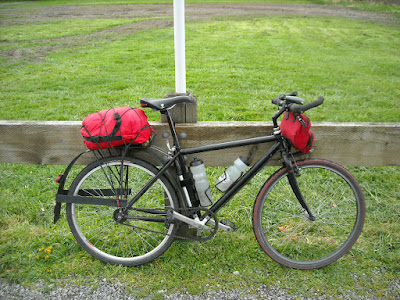
So I bought this Shogun (time will tell if I keep this bike or if it's just another in my ongoing bicycle catch-and-release program). I'd been looking for something to try out the Origin-8 bars on and the Shogun seemed like a good candidate. Version one of the build was wildly ugly with orange grips and a saddle with yellow highlights. But the bike rode great, so this weekend I made a quick run to the hardware store for some paint and masking tape.

The slide show tells the story. With the now classy-looking frame, I decided to go with a more sedate saddle and a basic black tape for the grips. It's the nicest looking bike I've had in quite some time.

Keep 'em rolling,

Kent

Bike Touring by Raymond Bridge


Raymond Bridge's book, Bike Touring: The Sierra Club Guide to Travel on Two Wheels, is the second, completely revised edition of a book Mr. Bridge originally wrote 30 years ago. In the thirty years since the first edition, some things have changed. We now have Internet forums to discuss our tours, we can track our routes using GPS and the Adventure Cycling Association has mapped out thousands of more miles of routes, but the lure of the open road is still the same.

In this age of Internet wonder, Raymond Bridge has created a book that does the thing that books still do best: he's created a compact, clear guide that condenses a wealth of practical how-to information into a portable, organized form. He explains the various types of bike touring a person might do from commercial tours to roof-to-roof and independent bike camping trips. He discusses a variety of bikes, explaining both fit and function, telling not just what options exist, but why a person might choose one bike or component over another. He explains basic roadside repairs, camping skills and things like the logistics of transporting your bike before and after your tour.

I'm really not the intended audience for a book like this, as I've been traveling by bicycle since before the first edition of this book was new, and yet I still found this book to be wonderfully organized and complete. With a critical eye, I'd find myself asking "yeah, but does he mention alcohol stoves?" Yep, he does, not only mentioning commercial stoves, but pointing his readers to a couple of instruction pages on the Internet for those who like to make their own stuff. This is typical of the book, it is marvelously complete in itself, but it also sends you off on your own journey.

In Bike Touring: The Sierra Club Guide to Travel on Two Wheels, Raymond Bridge has written a marvelous starting point for anyone interested in travel by bicycle. John Lencicki's wonderful drawings are sprinkled throughout the text, adding both clarity and charm to this book. My only complaint with this volume is the cover. This is a book that inspires and enables folks to get out on the road and experience the freedom of two wheels. The text and drawings inside the book capture that far better than the dull photograph of a pannier, water bottle, helmet, map and glove which the Sierra Club chooses for the cover of this book. In this case, don't judge a book by its cover. This one is better. I now have a guide to hand to anyone looking to get out and see the world from the seat of a bicycle.

Saturday, May 23, 2009

Gabriel's Eurospeciale


Gabriel is one of the Bike Works Earn-a-Bike kids and he's worked very hard refurbishing bikes for other kids. Now, he's working on a super cool bike of his own, but he's run into a problem and we don't have the needed bit here at Bike Works. I'm turning over my blog to him for a bit so he can explain the problem. Maybe one of you kind folks out in cyberspace have just the bit Gabriel is looking for. Take it away Gabriel!

Hello “Kent's Bike Blog” Readers!

My name is Gabriel and I go to Bike Works for the youth programs. I am nine years old. I love bikes a lot. My favorite thing is the feeling when you finish building a bike and take it out on the road for the first time.

I am working on a smaller than usual road bike, an Italian Eurospecial for myself to ride. I have been wanting a road bike for my entire life as a cyclist. This bike is awesome because it is vintage and has a whole bunch of really cool bike parts on it. The bike comes from far away, it is Italian!

Unfortunately, it has a bent fork and I am wondering if you can help me find a replacement fork that isn't broken. It has to be compatible with a 24” road wheel. I am building this bike out of parts that have been donated to Bike Works, if you have a fork you could donate to my special project, please email Kent ( kentsbike (at) gmail.com).

Thanks, I really appreciate your help!

Gabriel


Here's a bit more info about what's needed. The fork should have a 1inch steerer tube six at least 6 inches long (we can cut it down if needed). Threaded is best but we could make a threadless fork work by going to a different headset. A fork out of a Terry bicycle or one of the old time trial bikes with the 24" front wheel would be perfect. It's a long shot, but does anybody out there have such a thing kicking around? Gabriel has a budget of about zero dollars for this and Bike Works runs on shoestrings we make out of bits of other shoestrings, so I'm happy to put my blog to work on this quest. If you've got a fork that will help Gabriel out, please let me know.

Thanks,

Kent

Tuesday, May 19, 2009

Fight Cancer, Win a Kona Cadabra

My pal (and I know he's my pal because he's mocked me on his blog) Elden "the Fat Cyclist" Nelson is continuing in his quest to raise something like fifty-seven trillion dollars to fight cancer. Maybe it's not quite fifty-seven trillion, but it's a lot and Elden is good at coming up with fund raising schemes that are actually quite fun. He talked me into doing the Seattle Livestrong Ride next month as part of Team Fatty and thanks to the generosity of a bunch of you, I've raised over 500 bucks for this good cause.

Fatty's latest plan not only will raise a lot of money, anybody who pledges will be entered into a contest to win the bike you see at the top of this blog post. Cool, eh? You can read all about it on Fatty's site.

Now while you can read about the contest on Fatty's site, I'm going to ask that instead of pledging some bucks there, you go here instead. That's my Livestrong Page. Same cause, same deal. Same odds of you winning.

OK, according to the way Fatty has set it up, every time somebody pledges through my Livestrong Page between now and midnight MDT May 25th, I actually get a chance of winning the bike. Me, as in not you.

But here's the deal. Look at that bike. It's light. It's got gears. It's got shocks. It's just so not my kind of thing. So if I win the bike, I'll draw from the list of folks who pledged through my Livestrong Page this week and one of those lucky people will get the bike.

But wait, there's more. OK, not a lot more. I don't have a lot of those big, famous blogger connections like Fatty does but anyone who pledges through my Livestrong Page between now and midnight MDT May 25th and emails me at kentsbike(at)gmail.com will get a Livestrong wristband. And if one of you great pledgers wins the bike, I'll shave my head the day before the Livestrong ride.

But finally, there is one more reason to pledge through my Livestrong Page. It will send a signal to Fatty, a loud, clear signal, that we are fighting against cancer and that helmet mirrors are cool. C'mon, you know they are. And recumbents are pretty cool too.

So dig deep and pledge what you can.

Thanks and keep 'em rolling.

Kent

Tuesday, May 12, 2009

Closer to Fine

From A Trip to Evergreen

Douglas Coulter, the mad troubadour of the touring list, whose madness is one of the saner responses I've seen to these mad times, once wrote that all his tours are failures. If my goal is ultimate simplicity, I similarly fail on each journey, for my monkey mind gathers far too many shiny things and carries these burdens too far for too long. But, perhaps, a goal is only that which gets me rolling down the road, where my burdens resolve either into the strength needed to carry them further or the certainty needed to leave them behind. With thoughts such as these for companions, I pedal southward, into the wind. My gear today is too much, something I'll know for certain when I return home with unworn t-shirts and a laptop that I've lugged for miles and never used but in the words of the Indigo Girls, my kit is getting "closer to fine."

My gear today is minimal but more than sufficient. Using Colin Fletcher's metaphor of a house, my baggage consists of three main rooms. The bedroom sits on the bike's rear rack. A single waterproof compression stuff-sack contains my sleeping bag, bivy sack, Therm-a-Rest pad, tarp-poncho, ground-cloth, 4 tent stakes and my cozy camp jacket/vest. The jacket/vest, which is too warm to wear while riding, extends the comfort range of my 18 ounce sleeping bag down to the freezing point. The total weight of the bedroom is under 5 lbs.

Up front, a small handlebar bag contains the pantry and workshop. The main compartment holds whatever I feel like snacking on at the moment, today it contains Payday and Clif bars, while the smaller compartment contains a spare tube, patch kit, tire levers and chain lube. I have two water bottles in the main triangle of the bike and a Topeak Morph pump strapped behind the seat tube. Battery powered Planet Bike head and tail lights are sufficient to get me through the longest, darkest nights. For security, I carry an OnGuard Mini U-Lock on my rear rack. A bungie cargo net secures the load to the rear rack.

My closet is an Osprey Daylite backpack holding not only my spare clothes (a couple of t-shirts, a long sleeve wool t-shirt, a pair of wool socks and a second pair of shorts) but also way more technology than what any wanderer actually needs. In addition to my camera and cell phone, I'm packing my Eee PC in case I'm overcome with overwhelming web-withdrawal and my Peek Pronto connects me to all the email obligations I carry with me.

From A Trip to Evergreen

There's a school of thought that says I should be letting the bike carry all the weight and not use a backpack, but packs have proven to be handy to me over the years. The valuable bits stay with me when I lock up the bike and go into a coffee shop or wander around and keeping some weight on my back keeps me honest. The pack weight gets questioned every trip. In addition to the above mentioned items, the pack holds my toothbrush and razor, whatever book I'm reading, chargers for the gadgets, local maps and other bits that build up until I say "enough" and pare things down again. It's always a learning process.

The backpack expands and contracts as I layer clothes on and off depending on conditions. I wear a cotton cycling cap under my helmet and in cold conditions I wear a warm cap over the cotton one to cover my ears. Both my outer jacket and pants are convertible, with parts that zip off and dry quickly. It took me years to figure out that the key to wet weather comfort was not to battle to stay totally dry, but to have clothes that are comfortable when damp and dry quickly. My Marmot DriClime Windshirt is the best single garment I own and it is pretty much always on my person or in my pack. I carry the gets-damp-but-dries-quick theme down to my feet and found that the looks-dorky-but-really-works Pacific Northwest fashion of wool socks plus sandals.

From A Trip to Evergreen

On each trip I learn something. I've learned that by traveling light, I can travel far. With minimal gear, I need a minimum of gears, and touring on a fixed gear or single speed bicycle is not only possible, it's fun and instructive. In wind, rain, sun or whatever I can roll and think and learn something from every day, night, road and trail I roll down. The distance I have to cover is not far and I have sufficient time to hasten slowly. One of the wisest things I've ever read was written by the great sage Sheldon who asked "If you are in a hurry, why are you on a bicycle?" Since I am traveling at least as much to travel as to arrive, I have time to think and pause and photograph that which is odd or common or interesting. Each tour is not a failure, each trip gets me closer to fine.

From A Trip to Evergreen

Keep 'em rolling,

Kent

Monday, May 11, 2009

On The Road with the Peek Pronto


One of my entanglements with the world involves monitoring the info@bikeworks.org email and routing queries appropriately. While in theory I could rely on Wifi connections with my Eee PC or Nokia N800 to deal with this task or spring some extra bucks up front and every month till the end of time for a smarter cell phone, the Peekonomics 101 video combined with my "ooh-nifty" response and an excess of Amazon credit made me press that buy-now button that promises every good consumer that we can spend our way to frugality. I now am the happy owner of a Peek Pronto.

I recently took the Peek with me on my cycling trip from Issaquah to Olympia and back and the little 109 gram gadget proved itself to be an extremely handy companion. So even though this is a cycling blog, it's going to turn into a gadget blog for at least the duration of this post and if such things bore you, feel free to surf away.

The most important thing to understand about the Peek is that it is JUST AN EMAIL DEVICE. It does not make phone calls. It does not surf the web. It does not take pictures. It does not play music. It is JUST AN EMAIL DEVICE. Actually, the Peek will also do text messages and if you're into that Twitter thing it'll do that as well, but basically the Peek is JUST AN EMAIL DEVICE.

It's the simplicity that got me. The same impulse that makes me think things like "hey, I bet I could tour on a fixed gear bicycle!" makes me think "hey, I bet I could do a lot just with email!" And while that turns out to be true, as the Peek folks themselves admit "making it simple can be...complicated." But just as pushing against the limits of a single gear makes me stronger while questioning every gram of my touring kit, the Peek's limits made its designers and users come up with some interesting solutions.

The Peek makes sense for me because I've never been much of a phone person. My cell phone is a minimal, pay-as-you go device and I tend to spend less than $5 per month on it. Add on the $20 per month to feed email into the Peek and I'm still paying much less than I would for an iPhone. And I get a decent keyboard out of the deal.

Yeah, the Peek has a surprisingly good little keyboard. And the connectivity is darn simple. Tell it your email and password, pay for a month of access and you're good to go. I hooked it to my gmail account which was already hooked to my work email accounts, but the Peek will handle up to five different email addresses. I think the Peek connects to the big cloud in the sky via T-mobile but I'm not sure about that and I don't need to know. All I know is the thing hooks up and grabs my email.

Throughout my trip and the couple of weeks I've had the Peek, it does what it's supposed to do, it lets me send and receive email from anywhere. The Peek saves time by just grabbing the first 4K of a message and for a lot of email's that first 4K is plenty, I read enough to know where to route the mail and send it off. In other cases, I read more. Once I get to the end of the 4K, the Peek says [Retrieving more] and gets the next chunk. This can continue for a while and on huge emails the Peek will hit a point where it says [Wow! This file is too long for your Peek. View the rest on your computer.] In my world, I don't hit this limit too often and when I do, it's just about at the point where I'm figuring I shouldn't be doing this much work out of my pocket. But if this limit bugs you, the Peek isn't your kind of thing.

It is my kind of thing. I've figured out that I like pushing up against limits and seeing how much I can do with little. The little Peek does some cool things and there are some cool email services that the Peek and other folks have come up with. For example:

Sending a zip-code or a city-state pair to weather@askpeek.com will return a weather forecast for that area including some weather maps as attached jpeg files.

Sending an address to maps@askpeek.com will return a zoomed Google map and an area overview map as jpegs.

News@askpeek.com will give you news headlines from NPR, the BBC or the New York Times. You specify your prefered news source in the subject line of the email.

Other email services from Peek include local traffic reports and Google local search results. Sending the Subject "help" to ent@retroforth.org returns a list of various useful things like text versions of world wide web sites and local movie times available from Ent.

I used the Peek multiple times each day of my trip. I kept my wife up to date on where I was camping and used the map feature to find the house I stayed at in Olympia. I kept on top of my work email so I didn't have a big pile of it waiting back at Bike Works when I returned.

The Peek is earning its $20 per month keep. Actually the fee is lower than that if I buy access in three month chunks and I think I'll be doing that. The Peek folks also have an active community of users who discuss all things Peek at:

http://boards.getpeek.com/discussions/

And even though I've said over and over that the Peek is JUST AN EMAIL DEVICE, it also works fine as a clock and a flashlight for finding your way around a dark campsite. And I've been using the draft function of the email editor as a notepad. And you'll be happy to know that most of my notes are for a whole series of bike repair blog posts. Thanks for your indulgence in this gadget geek-fest. We now return you to your bike blog, already in progress.

Keep 'em rolling,

Kent

Saturday, May 09, 2009

Pictures from a trip to Olympia


I had a nice trip down to Olympia, despite headwinds and intermittent rain. I still travel with too much stuff but the kit is getting more compact. I'd started a longer blog post, which I've just nuked in favor of a series of shorter thoughts that should be filling this space over the next while. For now, enjoy some pictures from the road to Evergreen and back again.

Keep 'em rolling,

Kent

Thursday, April 30, 2009

The Spiders of the I-90 Bridge


I've ridden across the I-90 floating bridge more than 3000 times. It's part of my workday commute and you could say it's part of my routine, but every day reveals something new. Sometimes it just takes a look in a slightly different direction.

Last night, when coming home from work, I happened to glance down and north as I crossed the bridge, looking towards the water but the focus of my eyes fell short of the water and I saw, clearly for the first time, the gaps at the base of the protective side rails of the bridge. And in the gaps, in almost every gap, a spider had spun a web.

On the trip this morning I had my camera ready.


I walked slowly beside my bicycle, taking pictures of the spiders repairing and rebuilding their webs. Halfway across the bridge, I heard a familiar voice behind me, "Did you get tired of riding or what?" It's my friend John Duggan. I explain to him about spiders and the webs and point them out. "You know," he says, "I've ridden across this bridge thousands of times and never noticed them."

"Me neither," I agree.


John and I go our respective ways and the spiders continue with their work.

I'll still marvel at Mount Rainier looming to the south and thrill to the eagles that soar over Mercer Island. I'll still watch the morning sun crest the Cascades and light the Olympic Mountains. But sometimes now, I look down and a little to the north.

Keep 'em rolling

Kent

Monday, April 27, 2009

So I bought my son a Hummer

When you raise your kid like this:


There's a good chance he'll end up like this:


Actually that first picture is of Eric, but it's too good not to share. The rest of the pictures are of my first born son, Peter. Yes, by naming our son Peter Peterson, Christine and I made sure he had a head start on learning to write both his first and last names, which gave him a big jump over his peers.

Obviously, Peter inherited a great fashion sense from his old man, but he also got a lot of smarts from his mom. Last spring he graduated with dual degrees in Chemistry and Physics from Eastern Washington University and now he's teaching and doing grad work in Ice Physics at the University of Alaska in Fairbanks. Like the hero of a Zelazny novel, Peter has figured out that if he just stays in school forever, he won't have to pay back that massive student loan debt he's wracked up because his parents are poor hippies.

Christine and I are very proud of both our boys (I should brag about Eric in some other post) and I wanted to get Peter something that would be useful for him in the wilds of Alaska. And when I came across this killer deal on a barely used Hummer, I just had to get it for him. You know Alaska is the great frontier, wild country. Bears, glaciers, Sarah Palin and all that. A man needs a rugged vehicle to get around.

So I bought my son a Hummer.

I'm sure it's going to cost more to ship it up there than I paid for it. It's a good thing it isn't one of the really big ones like this:


It's the one that looks like this:

Now I have to find a box and figure out the best way to ship it north.

Keep 'em rolling,

Kent

Synergy Conference -- May 6th thru May 9th


The ironic thing about being enough of a bike geek that you eventually manage to make it not only into your full-time job, but in fact a full-time dream job, is that it's very easy to spend all the best biking days in the shop, building up bikes for other folks and making sure cool old bikes are ready to roll. I've managed to make sure I get in 37 miles of riding in each work day by the clever use of geography, living at the base of the Issaquah Alps while working at Bike Works in the Columbia City neighborhood of Seattle. And while my daily three hour tour is a clearest and treasured part of my day, there still are times when I long to ramble farther.

Next week, I'm rambling to Olympia. The bike shop will survive and thrive in the able hands of my colleagues while I roll off to visit the state capitol. I'll be attending, speaking and giving a seminar at the Synergy Conference at Evergreen State College. From 1:00 PM to 4:00 PM on Wednesday May 6th, I'll be talking about Bike Works, the Bikery, the Village Bicycle Project and how the synergy of various non-profit groups, individuals, businesses and government agencies work together to turn trash into transportation. The second part of the session will be hands-on work making bike fenders and luggage out of coroplast campaign signs. The folks at Evergreen have promised to have plenty of old signs, zip-ties and tools on hand. It should be a good time.


Aside from knowing exactly where I'll be for three hours on Wednesday, my schedule next week is pretty loose. I'll probably be attending some of the other seminars and talks at Synergy and I'll be doing my touring/hobo thing between Issaquah and Olympia. I'll consult my buddy Dr. Codfish to get his take on routing advice but if any of you cyberspace folks are in the Olympia area and want to meet up, drop me a note. And if any of you can make it to my seminar, I can tell you that if you like this blog, you'll probably like my talk. And you'll get to play with coroplast, which is always fun.

Keep 'em rolling,

Kent

Sunday, April 26, 2009

Vickie Believes In Bicycles

The radio series This I Believe has been collecting essays for several years and while they've broadcast a few hundred essays on the radio, they've posted thousands more on their website at:

http://www.thisibelieve.org/index.php


You can search the site in a variety of ways, including searching for words contained in the essays. Searching for the word "bicycle", I found quite a few essays, but this one by Vickie is a great, personal statement of why one woman rides:

http://tinyurl.com/cewfdl

Friday, April 10, 2009

Pedaling Revolution


Jeff Mapes will be at the Seattle REI Tuesday April 14th, 2009 reading from and signing his book Pedaling Revolution. Details here.

Thursday, April 09, 2009

Footage of a WOMBAT in her natural habitat

Despite her shy, reclusive nature, intrepid film-makers managed to capture this footage of my pal Jacquie.

http://www.westhill.com/gmb/gmb_high.mov (25MB)

If you’re having playback problems due to bandwidth, try one of these smaller versions


Wednesday, April 08, 2009

Any Bicycling Hypermilers Out There?

Here's the random thought from last night's commute. There are automobile drivers who identify themselves as hypermilers, who drive in such a way as to minimize their fuel use. Now I know there are many speed-focused cyclists and stop-and-smell-the-roses types but does anybody know of a hypermiling cyclist out there? I picture somebody who uses a Power Tap hub not to maximize their power output and workout, but rather to minimize their energy expenditure. Someone who brags not that they rode from here to there at some fast speed but rather at some low caloric burn rate.

While this isn't the kind of thing I'd obsess over, I can picture it being the thing somebody would obsess over. So I'll ask, are there any hypermiler cyclists out there?

Monday, April 06, 2009

A Sunny Sunday in Seattle


I have this theory that whenever folks from out of town visit, the weather improves in Seattle. The day last week that Meade Anderson flew into the city for a geology conference, I had to wipe the snow off my bike saddle before I rode to work in thirty-something rain, but by this weekend the "visitors get nice weather" effect had kicked in.

I've known Meade virtually for a few years via the iBOB list and when I found out that he'd be in Seattle for a few days, I'd told him I could hook him up with a bike. Running down my list of bikes, I quickly realized that Mark Thomas was right, I don't have any "normal" bikes. Figuring that Meade might like something more than a fixie, a tringle-speed, a three-speed folder, or a retro-direct to tackle the Seattle hills, I stripped the retro-bits off the Trek and made it into a slightly more normal bike with a single front chainring and a fairly wide range 7 speed cassette. The rear derailleur is shifted with an old thumb-shifter.

I hooked Meade up with the bike, a lock and a Seattle bike map on Friday night. I was working on Saturday, but I pointed him to Bainbridge Island and told him about Classic Cycle. It turns out he had a great time exploring Bainbridge on Saturday.

I emailed various pals proposing a mellow Sunday ride, but while many of my buddies used up their allotted cycling time riding the SIR 300K on Saturday, Mark Canizaro came through with enthusiasm.

Sunday proved to be stunningly nice. We met up at Pert's Deli at 10:00 AM and rolled north along the lake to the UW. Plans to show Meade the Burke Gilman trail were thwarted by what seemed to be thousands of MS walkers, so we wisely stuck to the roads. Mark is an absolute encyclopedia of Seattle history, geography, politics and general lore and he's one of the few guys I know who can talk more than I can, so Meade got a pretty much non-stop Seattle Chautaugua as we passed by Kurt Cobain's house, Gas Works Park, the Freemont Troll, the Lenin statue and other touristy sites. In Ballard we test rode the Conference Bike at the Dutch Bicycle Company before crossing over the locks, rolling through Magnolia, past the train yard and along the waterfront. Then it was off to west Seattle and the crowded Alki trail before heading back downtown. Mark wanted to make sure Meade got to roll on the floating bridge, so they accompanied me as far as Mercer Island before we went our separate ways.

Sometimes it takes a long, dank winter to make you appreciate the first really nice days of spring. And sometimes it takes a visitor from out of town to get you out in that sunshine and remind you how lovely it is to live in this part of the world. Thanks for the ride, Mark and Meade. It was really a great day.

Keep 'em rolling,

Kent

Thursday, April 02, 2009

Bicycle Gearing: A Rant


There are plenty of good, rational words about bicycle gearing out in the world. Dave Hood's page at:

http://web.archive.org/web/20090303203321/http://www.geocities.com/SiliconValley/Port/2945/Gears/Gears.html

covers the subject quite well and, as usual with all things related to bicycles, Sheldon Brown generously wrote a wealth of wise words on the subject here:

http://www.sheldonbrown.com/gearing/index.html


And, for those of you who love history and like seeing words on paper pages and not just computer screens, Frank Berto and some other very smart folks wrote this book:


While the folks I've mentioned above cover the subject quite thoroughly, the one thing I'd like to add to the discussion is something of a rant. While I'm not as skilled at ranting as some of the pros like Lewis Black or Dennis Miller, my kids will tell you I can still get up a good head of steam now and then, so hang on folks, I'm just getting rolling here.

When I was a kid, we had bikes. You get on it, you turn the pedals, you go. You want to go faster? You pedal faster. That was the story.

Now the fancy bikes had speeds. What we called "English Racers" had three speeds and shifted with a little trigger or a twist grip like a motorcycle throttle. The gearing was built into the rear hub and the wonderfully clock-like mechanism was sealed away from the weather and mostly wasn't something you'd think about. One was the easy gear, Two was harder, Three was hardest. You'd use One when going up a hill, Two when cruising around and Three when you were hauling butt. That was the English Racer story.

But any kid would tell you that the really fancy bikes, the really fast bikes, were ten-speeds. Five gears in the back, two gears up front and you shifted the gears with these things called derailleurs. Since there were ten different ways the derailleurs could connect the chain between the gears (five times two is ten) the bikes had ten gear ratios, but everybody just called these ratios "speeds". In practice some of the ratios might work out to be very similar or identical and it was best to avoid cross-chaining, where the chain has to go at an extreme angle connecting the small ring up front with the smallest cog in back or the big ring up front with the biggest cog in back. Real gear geeks would know all their ratios and serious bike shops would have a board with different cogs for your freewheel. Dick Marr, wrote the standard book at the time, a slim tome called Bicycle Gearing: A Practical Guide.

Around the time I got into bicycle racing (the late 1970s), ten-speeds were being supplanted by twelve-speeds. If five gears in the back were good, six would be better. The folks who made bicycles figured out a way to squeeze an extra cog in the back. Oh and if you're into touring, they put another chain-ring up front. That set-up was called a triple. So you could have 18 gears! (three times six is eighteen). And before Jan and other historians jump in with "oh but the French had X speed in 19XX") I'm talking about the general perception of things as I saw them as a kid growing up in the Midwestern United States. I know now that all kinds of bicycling technology existed many years before, but in terms of a bicycle you'd see in your local shop, it was at the end of the 70s when six cogs in the back became common. And racers rode double rings up front.

Hmm, if six is good, seven must be better. It's around this time that the folks who make bikes decided to increase the width of the rear triangle from 126 mm to 130 mm. That let them squeeze that 7th cog in. Racers got 14 speeds, tourists got 21. Moving the bearings out caused more strain on the rear axle and it was a while later that the cassette hub replaced the old freewheel mechanism. Sheldon explains the difference here:

http://www.sheldonbrown.com/free-k7.html


By the way, the rear spacing standard for Mountain Bikes is now 135 mm. Track hubs and BMX are 120 mm. But in the road bike world, going from 126 to 130 mm gave that extra four mm to let that 7th cog fit in nicely.

Now here's where I kind of start ranting. When I worked in the software business, I learned about what we call feature creep. Microsoft Word is a classic example of a product that has suffered feature creep. Back when Microsoft and Word Perfect were duking it out, product reviews would always point out if one product had a feature the other was lacking. So as users we got a thesaurus and auto-capitalization and annoying animated paperclips that would pop up and say "it looks like you're trying to write a death threat to Bill Gates, would you like to use Helvetica for your font?" and other such dubious features. And now Word is packed with all kinds of things that very few people need, use or even want. But that's the way feature creep works.

Well, I'm sure many people will disagree with me, but I think around the time bicycle and component manufacturers slipped that 8th cog on the back of bikes, we were well into the feature creep side of things. Because if seven is good, eight must be better. Except when they kept packing more cogs into the same space, they started making things thinner. And things didn't stop at eight cogs.

Nine speed cassettes and chains became the norm. And then ten. Yes, now when we talk about ten speed drive-trains, we mean ten cogs in the back. Your bike with a double ring up front would be called a twenty-speed if we still used the old nomenclature. And your triple-equipped bike? It's a thirty-speed.

Unless you have the latest drive-train from Campagnolo. Campy goes to eleven. No, I'm not making this up. See:

http://www.velonews.com/article/77895

And if you want all those gear combinations, go for it. I'm not going to stop you. But this "progress" comes at a price. Narrower chains and narrower cogs don't hold up as well. In the damp part of the world where I ride, I see nine and ten speed chains and cassettes wear faster than the older stuff. And that newer stuff costs more, sometimes a lot more. I can replace a seven speed cassette for twenty bucks and a SRAM 830 chain (which will work fine on five, six, seven or eight speed cogs) sells for $13 at my shop. Nine and ten speed stuff is more expensive and wears out faster. And the Campy eleven speed stuff? Well, you can check out the prices here.

Now admittedly, my shop sells refurbished used bikes. We're a non-profit and our stock is all bikes that have been donated to us that we've refurbished. All our proceeds go into our kid's programs. So most of what we sell are bikes from the pre-nine speed era. But as near as I can tell, everything past seven cogs in the back is not a real gain for most folks.

I tell people that you need a low enough gear to climb what you want to climb, a high enough gear to go as fast as you want and enough gears in between that you don't feel that something is really missing. For some people, that's just one gear! Others will be happy with a three speed. Or a bike with seven gears in the back and three up front. And I'm sure there are some folks who really need a bike that goes to eleven. Maybe pro racers or the guys in Spinal Tap.

Monday, March 30, 2009

WTB Saddles


When I was visiting Portland my pal Scott reminded me that I haven't really written much about WTB saddles. I guess it's time to correct that.

But before I write about WTB saddles, I'm going to write a bit about Brooks saddles. A lot of people love Brooks saddles. Heck, I love Brooks saddles. About a decade ago my pal Andy and I were unpacking our crates of excess bike stuff while setting up for the annual Seattle Bike Swap. Andy pulls a well-worn Brooks Pro out of his crate. "How much you want for that?" I ask him. "Ten bucks," he says, "but it's pretty well shot." I check my wallet, "I've got eight bucks," I say. "Deal," says Andy.

That saddle had a few more miles in it. I rode a full brevet series on it in 1999. And I rode Paris-Brest-Paris on it. And the next year's brevet series. And Boston-Montreal-Boston. And the Rocky Mountain 1200 a couple of times. And a quick tour back to Minnesota. And a few more brevet series. And the Raid Californie-Oregon.

And, eventually, after I'd put about 50,000 miles on it, Andy was right. It was pretty well shot. The leather started to tear out at the rivets and the saddle developed a terminal sag that caused numbness in what my friend Alan Tilling refers to as "the gentleman's department." Time for a new saddle.

I tried various other Brooks saddles. I tried another Pro and a B17. I had some old Ideales (a leather French saddle similar to a Brooks). I gave them good trials (thousands of miles) but nothing quite fit like Andy's old Pro. Either the saddle would refuse to break in or it would break in and keep going. And the Brooks saddles, for all their fine qualities are expensive. And heavy. And the rail design is from an older era a more slack seat tubes. On some bikes, it's hard to get a Brooks back far enough.

I was working at Sammamish Valley Cycles when my Brooks Pro finally perished. Sammamish had (and probably still has) a bin of "take-off" saddles. Take-off saddles are saddles that customers have discarded. In some cases, these are brand new saddles. The customer may buy a new Bianchi or Colnago or whatever and they may have a saddle they prefer. Maybe it's a well-loved Brooks Pro or a Flite Trans-Am or something. In any case, they want their saddle mounted on their new bike and the old saddle goes in the take-off bin. Back when I was working there, Sammamish sold many of the take-off saddles for ten bucks.

Now here's the thing. These take-off saddles may be fine. Heck, they may be great. And at ten bucks a pop, it's pretty cheap to experiment. Lon Haldeman told me a story once that illustrates something interesting about the world of bike saddles. Lon is an ultra-distance legend and he runs these hundred-plus miles-per-day events called PAC Tours. At those kind of miles, PAC Tour riders have every kind of saddle issue and Lon's support van has a bin of saddles for folks to swap out. "Every trip," Lon told me, "somebody is cursing out their saddle and we swap it out with one from the bin. And on every trip, we end with someone praising the saddle we gave them out of that bin. And, you know, every saddle in that bin, every saddle that literally saved somebody's butt, is one that we took off of somebody else's bike when they were cursing it!"

I was thinking of Lon's story when I pulled my first WTB saddle out of the Sammamish Valley Cycle's take-off bin. It was a Rocket V. Sky Yaeger was making sure the Bianchi bikes came with WTB saddles back then, but some folks know exactly what saddle they want and it wasn't a WTB so we'd get a few in the take-off bin. I was looking for a saddle that I'd like well enough to commit to it for the 2500-mile Great Divide Mountain Bike Race. I'd noticed a lot of 24-hour racers favored the Rocket V, so I gave it a try.

Now I don't think there is anything magical about WTB saddles, but I find they fit well. I rode the Rocket V on the GDR and I've been riding it since. All WTB saddles with the "V" designation have what WTB calls the "Love Channel" to keep the saddle from pressing on places that you don't want to go numb. Since this is a family-friendly blog, I'll just say that it works fine.

All my bikes wind up with WTB saddles. The Rocket V is a bit narrower than the Speed V and the Laser V. The wider saddles work well on bikes like my Dahon, where I ride a bit more upright. The Laser and Speed saddles have a bit more padding than the Rocket but for me at least they don't pass over into the "too cushy" range. In my experience, too much padding can lead to chafing or numbness.

Another thing I like about WTB saddles is that if you find a shape you like, say a Rocket V, you can get a cheaper one with steel rails or spend some more money and get a lighter version of the saddle. Also, because they do OEM saddles for a variety of bike makers, you can sometimes find different color schemes in shop take-off bins. Some Bianchi WTB saddles would have exotic looks, like fake leopard skin or chrome, if that's your thing.

The shop I manage, Bike Works, is physically tiny. Our sales floor is about the size of my living room and at any given time it'll have at least a dozen bikes in it (the shop, I mean, not my living room. Christine, Peter and Eric, before you chime in here, I've never had a dozen bikes in the living room. Four max. So don't give me a hard time about that!) Where was I? Oh yeah. I've got a tiny bike shop, space is at a premium. We've got a bin of used saddles, but there are only two models of new saddles we sell. They are both WTBs, the Speed V and the Speed She.

The bottom line, for me, is that WTB saddles work. They work well for me and they seem to work well for my customers. I always tell people that everybody has to find out for themselves what works for them and I tell them the Lon story. I tell them if they don't like the WTB, they can bring it back for a refund. As of this writing, nobody has come back for a refund.

Keep 'em rolling,

Kent

Sunday, March 22, 2009

Which Pedals Should I Buy?

On the right hand of this blog I have a note inviting readers to "send your thoughts to my over-flowing inbox by emailing me at:

kentsbike (at) gmail (dot) com"

and adding "If you are not a robot I figure you are smart enough to replace the (at) and the (dot) with the appropriate symbols." My wife will tell you I'm not kidding about the "over-flowing inbox" part of that statement and that I feel bad that I don't always manage to respond to everybody who writes me. I don't feel too bad if you want me to link to your spamariffic blog of cycling ads, yes I know you've "read my blog and find it so interesting," but no, I don't think my readers will find your site valuable, but I digress...

Anyhow, I get a lot of email out of vastness of cyberspace and every once in a while, one of these missives stirs me to action. Yesterday, for example, I got this note from a fellow named Mark Marowitz.


Subject: platform pedals HELP & wisdom

Dear Sir,

My name is Mark. I am 57 years old. I am riding a bike for the first time in 25 years. I live in and ride in the confines of NYC, the only home I've ever known. I met a young enthusiastic bike builder who built me this very sweet Townie (the blue Civilian with the Velo Orange saddle bag and the SRAM imotion 9-sp internal gear hub with mechanical disc brakes). I'm afraid on his first time out he built a bike with an aggressive seasoned bike rider's approach. Notice the Nitto North Road Bars are laid upside down to bring the rider into a low cyclcross-like position.


When I got the bike I flipped the handlebars over to put me in a sitting upright position like the purple Boston Roadster by ANTbike Mike Flanigan.


I, also, ordered MKS Touring pedals but the bike builder, Tyson Hart, decided on MKS Stream pedals which are a narrower version both horizontally and vertically than the MKS Touring and made for a more aggressive ride. These pedals give the rider more cornering clearance and the only cornering clearance I need is to turn the corner onto 85 St. where I live. I wear sneakers or Keen walking or hiking shoes when I ride. In other words I just get on it (the bike) and ride. I find the MKS Stream pedals uncomfortable. My heel strikes the crank arm and I'm only attached to the bike by the ball of my foot. I want to change to a bigger more comfortable platform pedal. I have provided some examples of these.


MKS Grip King ($54)


MKS Touring ($40)

Wellgo Platform ($15)


MKS RMX sneaker pedal ($27)


MKS Stream (narrower version of the MKS Touring)


GK vs Touring


GK vs RMX


Perhaps you have had more experience riding a bicycle than me and I'm hoping that you will share some of your experiences with me, thereby saving me a lot of trial and mostly error. I'm hoping even though you might be reticent to actually recommend a pedal for my bike that you will actually do just that. That is help me to decide on one. 90% of the bikes life will be on the streets of NYC. I might do some CC touring with it in the not to distant future. Speed is not for me but fun and fitness are. Grant Petersen recommended The MKS Grip King pedal for it has lot's of surface and lot's of support (by far the most support). Mark Abele, Rivendell's head mechanic recommended MKS RMX sneaker pedal. ANT bike Mike recommended the MKS Touring pedal. My local bike shop recommended the Wellgo Platform pedals which have a very wide platform, indeed. Now perhaps you're thinking that I can't go wrong with any of these selections. And you'd be right. But as you can see the GK's are kind of narrow with a wide toe-box shoe. The Touring pedals are wide enough but don't give the same support as the GK's. The Wellgo Platform and the MKS RMX sneaker pedals are approximately the same size. The prices are from Rivendell and can be found cheaper with a google search. Perhaps you can recommend some other pedals for me to consider. Anyways, which pedals should I buy?

Kind Regards,

Mark


When I got Mark's note, I stared at it for a bit. My first thought was "Wow, this guy has done his homework!" my further thoughts, on expertise and advice, brought to mind a story I've often told friends but that I haven't told on the blog until now. While the story doesn't directly involve bikes, it does explain something of the course that lead me to being a guy who gets emails from guys like Mark. And I think it does something to explain why I gave him the advice you'll read at the end of this post.

But for now, fans of diversion (and if you stick through my long and winding blog posts, I'm betting you're fans of diversion), let me tell you a story.

Thirty years ago I was an undergrad student at the Duluth campus of the University of Minnesota, theoretically majoring in Physics or Mathematics while actually spending way too much time in Doc Olsen's lab rooms fixing oscilloscopes and hacking field mills, taking far too many philosophy courses and reading way too many books and back issues of The Mother Earth News to be any kind of serious Science Major. To show that even then I was a curmudgeon in training, even in 1979 I knew that the early 70s copies of Mother Earth were better than the watered-down commercial crap they were printing in 1979, but I'm digressing from my digression...

Anyhow, I was also into computers. Really into them. I learned Fortran 77, I knew CDC assembly language. I lived on Snickers bars and could camp out for 36 hours at a stretch so I wouldn't loose my spot on a DECwriter or a "glass TTY". I burned through my timeshare allotment on the mainframe, so I built my own Ohio Scientific Superboard Computer from a kit. I taught myself 6502 machine code, wrote bootloaders, sector readers and games. I got a job being the computer geek for a local engineering firm. I was a nerd before most of the world knew what nerds were. I'd started reading Byte magazine at issue one.

It was via HP calculators and Byte that I started learning about a computer language called Forth. Forth was (and is) something amazing, a tiny set of low level tools that comprise a language, an operating system and an interactive development environment in one tiny package. You pretty much don't write programs in Forth, you extend the language to encompass the problem space you are trying to navigate. I began to devour every bit of information I could find about Forth.

It was my math advisor, Dr. Dunham, that asked me one day what I'd been working on. I told him about Forth, my Superboard, building interactive debuggers in a few hundred bytes and then I asked him if he knew where I could find out anything more about Forth. He said he didn't know anything about it, but he suggested I talk to a colleague of his, Dr. Mark Luker. Dr. Luker was the guy basically heading up the Computer Science department, which was just coming into it's own after having branched off from the Math department. "Dr. Luker was telling me that there is somebody on campus who is something of a Forth guru," Dr. Dunham said.

"Forth guru? Hot Damn!" I'd been piecing stuff together from books and experiments and newsletters sent from California and now it turns out that here, on my tiny little freshwater campus, there's a guru of this stuff. Awesome!

I sprinted over to Dr. Luker's office. I'd never met Dr. Luker before but Dr. Dunham had told me where his office was and what his open hours were. I poked my head in and saw a bearded, thoughtful, scruffy looking guy not really that much older than me. I stammered my introduction "Dr. Luker, I'm one of Doug Dunham's advisees and he said I should talk to you. I'm really interested in Forth and Dr. Dunham says you know a guy here on campus, a professor perhaps, whose something of a Forth guru?"

Dr. Luker looks up from his cluttered desk, and says, "No, I don't know the guy, I've just heard about him. And he's not a professor, he's a student here. I've been meaning to look him up. I've got his name jotted down around here somewhere..." Dr. Luker digs around for a bit and unearths a scrap of the green and white tractor feed paper. "Ah," he says, "here we are. This is the guy you need to talk too."

And with that, Dr. Luker hands me a scrap of paper with the name "Kent Peterson" written on it.

A few years later I got another piece of paper from the University of Minnesota. I think doctors Luker and Dunham were kind of disappointed it was a degree in Philosophy instead of Math or Computer Science. But those two guys had already given me something far more valuable than a bit of parchment when they gave me that scrap of paper with my own name on it.

Now, thirty years later, this is what I wrote back to Mark Marowitz when he asked me for pedal advice:

Gee Mark,

You've already put a ton of thought into this. If I was in your shoes (so to speak! and I kind of am, I ride in Keens all the time these days) I'd spend $15 at my LBS on the Welgo Platform pedals.

And what's the worst case? You guess wrong and you try again. It's not like you'll suddenly be thrust into a world without these other pedals.

There are other choices as well, but I get the sense your problem isn't a LACK of choices. If you've got some time, check out this video:


http://www.ted.com/index.php/talks/barry_schwartz_on_the_paradox_of_choice.html


There is one expert who can tell you what pedal is right for you. His name is Mark Marowitz.

Would you mind if I use some of your note as material for a blog post? I can fully credit you or anonomize you if you wish. Or I could not use anything from your note at all, it's completely up to you. I just think that what you're going through with pedal selection is something others are going through.


Kent Peterson,
Issaquah WA USA

Mark replied:


Dear Kent,

Of course you can use my note. I'd be proud to. I was hoping that you had used some of these pedals yourself. Other choices would be welcome as well:):)

Thanks for the video. I think it's terrific. If you knew me this video would be even more ironic. I am 57 years old. I live in a tiny studio apartment. I have an inexpensive tv, an inexpensive computer, but I have treated myself to a rather expensive bike. I haven't a car, or expensive clothes or much in the way of savings. In other words I have always eschewed ownership and material. I wear overalls.

Not owning much has caused me to obsess about the only thing I do.

There are three contact points between a rider and the bike. The saddle, handlebars and pedals.

I've just finished the video you so thoughtfully provided and I'm about ready to click the send button and shoot this email off to you. 1000 thanks for so aptly solving my dilemma of choices. As usual the answer is right underfoot.

Kind Regards,

Mark