Friday, November 15, 2019
Bicycle Tree Planting with Friends of Trees
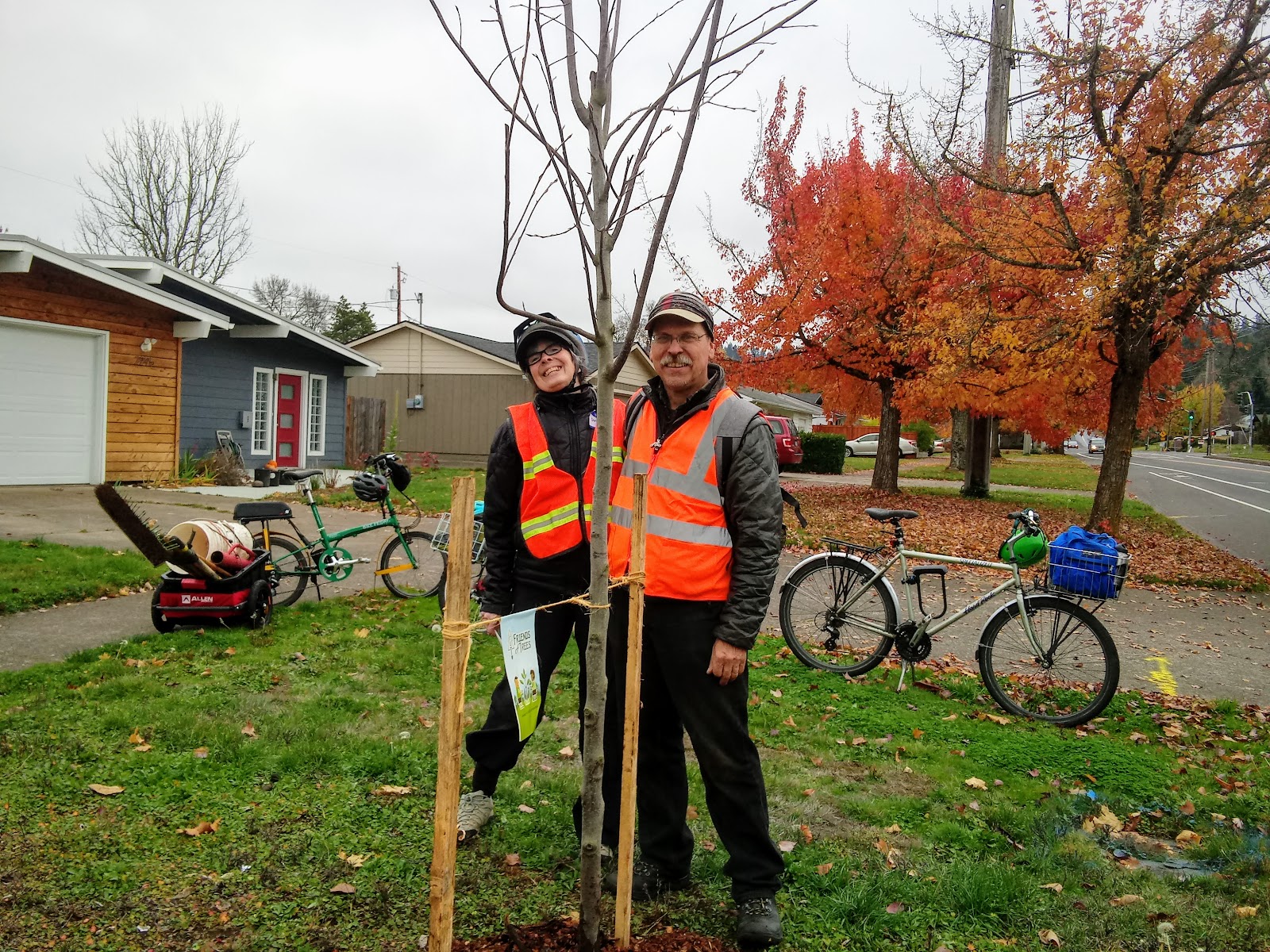
Last Saturday Christine, our friend Sally and I joined up with some other folks from Friends of Trees to plant some trees here in Eugene. One of the super cool things about Friends of Trees is that while they do have a couple of big trucks for tree and equipment hauling, they try to do as much as possible with as few motor vehicles as possible. So, in addition to having volunteers carpool to planting sites, they also have a bike-based crew of volunteers. Naturally, Christine, Sally, and I were part of the bike crew.
I can say that things went off without a hitch and that's literally true. Friends of Trees recently moved their office and in the move they mislaid the hitches to the big platform bike trailers they usually use. Fortunately, Sally had her Burley Travoy and I had my little Allen Yoogo Cargo Trailer so we were able to haul the shovels, buckets and other tools to the various planting sites. Christine carried some tools in her Allant's bike basket and the hard hat in her pannier. The trees and mulch were dropped off ahead of us at the sites by one of the cargo trucks. Next time, the entire operation will be done by bike.
On this particular Saturday all the planting sites were ones requested by various local home owners. Friends of Trees also works with the city planting trees in different public spaces. Home owners also get tree care information and several years of follow up visits by Friends of Trees for pruning and other health checks as the trees grow.
The post pounder is a surprisingly heavy tool that allows even a fairly small person to pound a stake into hard ground. It also is easy to get carried away with the post pounder and catch it on the edge of the stake and have it bounce up and smack the person holding it right on the top of the skull. Hence, the hardhat.
Erik Burke is a certified arborist and the Eugene Director of Friends of Trees. Christine and I first met him when we attended a local tree walk that he was leading. Erik's knowledge of trees is vast and his passion for them is obvious in everything he does.
Christine got to try her hand at the post pounder.
Sally hauled an amazing amount of stuff on her Travoy. The empty tree and mulch buckets weren't heavy, but they were awkward.
In general we had a great time planting trees but it's hungry work. Unfortunately, the bike crew wasn't as speedy as the truck crews and by the time we got to the post-planting potluck most of the food was gone!
Next time, we'll bring snacks.
Keep 'em rolling,
Kent
Thursday, November 14, 2019
100 Good Bike Books
A few years ago (OK, maybe more than a few!) I put together a list of 50 good bike books and then a week later I published a list of 50 more good bike books. For convenience, here are links to both of those lists:
http://kentsbike.blogspot.com/2011/10/50-good-bicycle-books.html
http://kentsbike.blogspot.com/2011/11/50-more-good-bicycle-books.html
I stand by the contents of those lists, but I'm sure there many other fine bike books I'm missing. So if there is a favorite of yours that you think should be on the next iteration of the list, make a note in the comments or send me an email.
Keep 'em rolling,
Kent
http://kentsbike.blogspot.com/2011/10/50-good-bicycle-books.html
http://kentsbike.blogspot.com/2011/11/50-more-good-bicycle-books.html
I stand by the contents of those lists, but I'm sure there many other fine bike books I'm missing. So if there is a favorite of yours that you think should be on the next iteration of the list, make a note in the comments or send me an email.
Keep 'em rolling,
Kent
Friday, November 08, 2019
Schwalbe Tire Levers
Over on the iBOB list, Joan has nice things to say about Schwalbe Tire Levers. Joan notes how the clip mechanism of these levers helps you lock down the section of tire that you already have seated and then you can use the third lever to get the last section of the tire onto the rim. She also notes that the tip of the levers is quite thin, which also is a great help for those tight tire/rim situations.
Over the years I've certainly had my share of punctures and I've used a wide range of tire levers. I can confirm Joan's high opinion of the Schwalbe Tire Levers, they really do a good job in tight situations.
Thursday, October 10, 2019
Thinking About Socks and Alpacas
I was going to start this post by stating that like most folks, I don't spend a whole lot of time thinking about my socks. While that's certainly true most days, I realized that there have been times in my life when I've thought a whole lot about my socks. These have usually been times when I've been miserable or, more importantly, times when I've been planning ahead to avoid misery.
Allow me to explain.
I have, at various times, done things that push me beyond my comfort zone. These include things like riding my Bike Friday from London to Edinburgh and back, or riding a fixed gear bike from Issaquah to Minnesota, or being the first person to ride a single speed bike from Port Roosville, Montana to Antelope Wells, New Mexico. On these and other adventures of varying degrees of stupidity, I've considered my socks carefully. When you are traveling light, you want the gear you bring to be up to the job.
On most of my adventures, I bring wool socks. In general, I'm a fan of wool. It's warm when wet and while some folks are allergic to it, I'm not. Over the years I've written quite bit on this blog about the virtues of wool, so I won't bother to repeat that here. Instead I'm going talk about something better than wool socks: alpaca socks.
Brain Davis apparently thinks more about socks than I do. I first got to know Brian through the internet and his nifty Fix It Sticks. Since then Brian and I have kept in intermittent touch and he's gone on to create several other products including the Weatherneck and the BackBottle. His latest project is a pair of socks made from Alpaca fiber. He sent me a pair to check out and I'm impressed. Well, impressed enough to do this blog post. They really do seem better than regular wool socks. Brian explains it better than I do, but they really are warm, not itchy, not stinky, and very comfy. I suppose you could say I've been bribed with socks, but a bribe only works if it's something of value and by gosh these socks are valuable. They've earned their spot in my kit for my future adventures.
Anyhow, like most of his ventures, Brian is Kickstarting this one. I know he'll succeed because they're good socks and he's a smart, hardworking guy who delivers on his promises. Here's a link to his Kickstarter campaign:
https://www.kickstarter.com/projects/briandavis/performance-alpaca-socks
Wednesday, August 28, 2019
Solar Nomadics
I've been devoting a good chunk of my energy these days into a little venture I'm calling Solar Nomadics. You can read a bit about it here:
https://solarnomadics.blogspot.com/2019/08/what-heck-is-solar-nomadics.html
Kent Peterson
https://solarnomadics.blogspot.com/2019/08/what-heck-is-solar-nomadics.html
Kent Peterson
Saturday, August 03, 2019
Watching my Watts
Alan Scholz recently gave me a new KT-LCD6 display console for my ebike. It’s a bit bigger than my old KT-LCD5 console, but it shows me a few things that my old display didn’t. In addition to the usual speed, average speed, trip distance and total mileage, the new console also show me the current temperature, my cadence and the number of Watts the motor is consuming.
The temperature sometimes reads a bit high if the bike has been sitting in the sun, but once I’m rolling it seems to be pretty accurate. I couldn’t find an explicit way to select Celsius or Fahrenheit for the degree display, but if you select kilometers for your distance measurement the console assumes you’ve bought into the metric system and will display the temperature in Celsius degrees. If, on the other hand, you measure your distance in miles, the console figures that you are one of those quirky Americans who still measures the temperature in Fahrenheit degrees.
The cadence reading tells me what I already knew, that I tend to spin in the 80 to 90 RPM range. It’s a habit that got drilled into me early on. Several years of fixed gear and single-speed riding expanded my cadence and power range so I can comfortably grind up hill and spin down the other side, but given multiple gears and choice I tend to settle in around 85 RPM. With my ebike I often leave the power level set at three (out of five) but I use the gear shift quite a bit to keep my spin rate and effort in the same comfortable range as the terrain or winds change.
The Watt reading is the one I’ve found the most informative. While articles like this one:
https://www.electricbike.com/watt-hours/
provide a good explanation of Watt Hours and try to inject some reality into the often inflated world of ebike range claims, the truth of the matter is people ride ebikes in a wide range of ways and the phrase “your mileage may vary” is very, very true.
Take for example the “real world” estimate of 20 Watt Hours per mile. Even before I got the Watt Meter, I knew that I wasn’t that many Watt Hours. I knew this because of math. I have a 36 Volt 12.5 AmpHour battery on my bike. Since
Watts = Volts * Amps
My battery’s capacity is 36*12.5 or 450 Watt Hours. Taking the 20 Watt Hours per mile estimate, I should expect 450/20 or 22.5 miles of range. But I was regularly going 50 or 60 miles before my battery meter would read ¼ full and then I’d charge it up. Alan told me he was getting similar results. Obviously, we weren’t using 20 Watt Hours of electricity to go a mile, something else was happening. Getting mileage like that would indicate that Alan and I regularly use more like 6 or 7 Watt Hours to go a mile.
There are several factors that contribute to our better than expected numbers. First off, Bike Fridays, even with the added weight of motors and batteries, are lighter than most other ebikes. A lot of ebikes are heavy and frankly not much fun to ride with the motor off. They need their motors to overcome their portly design. My Bike Friday, with the motor off, still rides like a bike.
Second, both Alan and I are what I call “fit old codgers.” I’m sixty and Alan’s a few years older. We’ve been riding bikes for years. We don’t want electric motorcycles. When we get on a bike, we expect to pedal and we do. We’re willing to have the motor help a bit, but we still tend to do the majority of the work involved in keeping our bikes rolling down the road.
Finally, Alan and I both live, work, and shop in the relatively flat Willamette Valley floor. When we do go out on spirited weekend rides in the hills or carry touring loads in the mountains, we wind up using more Watt Hours. But even then, we both find we do quite a bit better than the pessimistic 20 Watt Hours per mile estimate.
I’ve found riding with the Watt Meter to be quite informative. The motor provides most of its kick when I pull out from stop lights, that’s when the Watt number climbs. When it comes to maintaining cruising speed, I can see that as I push a higher gear, the motor draws fewer Watts. And, of course, when I’m coasting or in a tuck going downhill, the motor doesn’t have to do anything.
I find myself doing a bit of mental math, calculating Watt Hours per Mile as I go along. If the meter is showing 100 Watts and I’m doing 16 miles per hour then 100/16 equals 6.25 Watt Hours per mile. If I’m climbing a hill at 8 miles per hour and the motor is drawing 120 Watts than I’m using 15 Watt Hours per mile. Going down the other side of the hill, I’m using zero Watt Hours per mile.
The Watt Meter lets me see how adjusting what gear I’m in or what power assist level I’ve selected affects my range. I’ve always been more interested in going far as opposed to going fast, so I find myself trying to minimize the motor’s contribution and maximize my own. But I have found that for my commute, if I have the assist level set to 2, I average about 13 mph while drawing 80 Watts. If I punch the assist up to level 3, my average speed climbs to 16 mph while the Watt draw is 100. Running the numbers on this I get:
80/13 = 6.13 Watt Hours per mile to go 12 mph
or
100/16 = 6.25 Watt Hours per mile to go 15 mph
I find the small decrease in mileage to be worth the extra three mph. At levels 4 and 5, however, the power consumption is quite a bit greater. Wind resistance increases exponentially with speed, so moving at greater speed takes quite a bit more power. For myself, I virtually never use the higher power settings. I also tell customers that the higher settings (4 and 5) are designed to spin the motor fast, not really provide more power. When climbing, you are going to be going slow and the lower settings (1 through 3) will be more efficient in terms of helping you out. As Alan says “it’s an e assist, you’re still going to be getting a workout climbing a hill.”
One final word of caution with the Watt Meter: like any gadget it can be a distraction. Don’t forget to keep your eyes on the road.
Sunday, April 28, 2019
Running an Ebike on Solar Energy: The Sheddy Kilowatt Story
Five minutes after I installed a solar panel on the roof of my bike shed it began to rain. Since this was April in Oregon, the rain was not an unusual or unforseen event and in fact the next five days were rainy and mostly cloudy. But even on those damp days my solar system managed to generate enough power to not only charge my ebike, but also my phone, Android tablet and radio batteries. After that first week, I knew that I had pieced together a workable system. It's not fancy or particularly elegant, but it gets the job done.
Sparky, my eBike, runs off a 36 Volt, 12.5 AmpHour Lithium-ion battery Since Watts equal Volts times Amps, Sparky's battery holds 450 WattHours of power. Sparky's stock wall charger plugs into a U.S. standard 120 Volt AC outlet and puts out 42 Volts DC at 2 Amps so it puts out 84 Watts in an hour. To completely load Sparky up with 450 Watts takes about five and half hours if I plug into the wall. Charging off the sun is a different story.
The hundred Watt solar panel I got from eBay only puts out 100 Watts in some theoretic, perfectly sunny world that I certainly don't live in. And even if the panel were to miraculously put out 100 Watts, it would do so only at a maximum voltage of 18 Volts. I needed to get that up to a steady 42 Volts to charge Sparky.
My first thought was to get what is called a "boost controller." This is a device which will take a variable voltage input (like what a solar panel puts out) and boosts it to a constant voltage. Like damn near everything these days, the Chinese make an inexpensive one you can buy on eBay, so I ordered one to go with my solar panel.
The device is marvelously complicated and came with a manual that had obviously been translated into English by a not too bright robot. Here is an actual paragraph from that manual:
The controller uses advance software algorithms initiative rope move, quickly and accurately tracking the maximum power point of photovoltaic panels module voltage, active tracking work at the maximum power point of the solar cell module in order to get more solar energy. Enhance the charging current and power generation.
After reading that I decided to initiative my own rope move and I went on YouTube and found some guy with a British accent who had messed around enough with one of these controllers to figure it out and explain it in such a way that even a dumb American like me could use it. Following his instructions, I set up my boost controller put out the 42 volts I needed to charge Sparky's battery.
While that system worked, the flaw in my plan quickly became apparent, I had to have Sparky parked in the shed and plugged in to get the power off the panel. The panel doesn't generate power at night and in most of the daylight hours, Sparky is at work with me. While I could just charge Sparky using the main power at work and have my employer pay the power bill, that is not at all what I wanted to do. I want to run Sparky on sunshine.
Sir Robert Watson-Watt, the inventor of radar, once said "you get one idea today, you get a better idea tomorrow, and the best idea...never." My next idea was to add an intermediate storage battery to the system and as I researched and thought my next, next better idea was to get a little integrated battery/inverter Power Bank unit. I found a good one, again made by the Chinese and available on eBay.
I also got a little recording Watt meter which is not needed for the system to work, but useful in that it tells me how much power the panel is generating and how much has been stored. The Power Bank has a little 4 LED power meter but the Watt meter gives me a clearer picture of what is going on.
You might have noticed that the Power Bank has roughly half the capacity that Sparky does. That means that if I came home at the end of the day with Sparky completely depleted, even if the Power Bank was fully charged, I could only charge Sparky's battery half way. If that actually happened, I'd need a second day to charge the Power Bank and then transfer that power to Sparky. In practice, I'm a pretty frugal ebike rider and in a week of commuting and errands, I only use a few hundred Watts.
My typical charging pattern looks like this: I get home Friday night and Sparky is down to around 50%. I plug Sparky's standard wall charger into one of the 120 VAC inverter outlets on the Power Bank. The next morning, Sparky is full and the Power Bank is empty. I spend the weekend riding Sparky around and the Power Bank spends the weekend in the shed charging up. Sunday night I again connect Sparky to the now full Power Bank. Monday morning the Power Bank is again depleted and Sparky is ready to take on the work week at full strength.
The actual truth of things is that even with less than great weather and the inefficiencies of various intermediate batteries and inverters, my little solar system gives me more than enough power to keep Sparky humming along. In fact, I have more than enough power so I also use the power bank to keep my phone, tablet, and radio charged up. All the words and pictures in this post come are here thanks to solar power.
If you want to build a system like mine, the only two parts you really need are a Solar Panel and a Power Bank. The prices of these things tend to fluctuate. I paid about $100 for my 100 Watt panel and $131 for my Power Bank. I consider it money well spent.
Keep 'em rolling,
Kent Peterson
Eugene, Oregon
Saturday, April 27, 2019
Wednesday, April 24, 2019
I didn't need or want an ebike, but now I'm glad I've got one!
While ebikes have been a growing part of the bicycle business for
several years, I'd always figured I didn't need one and frankly, I
didn't want one. For decades I've managed to get around just fine on a
bike where I'm the only motor and I didn't see any reason to complicate
matters. It was somewhat ironic then when Bike Friday started doing more
and more ebikes for our customers that I became "the ebike guy." While
Alan Scholz, our company's founder, did the bulk of the preliminary
research and development for Bike Friday's new line of ebikes, my job in
the service department involves adding electric motors to customer's
existing bikes and troubleshooting bikes with problems. As I've been
known to grumble now and then "adding a bunch of electronics and a motor
to a bike doubles the universe of potential problems." I also may have
said the ebikes are "bikes for lazy folks." Statements like this are why
Bike Friday doesn't have me working in the sales department.
As I got to work with more ebike customers, I saw that I was very wrong about the "lazy folks" comment. In many, many cases a person gets an ebike so that they can keep riding. One 80 year old customer wanted to keep riding with his slightly younger, faster pals. Another wanted to bike to work instead of drive and the motor took care of the one big hill in her way. A mom uses the extra oomph of an ebike to help her carry her two kids to school on the back of her Haul-a-Day. These are not lazy people.
Still, I have a flat commute to work. I'm no longer young, but I'm reasonably fit. I sure didn't (and don't) need an ebike. But Alan, who is a bright guy, kept bugging me. "You won't really get it until you have one. Test riding customer bikes isn't the same." And Alan kept giving me stuff. "This motor was one I was checking out for research, but it's a bit heavier than what we'd want for a customer's bike. You should put it on your bike." The next week we had a warranty issue with a battery because of a cracked mounting bracket. "We can't sell it to a customer, but I bet you could make it work on your bike." Eventually, the pile of parts was either going to bury my workbench or get put on a bike. I installed all the various bits on my Pocket Companion.
My first commute was a couple of miles per hour faster, but it wasn't life changing. Riding an ebike is like riding a tandem with a strong partner. With the pedal assist system we use on the Bike Fridays, the motor only kicks in when you are pedaling. You select how much (or how little) of a boost you want. With e-assist I'm quicker getting across an intersection when the light turns green. My top speed isn't changed. Ebikes by law have a regulator that stops the motor from applying power at a certain speed. You can pedal faster than that speed, but it is you doing the work, not the motor. But my average speed went up because where ebikes shine is helping you at times when conditions would slow you down. On my flat commute, in addition to the intersections, I noticed the boost most on days when I was riding into a headwind.
But it was on my days off that I really began to bond with my ebike. I've always been a strong climber, but with the ebike I really don't even have to think about hills. Yes, I gear down and pedal, but Sparky (as I've renamed my bike!) is like a little pal saying "let me help you with that." Hauling a couple of big boxes of books to the thrift store with the bike trailer? No problem, Sparky is there to help.
They did a study in Norway and they found that in general ebike riders get about 80% of the workout they would riding a non-electric bike over a given distance. But they also found that ebike riders tend to ride about 20% farther on average and their average speed is about 20% faster. My own experience echoes this. I'm having fun, riding more and riding farther.
I've told my friends that I've gone from being an ebike skeptic to being an ebike enthusiast and I'm dangerously close to becoming an ebike evangelist. Alan was right, I had to own an ebike to really get it. I still don't really need an ebike, but I'm damn glad I've got one!
As I got to work with more ebike customers, I saw that I was very wrong about the "lazy folks" comment. In many, many cases a person gets an ebike so that they can keep riding. One 80 year old customer wanted to keep riding with his slightly younger, faster pals. Another wanted to bike to work instead of drive and the motor took care of the one big hill in her way. A mom uses the extra oomph of an ebike to help her carry her two kids to school on the back of her Haul-a-Day. These are not lazy people.
Still, I have a flat commute to work. I'm no longer young, but I'm reasonably fit. I sure didn't (and don't) need an ebike. But Alan, who is a bright guy, kept bugging me. "You won't really get it until you have one. Test riding customer bikes isn't the same." And Alan kept giving me stuff. "This motor was one I was checking out for research, but it's a bit heavier than what we'd want for a customer's bike. You should put it on your bike." The next week we had a warranty issue with a battery because of a cracked mounting bracket. "We can't sell it to a customer, but I bet you could make it work on your bike." Eventually, the pile of parts was either going to bury my workbench or get put on a bike. I installed all the various bits on my Pocket Companion.
My first commute was a couple of miles per hour faster, but it wasn't life changing. Riding an ebike is like riding a tandem with a strong partner. With the pedal assist system we use on the Bike Fridays, the motor only kicks in when you are pedaling. You select how much (or how little) of a boost you want. With e-assist I'm quicker getting across an intersection when the light turns green. My top speed isn't changed. Ebikes by law have a regulator that stops the motor from applying power at a certain speed. You can pedal faster than that speed, but it is you doing the work, not the motor. But my average speed went up because where ebikes shine is helping you at times when conditions would slow you down. On my flat commute, in addition to the intersections, I noticed the boost most on days when I was riding into a headwind.
But it was on my days off that I really began to bond with my ebike. I've always been a strong climber, but with the ebike I really don't even have to think about hills. Yes, I gear down and pedal, but Sparky (as I've renamed my bike!) is like a little pal saying "let me help you with that." Hauling a couple of big boxes of books to the thrift store with the bike trailer? No problem, Sparky is there to help.
They did a study in Norway and they found that in general ebike riders get about 80% of the workout they would riding a non-electric bike over a given distance. But they also found that ebike riders tend to ride about 20% farther on average and their average speed is about 20% faster. My own experience echoes this. I'm having fun, riding more and riding farther.
I've told my friends that I've gone from being an ebike skeptic to being an ebike enthusiast and I'm dangerously close to becoming an ebike evangelist. Alan was right, I had to own an ebike to really get it. I still don't really need an ebike, but I'm damn glad I've got one!
Monday, April 22, 2019
A Little Story for Earth Day
Now various folks call people like me who try to reduce their
environmental impact on the earth "Tree Huggers". Most times I take the
reference as a badge of honor. But sometimes, depending on the context,
I'm not always thinking Bob Ross style happy thoughts about trees.
I
recently built myself up an electric bike and even more recently
pledged that I was not going to charge it off the main power grid. With
the help of my son Peter, I assembled a small bike shed in our back
driveway and a few weeks ago I installed a 100 Watt solar panel on the
shed's roof. Since then all the power for my ebike, radio, phone and
Android tablet have been generated from sunlight.
Late
yesterday afternoon, while it was still bright and sunny, I was
puttering around in the shed and I noticed the Watt meter was showing a
lot less power than I'd expect. I stepped out and looked at the shed's
roof. A tree at the edge of the yard (which I'd always thought of as
quite lovely) was casting its leafy shadow on the solar panel.
"You stupid tree!" I grumbled.
I guess I'm a bad tree hugger.
Thursday, November 22, 2018
Moving On
I have pretty much said all I have to say on the subject of bicycles so this blog is basically dormant. But there are years of posts you can browse in the archive and they are sticking around.
I'm doing a whole lot less on the internet these days but may be posting a few other things over on my occasional blog at:
http://seldomspeedy.blogspot.com/
Thanks for reading,
Kent
I'm doing a whole lot less on the internet these days but may be posting a few other things over on my occasional blog at:
http://seldomspeedy.blogspot.com/
Thanks for reading,
Kent
Tuesday, March 27, 2018
Our Bicycles Have Gone Astray
-----------
Our Bicycles Have Gone Astray
(a rant for Grant)
The problem, I suppose,
is one of seductive speed.
The simplest frame, two wheels,
a chain and some gear ratio
makes a miracle,
amplifying human speed by three.
Why walk one mile
when you can bike three?
Why take three hours to go
when you can be there in one?
But it is so easy
to forget
that the better
is the enemy
of the good
and there is more
to life
than increasing
its speed.
If three is good
then isn't four better?
Or five, or six, or more?
And so we've calculated, computed,
added and subtracted,
invented all kinds
of cleverness.
Carbon fiber, great gangs of gears,
spandex clothing, shoes that click,
shifters that click, shifters with batteries,
bikes with batteries, bikes with motors.
Faster, better, newer, more.
Or maybe less.
We like to make them lighter,
more expensive, more exotic,
more impressive.
You'll climb faster
with a lighter wallet.
I make a decent living
I suppose
making and fixing bicycles
more complicated than my own
a few miles from my home.
I ride back and forth
those few miles to the factory
five days a week
on a bicycle
I made with friends,
I made friends with.
It has three gears,
two more than I use
most days.
But some days
those extras
come in handy.
On weekends my wife and I relax.
Our bicycles stay home
with the cat
and we walk everywhere.
I reckon I can afford
this luxury
because of the various ways
our bicycles
have gone astray.
Our Bicycles Have Gone Astray
(a rant for Grant)
The problem, I suppose,
is one of seductive speed.
The simplest frame, two wheels,
a chain and some gear ratio
makes a miracle,
amplifying human speed by three.
Why walk one mile
when you can bike three?
Why take three hours to go
when you can be there in one?
But it is so easy
to forget
that the better
is the enemy
of the good
and there is more
to life
than increasing
its speed.
If three is good
then isn't four better?
Or five, or six, or more?
And so we've calculated, computed,
added and subtracted,
invented all kinds
of cleverness.
Carbon fiber, great gangs of gears,
spandex clothing, shoes that click,
shifters that click, shifters with batteries,
bikes with batteries, bikes with motors.
Faster, better, newer, more.
Or maybe less.
We like to make them lighter,
more expensive, more exotic,
more impressive.
You'll climb faster
with a lighter wallet.
I make a decent living
I suppose
making and fixing bicycles
more complicated than my own
a few miles from my home.
I ride back and forth
those few miles to the factory
five days a week
on a bicycle
I made with friends,
I made friends with.
It has three gears,
two more than I use
most days.
But some days
those extras
come in handy.
On weekends my wife and I relax.
Our bicycles stay home
with the cat
and we walk everywhere.
I reckon I can afford
this luxury
because of the various ways
our bicycles
have gone astray.
Thursday, November 17, 2016
Made With Extra Love
Mrs. H. wakes up slowly. For too many years she’d gotten up quickly, swatting down a clock that jangled or beeped too insistently to be ignored. When Boots knocked the last clock off the nightstand and broke its ringer, Mrs. H figured that she’d reached the point where she no longer needed to be alarmed by things. The hungry cat would do just fine in making sure she got up in time to feed him.
This morning Boots is doing just that. He pokes her ear gently with his paw, claws retracted like a little white boxing glove. “Mreow?” the cat asks. “Good morning to you too, Mr. Boots.” Mrs. H. replies, slowly moving her feet from under the covers, shifting feet to floor, fumbling around for her slippers and her comfy robe.
Mrs. H. turns the heat down every night but she has a big down quilt and a cat so it’s plenty warm for sleeping, although not as warm as it was when Henry was still alive. For such a small man, Henry sure generated a lot of heat. She misses that about him and the way he’d tell her silly stories and make up songs and tell her she would always be his girl.
“Mrreow?” Boots insists. Mrs. H. turns up the heat and follows the cat into the kitchen. She pours his morning food into the dish and fills his bowl with fresh water for the day. Mrs. H. then makes her morning tea and toast. Some mornings she listens to the news on the radio but the news is mostly forgettable things, which is convenient because then later when she sees Mr. Chan she can say “what’s news?” and it will be very new and very interesting. It is always more interesting when Mr. Chan tells her things. Today Mrs. H. doesn’t listen to the radio, she sings a little song to herself, one of Henry’s old songs, and she looks at her list. She makes herself lists these days, lists of things to remember. Today’s list looks like this:
Nancy’s prescription
Make Brownies for Mrs. Clarke
Two items isn’t much of a list, Mrs. H. thinks. Even Henry, God bless him, who had a mind like a steel sieve, would only make a list when he had more than three things to remember. Two items isn’t much of a list. And Boots is getting low on food. Mrs. H. adds
Food for Boots
Boots isn’t the only one needing to eat so below that she adds
Something for dinner.
Mrs. H. finishes her tea and toast, goes to the bedroom and gets dressed to go outside.
The day looks like it will be warm, but Mrs. H. gets cold easily these days, so she brings a jacket and her gardening gloves. The gloves aren’t just for warmth, she’ll be going to the garden today. It’s not a big garden, just some roses and a bit of green, but land without life is just death, so she tends it as best she can. The plants will be getting high now and will need to be cut back.
She and Henry had never been gardeners until the last years, when Henry was sick. Those times were hard, of course, the chemo sessions and the awful weakness. There were good times as well, when the disease was in remission; when Henry was again strong enough to walk and ride his bicycle. The garden had been his idea “as long we have a bit of land, we should put it to use” and the little plot got both enough sun and rain for the plants to do well. The people at the cemetery had resisted at first. Well the living ones had, the dead expressed no opinion, but Henry had been stubborn and logical. “We’ve paid for the land and if you’re fine with putting cut flowers on other graves I can’t see no reason why the Mrs. and me can’t grow roses on mine.”
And so, with the promise that they’d keep it tidy and do the extra work when the time came, they planted Henry’s plot. On the good days they both rode there, side by side where the road was wide enough and the traffic was light, on the bicycles they’d ridden since their courting days. They’d ridden more quickly when they were younger, and farther of course, but that old saying about bicycles is true, “once you learn to ride you never forget” and while Mrs. H. would forget things some days now if she didn’t put them on her list, she never forgot how to ride her bicycle or how it reminded her of all the rides she and Henry had taken together over the years. Henry would always ride beside her or behind her, letting her set the pace and never racing on ahead. “It’s a beautiful day and I’m with the woman I love,” he’d say, “Where would I want to hurry off to?”
Her bicycle lives in the living room. That’s the way she and Henry had always said it, “our bicycles live in the living room.” The apartment doesn’t have a garage, which is fine because Mrs. H. and Henry never owned a car and she’d be scared to death to drive. Too big, too fast, too noisy and too hard to find parking places in the city. The bicycles always made more sense.
When Henry passed she’d asked Mr. Cooper at the bike shop what he thought should be done with Henry’s bicycle. She knew it was old and not fancy like the new racing bikes but perhaps someone could still use it? Mr. Cooper had assured her that he could find a buyer and sure enough not more than two days later he’d stopped by to pay her what she was sure was too much money for an old bicycle. Mrs. H. suspected that Mr. Cooper being overly generous, perhaps thinking, not incorrectly, that she could use the extra money to help with the last of Henry’s doctor bills. But Mr. Cooper told her that this wasn’t so and when she checked with the buyer, a nice young man with old style glasses and a neatly trimmed beard, he’d assured her that he felt the price he’d paid for Henry’s old bike was very fair.
Mrs. H. rides alone now but she still sees Henry’s bike in the neighborhood and that makes her happy. Sometimes she sees the young man riding it, but more often she sees it parked by the little shop, the one with the complicated kinds of coffee. The young man is often there, staring into his phone or typing on his little computer. She’s not sure how he makes his living. Something with computers and it pays enough that he seems to be able to pay more than she would for an old bicycle or a cup of coffee.
Mrs. H. has never been a coffee drinker, but she buys her tea and other groceries at Mr. Chan’s market. Mr. Chan’s market is still called “Garcia’s Grocery” because Mr. Chan never saw any need to change the name when he bought the market a couple of years ago. Mrs. H. used to shop at the Safeway across town, but Mr. Chan’s market has everything she needs.
Mr. Chan had watched Mrs. H. ride by every day and he had thought about this. One day, he installed a bicycle rack out front. The next time Mrs. H. rode by, Mr. Chan had waved her down. “You, Bike Lady,” Mr. Chan said proudly, “You always riding somewhere. You stop sometime, buy food. You stop here now.” Mrs. H. had stopped. “You, Grocery Man. How much you charge for tea?”
Today Mrs. H. locks her bicycle carefully to the rack in front of Mr. Chan’s market. She takes her bag from the bike basket and steps inside the cramped but well-ordered market. “Ah, Mrs. H.” says Mr. Chan, “Good to see you. What’s news?” Mrs. H. tells Mr. Chan about how Nancy fractured her hip and how Mrs. Clarke’s chemo sessions are going, “she’s at that terrible, no hair, no appetite stage. The drugs are better now, but they’re still horrible.” Mr. Chan tells her about the latest politics and how his daughter is doing in school. “Not so good,” he says “She used to be good at the math, but now she think too much about the boys!”
Mrs. H. buys brownie mix, cat food for Boots and some spaghetti and sauce for dinner. She also buys a small onion and a clove of garlic. Yes, she buys her sauce in a jar, but she learned long ago that a little bit of onion and garlic chopped and fried up in olive oil added to the sauce as it simmers makes it so much better. Mrs. H. has developed a reputation as some kind of wonderful cook and she is often asked for her recipes. Folks always seem slightly disappointed when she tells them the whole truth, so she’s learned to keep a little mystery. “Oh, it’s nothing special,” she’ll say, “It’s just spaghetti from a box and sauce from a jar. It’s just made with extra love.”
Mr. Chan bags her groceries and tosses in a day-old bagel that he’s “just going to throw out, you feed to bird.” As she leaves, Mr. Chan gives the weather forecast. “No rain," he says, “my knee get stiff when rain is coming. It feel good today. No rain."
Mrs. H. rides to the park and watches the young mothers and nannies watch the kids on the swings. An old man and a young man sit at a picnic table playing chess. They say little, but take long pauses to think between moves. Mrs. H. rolls past the mothers and the nannies and the men, past where most of the people and the pigeons are. She doesn’t feed the pigeons anymore. Once an earnest young man had instructed her not to feed the pigeons. “There are too many of them and they spread disease.” She’d listened politely, thinking not so much that the young man was right but that there seemed to be too many earnest, polite young men with nothing better to do than to make up rules and laws telling other people exactly how and when they can be kind. But she’d listened to the young man and perhaps he’d had a point. There were a lot of pigeons and they didn’t seem to care if she fed them or not.
Crows are another story. Mrs. H. likes crows. While the pigeons just seem to stumble on food by chance, the crows are always clever at seeking it out. Mrs. H. knows a particular crow, a big one that Henry named Edgar. They’d first met him on one of their cemetery picnics. Edgar makes a regular circuit of the neighborhood and he knows which trash cans get set out on which days and which lids can be pryed open with his beak. Every Thursday morning he can be seen working the lid off Sam Johnson’s trash can across the street while Boots watches, fascinated, from Mrs. H.’s window. A weekly crow visit is like having a favorite TV show for a cat.
The cemetery is on the far side of the park and Mr. Simmons, the grounds-keeper, nods as Mrs. H. pedals through the open iron gate and into the quiet green space. Mr. Simmons has never been a chatty man and this job suits him well. People generally don’t come to graveyards to talk, at least not to talk to the living. He does his job and keeps to himself. Of course he knows about Mrs. H. and her little garden with the rose bushes and the greenery. That plot is one of the nicer looking ones in the yard and Mrs. H. keeps it looking nice. It’s one less grave for Mr. Simmons to mow, so what’s the harm?
Mr. Simmons leaves her in peace but Edgar Allen Crow is right there, swooping down on her basket before she can even park her bike. “Patience!” Mrs. H. laughs, “yes I brought you something, hang on.” She reaches in the bag, extracts the bagel and hands it to the bird. While the crow picks apart the bagel, Mrs. H. gets out her clippers. She’s learned to feed Edgar first, otherwise he gives her no peace and tries to peck at the shiny clippers.
She talks to Henry while she works; a conversation not unlike the one she’d had with Mr. Chan with the additional details of mutual friends, how Boots is doing and how much the plants have grown. She trims the broad green leaves back, packing the clippings carefully in a plastic bag. She’ll dry them later at home. The supply of dried leaves is getting low.
She can’t stay too long today, she explains to Henry. She still has to pick up Nancy’s prescription and make the brownies for Mrs. Clarke. She’ll be back tomorrow. It’s been a good day. She only cried a little this time.
Mrs. H. rides to the drug store. She doesn’t like the drug store. The lights are too bright and the music is too loud. They are too happy to sell you pills if you have insurance and too busy to talk to you if you don’t. She’d rather not go there, but Nancy has a hard time getting out now and she had told Nancy that she’d pick up her prescription for her. She has Nancy’s driver’s license with her and Nancy’d told her that she’d called in the prescription and it would be ready today. “Just say you’re me and they’ll give it to you. It’s all paid for and all old ladies look alike to them.” Mrs. H. didn’t like to lie and she didn’t like Nancy calling her an old lady. But Nancy was an old friend and Mrs. H. had said that she would help.
Mrs. H. doesn’t lie. If you do things right, you don’t have to, she thinks, so she says “Prescription for Terwilliger” and presents Nancy’s driver’s license to the young woman behind the counter. The girl doesn’t ask if Mrs. H. is in fact Nancy Terwilliger and simply hands over the white bag with the bottle of pills inside. Mrs. H. isn’t sure what the pills are for, if they are for Nancy’s liver or her hip or her blood pressure or what. Nancy is always telling her the things that are wrong and it is a lot of things and Mrs. H. hasn’t bothered to make a list.
The drug store doesn’t have a bike rack, so she’d locked her bike to an iron fence around the corner. The fence is solid and strong. Her bike lock is very big. When she and Henry had moved to the city, they had gotten the biggest locks they could find, the ones Mr. Cooper at the bike store called Fahgettaboudit. Mr. Cooper had advised always locking up to something big and solid. Mrs. H. follows that advice always, except, of course, when she’s at the cemetery. Nobody ever bothers her at the cemetery.
She comes around the corner and she sees a young man. He’s fiddling at the lock with a knife, an action unlikely to yield any meaningful results, but as Henry had been fond of noting “there’s a lot of stupid in this world.” Mrs. H. has a fraction of a second, an instant where she sees the criminal but he doesn’t see her. She has a chance to step back, to retreat around the corner, but that wouldn’t be right. Mrs. H. doesn’t retreat. She doesn’t stop and think. She just blurts out “Hey!”
She says it loudly, yells it actually. She wanted to sound like Clint Eastwood, but as the word leaves her lips she knows that she sounds like an old lady. She hopes that the young man will drop the knife and run away. At least run away.
He doesn’t. He smiles at her. There are smiles that are reassuring and friendly, smiles that make you feel safe. This is not one of those. The young man motions towards her with the knife and says “Why donchu hand me that bag?”
Mrs. H. thinks that Boots will get awfully hungry if she doesn’t come home. On the other hand, Henry’s been waiting for her for a while now...
Mrs. H. smiles.
The young man repeats the threatening motion with the knife, a glint in the sunlight. “Whatchu grinnin’ at granny?”
“I’m not your granny,” Mrs. H. says softly, remembering that Clint Eastwood never yelled. He would growl. Softly. Gruffly. Like something you’d have to be an idiot to mess with. Her lowered voice is steady in her ears, “You call me Mrs. H. Everybody calls me Mrs. H.”
She has no plan beyond this moment. She supposes a bag full of cat food and spaghetti could be swung as a weapon but only an idiot would bet on an old lady with a bag against a punk with a knife. She didn’t get this old by being an idiot.
“What the hell?!?” A dark shape, all wings and beak and beady eyes is suddenly at the punk’s wrist.
“I’m a witch, and this is my Familiar,” says Mrs. H. working hard to keep her voice low and menacing. “Didn’t your mama teach you not to bother witches? I’m a crazy old lady who hangs out in graveyards and talks to dead people. You don’t want to mess with me. Scram!”
Mrs. H. is not sure how much of her quiet speech the young man hears, he’s rather distracted by the bird. To a crow, a shiny blade is a trinket worthy of a closer look, certainly nothing like a threat. To a city kid, a big black crow is something sudden, wild and dangerous. The young man flails, fumbles and flees.
Edgar turns his attention to Mrs. H. “Caw?” the bird asks. “Sorry,” Mrs. H. replies, “no bagels, see?” She opens up the bag and shows the crow. He cocks his head as if he understands. “But thank you,” Mrs. H. adds “I’ll see you tomorrow. I promise. I’ll bring you something extra.”
The crow shrugs; an action which is extra expressive in a winged creature. He flies off. Those garbage cans over on Third still need to be examined.
Back at home Mrs. H. parks her bike safely in the living room. Boots tears himself away from the window to bother her about food until she feeds him. She takes the green leaves out of the plastic bag and lays them on the drying rack. The dried leaves, of course, are going into today’s batch of brownies. She heats up the double boiler and starts the butter melting.
She and Henry learned to make the brownies back when he was in chemo. Awful stuff that chemo, you lose your hair and you lose your appetite for everything.
Well, almost everything.
They’d learned about the plants and figured out how to cultivate them alongside the roses. People look at the pretty flowers and tend not to pay attention to the leaves.
Mrs. H. adds the dried leaves to the butter, gets out her mixing bowl and greases the brownie pan. Henry doesn’t need the brownies anymore, but Mrs. Clarke can use some kindness. A batch of brownies, made with extra love.
Sunday, September 18, 2016
The rise of e-bikes does not equal the death of human-powered bikes
There is no doubt that the rise of e-bikes is changing the bicycle business, but sometimes the excitement of the new and fear of missing out make for some mistaken bits of hyperbole. For example, this came across my Twitter stream this morning:
I replied:
Some technologies really do replace and "kill off" others. Wikipedia really did put a lot of encyclopedia salesmen out of work. Digital cameras did kill Kodak's film business. And video killed the radio star.
Wait a minute, let's look at that last one for a bit.
When TV came along, it didn't kill radio. Radio drama pretty much died, but radio still exists. You may still listen to radio for news, music or traffic reports. For much of your information needs, you don't need or want a video component.
Now e-bikes solve some problems some folks have. They can add range and hill-climbing ability. But they add weight, price and complexity. For some folks, in some situations, e-bikes are the solution. But not all folks, in all situations. For many people, a bike that is solely human-powered is a better answer.
The Swiss Army Knife didn't make chef's knives obsolete. We live in world that has sporks, forks, spoons and chopsticks. And the non-e-bike isn't going away. E-bikes are here and they're getting better but they won't kill the bicycle.
Kiss goodbye to pedal-powered bicycles, says @BromptonBicycle boss @Will_Brompton https://t.co/jdG8neC8ls pic.twitter.com/9m6lOF56eJ— Carlton Reid (@carltonreid) September 18, 2016
I replied:
On reflection, it's a fine headline. It generates clicks and it accurately quotes Mr. Butler-Adams. But I think he's wrong.Horrible headline. The rise of e-bikes does not equal the death of human-powered bikes. https://t.co/p52181xTgw— Kent Peterson (@kentsbike) September 18, 2016
Some technologies really do replace and "kill off" others. Wikipedia really did put a lot of encyclopedia salesmen out of work. Digital cameras did kill Kodak's film business. And video killed the radio star.
Wait a minute, let's look at that last one for a bit.
When TV came along, it didn't kill radio. Radio drama pretty much died, but radio still exists. You may still listen to radio for news, music or traffic reports. For much of your information needs, you don't need or want a video component.
Now e-bikes solve some problems some folks have. They can add range and hill-climbing ability. But they add weight, price and complexity. For some folks, in some situations, e-bikes are the solution. But not all folks, in all situations. For many people, a bike that is solely human-powered is a better answer.
The Swiss Army Knife didn't make chef's knives obsolete. We live in world that has sporks, forks, spoons and chopsticks. And the non-e-bike isn't going away. E-bikes are here and they're getting better but they won't kill the bicycle.
Monday, August 22, 2016
Bike Friday introduces the PakiT
Today Bike Friday is officially unveiling the Pakit. I've been riding a prototype of this bike for the past month. I can assure you, it's real. I work at Bike Friday and over the past couple of decades we've built and shipped thousands of bikes.
This is my prototype PakiT. It weighs a bit under 20 lbs.
We build all the Bike Friday's here in Eugene, Oregon. It's a pretty nice place to live and work
Unlike the production PakiTs, my prototype has a coaster brake and chain drive. Although I grew up with coaster brakes, I found I missed the ability to spin the pedals to just where I want them when I stop. Everybody who test rode the bike made the same comment. So all the production PakiTs will have cable-activated brakes.
The PakiT folds quickly to a narrow package.
The stem and handlebars detach and clip to the frame.
The bike folds to a very narrow package. We realized that a lot of folks will quick fold it and then walk into a crowded place like an elevator or a farmer's market so using a clean belt drive for the production bikes. But, down the road we will make the chain drive available as an option.
We've already build multiple PakiT prototypes and have a wide range of riders testing them. We have a factory that has already built thousands of Bike Fridays over the past few decades and we our experienced crew is ramping up to add the PakiT to our product line. The Kickstarter will let us bulk buy materials and gauge our first production run for this new bike.
The Kickstarter will tell you more about the Pakit. I like mine and it's a rough prototype. The production bike is even better and I think at least some of the people reading this blog might want one.
Keep 'em rolling,
Kent
Tuesday, May 10, 2016
Review: TiGr mini Bike Lock
While I've never been as obsessed with weight as some of my speedier bike riding friends, I do understand why weight is important to a cyclist. On a bicycle the rider is the engine and any time the terrain goes up or you want to accelerate it is your power that is making that weight move. Performance is a function of the power to weight ratio and even a touring cyclist who is not particularly interested in going fast can travel farther with less effort with a lighter load. In the high end racing bike world, people pay thousands of dollars to get the lightest frames, wheels and components.
Until recently, when it came to bike locks, you had to make a choice between weight and security. Good U-locks are quite secure, but they are heavy. Cable locks are flexible and light, but not very secure.
The folks at TiGr decided to make a secure lock out of titanium. Titanium is strong and flexible. Their first lock was a bow designed to lock both wheels of a road bike. Of course any lock can be broken given enough time and big enough tools and the initial version of the lock with a .75 wide bow could be defeated with a large set of bolt cutters. Their current bow lock is 1.25 inches wide and has been extensively tested and ART certified. Of course, no lock is 100% theft-proof but from what I've seen the TiGr locks provide a level of security on par with a good U-lock.
While the bow design works well for various bikes, I was more interested in the TiGr mini, a small lock quite similar to a U-lock.
Here's my old, very reliable ABUS U-lock:
I have no real complaints about the Abus lock, it's been very reliable. It also weighs a bit over three pounds.
My TiGr mini lock weighs a bit under one pound.
I use the TiGr mini much the same way I used the Abus, with a flexi cable to secure the front wheel of my bike (yeah, I know, someone could cut the cable. But there isn't a huge illicit market for 20" wheels, so so far, so good). And the lock itself is just big enough to secure the rear wheel via the Sheldon Method. If you have a fat-tired mountain bike the TiGr mini might not be big enough, but for a road bike or something like my Bike Friday, it's just about the perfect size.
The lock mechanism itself has a very smooth action and it comes with two keys. Like most good locks, you register it with the company so you can get a replacement key if you ever need one.
The lock comes with a very nice bracket that I don't use. The bracket takes up a waterbottle spot and with every lock I've ever had, I never use the bracket. I always just toss the lock in a pannier or pack or strap it to my rear rack. But if you're the type who uses a lock bracket, the TiGr folks make a good one.
The TiGr is made by a small, family owned business right here in the USA. Yes, the lock cost about twice what my old lock did, but I consider it money well spent. BTW, yes I bought this. I get industry pricing because I work in the bike biz, but like you, I buy stuff. Nobody is paying me to say nice things. But this is a nice thing.
Oh, and if you do buy it through the Amazon link, I do get a kickback. Bottom line, it's a good, secure, lightweight lock.
Subscribe to:
Posts (Atom)


