Wednesday, October 10, 2012
Port Townsend Tour: Day 3 Kitsap Memorial State Park to Oak Bay County Park
It's a misty morning along the Hood Canal and after breakfast and breaking camp we set out with our bike lights lit and at least one extra layer packed on our bodies instead of in the panniers.
Today's bridge is a big one, the mile and half long Hood Canal Floating Bridge. It's a monster, but Christine slays it with style, riding the bulk of the bridge but wisely walking the slick metal drawspan sections.
As we cross the bridge, I see, but am unable to photograph, a sea lion swimming just north of the bridge.
At the end of the bridge we take my friend Mark Canizaro's advice and turn left to follow Shine Road for a few miles. This small road has almost no traffic and is a very pleasant alternative to the busier SR-104.
Just across from where Shine Road rejoins SR-104 there is Teal Lake Road heading pretty much straight north. I've ridden many of the roads around here in the past, but never Teal Lake Road. Since one of the ideas of this trip is to visit both familiar and new places, I've optimistically added this road to our route.
A good rule of bike touring would note that "the shortest distance between two points is often hilly as hell" or as Mark will later comment when I retell the tale of this day "You took Teal Lake Road? You didn't look at a topo map, did you?"
Christine takes this development in stride, so to speak. "I'm walking," she wisely declares as the road becomes a wall. "Smart woman," I agree as I dismount my bike. When your riding speed is less than your walking speed, only a stubborn idiot insists on turning the pedals. I quote Jan Heine: "It is good, sometimes, to stretch the legs."
When the grade relents for a bit we remount our faithful steeds and creep towards the summit. We roll along the top of the rolling ridge and then coast down a hill that would be a real leg stretcher if we were headed southbound and join up with Paradise Bay Road.
For years Christine has heard me report enthusiastically on the wonders of minimart food. Tales of fine beverages dispensed by coffee robots in tiny towns in the wee small hours of cold mornings, the existential excellence of a hotdog that, like you, has been rolling for hours under less than ideal conditions, cold ice tea consumed in the shade next to a very hot road, these are things whose delightful nature is only truly understood by the ravenous rider.
At the minimart in Port Ludlow, Christine understands. As we feast on chicken strips and chips and ice tea she declares, between tasty mouthfuls, that "Now I feel like a real bike tourist."
We leave the "Village in the Woods by the Bay" rolling north on the Oak Bay Road. It's early afternoon now and the sun has warmed away almost all of the morning mist. And we are at our destination for the day, the Oak Bay County Park.
I've ridden by the sign for the Oak Bay Park a few dozen times over the years, but this is the first time I've turned in to see the park. Confusingly, the signs for camping point both north and south when you leave the main road, so we check both options. The southern area is an exposed spit jutting out into the bay, optimal, I suppose, for those arriving by water or having intentions involving watercraft. The northern area is wooded and overlooks the bay. We opt for camping in the woods.
But first, there is important lounging to be done. Stories are read. Snacks are consumed. Thoughts are thought. Basking happens.
As the day moves towards evening we pitch the tent and make the food. As the air grows cooler, we bundle up.
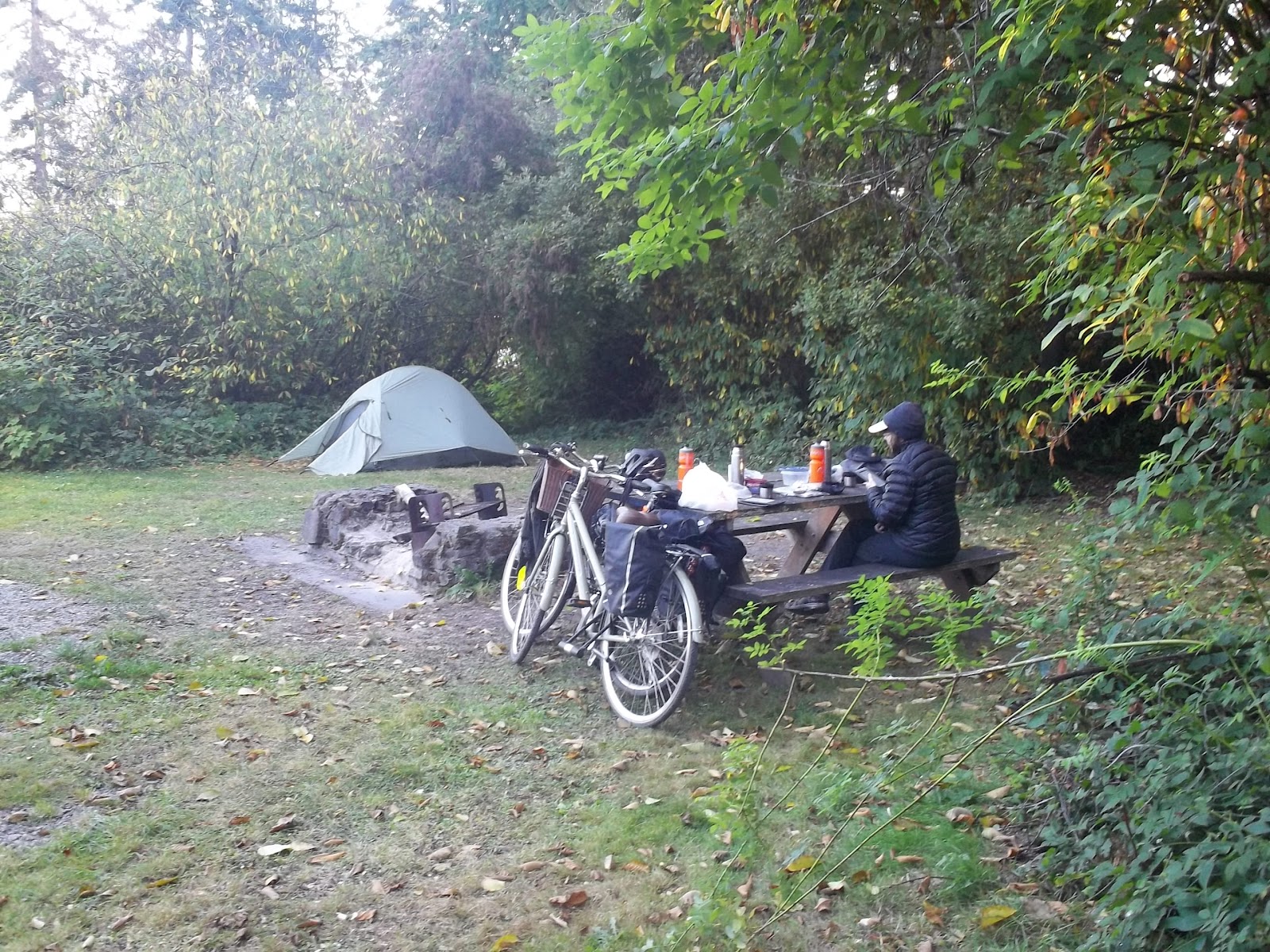
Before dark all the food goes in the bag that we sling high in the tree. We are cautious of bears but honestly more concerned with raccoons, crows, seagulls and squirrels.
The sun sets on another wonderful day. The birds call across the bay and we settle into sleep under warm layers of down.
Tuesday, October 09, 2012
Port Townsend Tour: Day 2 Fay Bainbridge Park to Kitsap Memorial State Park
Christine is still nestled in her warm sleeping bag, what she calls her cocoon, but this morning I'm awake early, watching the sky shift slowly from black with icy stars to something more purple. Sure as the earth turns, what was dark and cold brightens and warms with color. As dawn unfolds, the stars and the lights of Seattle are outshone by our home star, its light and warmth burning through the morning haze.
On a tour like this one, where home is few pounds of well-engineered nylon and when the road rises up to greet you the proper response is "Oh Lord, another hill!" and a timely downshift, one of the great luxuries we have is time. Time to take all this in, time to contemplate the workings of stars, of men, of spiders.
This spider spun a web below the light outside the camp bathroom. There's a sign here, warning of a toxic algae bloom, steering humans away from eating the shellfish. There is no such warning here readable by bugs, and they swarm in the night, attracted by the light. In the morning the web is filled with dozens of tiny desiccated carcasses and one very plump, satisfied spider.
The sun rises to warm the day. I fire up the kettle for cocoa and coffee.
We breakfast slowly, letting the sunlight dry most of the dew from the tent before packing up and then rolling down and up the various hills of Bainbridge Island.
Not far down the road we have to stop and photograph and contemplate Frog Rock. This colorful landmark has a lovely history and it's just the kind of roadside wonder that reminds me that there are a lot of fun people in this world. Some of them paint rocks.
While Frog Rock is green and friendly, Christine has to face down another green monster, the especially "bitey" Agate Pass bridge. It's narrow, often quite windy, and the trucks boom by awfully close. But it has a tiny sidewalk and she walks across, eyes straight ahead, not looking down.
We ride a few miles on SR-305 and then turn left to follow the somewhat quieter Lemolo Shore Drive into Poulsbo.
Poulsbo is a gem of a town, settled by Scandinavian immigrants who found its geography quite similar to the fjord-lands of the old country. The harbor is beautiful, and the downtown has bookstores, cafes and coffee shops and what just might be the best bakery on the planet.
Christine and I spend several hours wandering around town, buying little although Christine does discover a very cool bead shop where she buys some small charm beads including a tiny spider and a heron. Bike tourists by necessity travel light and beads make excellent, tiny souvenirs. We also load up on food at the bakery, enough butterhorns and trollhouse cookies to fuel us for the next few days.
We take the Bond Road out of town and then follow the pastoral Big Valley Road north. At the end of Big Valley Road we take a very brief left onto SR-3 followed almost immediately by a right into Kistap Memorial State Park.
Kitsap Park is right on the banks of the Hood Canal and the hiker/biker sites are so secluded we had to ask the campground host where the sites were. Campground rates have gone up in the past few years, with government at all levels having to cope with budget shortfalls. Here, the regular campsites are $21 per night, while the hiker/biker sites are $12.
One of the more striking things about this trip is the quality of the light. There is something about the low angles of the autumn sun and smoke from various wildfires burning elsewhere in the state that gives a glow to the mornings and evenings.
We make camp, make dinner and watch the sun set over the Olympic Mountains. If you measure your day in miles, a sixteen mile day may seem short. But if you measure time by spiders and sunrises, by bridges and butterhorns, by the smell of trees and the sound of waves lapping on the shore, it's been a day filled with all the best adventures.
Sunday, October 07, 2012
Port Townsend Tour: Day 1 Issaquah to Fay Bainbridge Park
"We invented civilization," my son Eric explains, "so we don't have to go camping. Besides," he added, "I have a job I have to go to. You and mom go off and have fun, I'll stay here and take care of the cat." And so, with Inkling left to spend quality time bonding with Eric, Christine and I venture forth into the September sunshine.
Each year we work our schedules so we can take some time off in autumn and this year we decided to take ten days to more thoroughly explore some of the beautiful parks, back roads, forests, islands and towns in western Washington. Port Townsend, on the northern tip of the Quimper Peninsula is one of our favorite towns and would serve as our nominal destination but our intention was to work our way from park to park at a pace that would involve a lot time for exploration, contemplation and good old fashioned fun.
While I've bicycled between Issaquah and Seattle literally thousands of times (it used to be my daily commute), this is Christine's first time riding many of these roads. On previous trips to and from the city, she's popped her bike on the bus rack, but today, despite her nervousness with city traffic and bridges, she's riding the full distance.
"I see how you got so mighty, riding these hills every day," she notes as we work our way up Newport Avenue, a long, slow climb that skirts the northern flank of Cougar Mountain. While Christine commutes daily to her job, her commute is less than 2 miles each way and those miles are all on the flat floor of the Issaquah valley. "I can go for months without shifting," she explains.
She's shifting a lot today and zooms down the hill in Factoria next to a lot more traffic than she's used to dealing with in Issaquah. "It's all bike trail from here to Seattle," I assure her at the bottom of the hill. "Good!" she replies.
We stop on the little bridge over the Bellevue Slough to watch a heron and then wind our way on the trail over the bridge to Mercer Island.
Christine does fine going across the big floating bridge that connects Mercer Island to Seattle although she assures me that she does not like bridges and that they are "bitey". She likes the bike tunnel which is one of Seattle's cooler bits of bike infrastructure and we cope with the busier bits of downtown Seattle (Dearborn Avenue and stuff like that) by walking along the sidewalk.
At the Seattle waterfront we catch the ferry to Bainbridge Island. Riding on Bainbridge is lovely and while the day is hilly, it's not chilly.
By 4:00 PM we're settled into Fay Bainbridge Park, a former state park now under the local control of the island. Our campsite is right down by the beach looking east across Puget Sound to Seattle.
Christine pitches the tent and gathers twigs for the Kelly Kettle. On these trips I'm in charge of water heating, with the first batch of boiling water going into rehydrating the evening meal and the next two batches going into the thermoses for tea, coffee or cocoa.
Tonight we feast on mac and cheese and smoked trout.
There is so much beauty right close at hand. Tonight, camped in this park we're 26 biking miles from Issaquah. The lights of Seattle shine across the water, the waves lap on the beach and the sounds of gulls and crows carry on the wind. I'm here with my best friend and the stars shine down upon us. The most beautiful thing in the world is Christine's smile as we settle into sleep.
Thursday, October 04, 2012
Solar Power On Tour
Our recent tour of western Washington was a good field test of solar gadget charging. We had wonderful, sunny weather and each day I had a Goal Zero Nomad 7 Solar Charger strapped to the top of the tent roll on my bike's rear rack. While in motion, I had the solar charger hooked to a small USB AA battery charger. In camp, if it was sunny, I could hook the solar panel directly to my Kindle to charge it or I could transfer the charged cells to another little USB unit to charge the Kindle. The AA cells also work in my bike headlight and camera. Yeah, it's a lot of gadgetry, but I'm a gadget geek.
So, how did things work? In general, pretty good but there are a lot of trees in western Washington so a lot of times I wasn't getting much sun at the campsites. And we really had ideal weather for this tour. In rainy conditions, I know solar wouldn't give me enough juice to keep everything going. As wise travelers Russ and Laura have pointed out, an extension cord to tap AC power is often your best investment.
My Kindle doesn't draw a lot of power, but Christine and I both read a lot on our Kindles on this trip and I also used the 3G connection and Kindle web browser to check the weather forecasts, send email and update Twitter. The Kindle is an awesome device for touring, it's like having hundreds of books with you (with access to tens of thousands) in something that weighs less than one single book.
The Goal Zero Nomad 7 Solar Charger is light and tough and worth its weight. My kit keeps evolving, but I'm a fan of rechargeable batteries. The folks at Burro have a nice looking, inexpensive charger and batteries that I'll be checking out soon. I just started reading Bright Lights, No City and I'm impressed with what they're doing.
How do you keep your gadgets juiced up on tour? Let me know in the comments.
Keep 'em rolling,
Kent "Mountain Turtle" Peterson
Issaquah WA USA
Tuesday, October 02, 2012
Chekov's Bike Pump
Chekov (the writer, not the guy who sat next to Sulu on the Enterprise) famously noted that "If in the first act you have hung a pistol on the wall, then in the following one it should be fired. Otherwise don't put it there." In the following true story Chekov's Gun is not the bike pump. It is, instead, a statement about the bike pump made by my lovely wife on the eve of our bike tour. While packing up Christine noted "You have a good bike pump, I don't need to bring mine." I, of course, nodded. Because I am an idiot. Fans of Chekov can see where this is going.
Christine and I both own Trek Allants. The Allants are wonderful, robust machines that have been our vehicles and companions on many fine journeys. This past July Christine and I both wrote small tributes to these bicycles on the anniversary of their first year with us. At that time I said little about the tires, hoping to preserve my membership in the No-Flat Club. And the first rule of No-Flat Club is that you don't talk about No-Flat Club. There are various explanations of why this is the way of the club, something my semi-fictional friend Perry may or may not have explained to me on a damp night a while ago, but last week in Poulsbo my No-Flat membership lapsed.
Riding into town the back of my bike felt a bit bouncier than it should. A blackberry thorn had worked its way through the tread and into the tube of the rear tire but of course I was prepared. I had a patch kit, a spare tube, tire levers and a pump that had sat idle on my bike for over a year. I guess I wasn't prepared quite enough.
An impressive layer of dusty, rusty corrosion revealed itself as I pulled back on the handle of my ancient, up until now trustworthy, Zefal pump. The pump made a wheezing sound like an asthmatic aardvark as I pushed the handle forward and bits of brown powder polluted the tiny bit of air that groaned out of the pump end. After that one test compression, the pump seized up, resisting any tendencies towards inflation with a tenacity that would make Alan Greenspan proud. I said something terse and colorful and then informed Christine that I would be stimulating the local economy of Poulsbo by purchasing a pump.
There may be a bike shop in Poulsbo, but on the particular Tuesday in question I found the Coast Hardware Store first. They had a pump, a big Bell Windstorm Floor Pump that gets lousy reviews on Amazon but gets a great review from me here because it was there in my hour of need and it worked just fine.
So that's how Christine and I finished our tour with me carrying a big floor pump for the last couple of days. And later that same day, I ran over a tack and flatted my front tire! The Puncture Fairy was working overtime to make sure I learned my lesson.
Keep 'em rolling,
Kent "Mountain Turtle" Peterson
Issaquah WA USA
Christine and I both own Trek Allants. The Allants are wonderful, robust machines that have been our vehicles and companions on many fine journeys. This past July Christine and I both wrote small tributes to these bicycles on the anniversary of their first year with us. At that time I said little about the tires, hoping to preserve my membership in the No-Flat Club. And the first rule of No-Flat Club is that you don't talk about No-Flat Club. There are various explanations of why this is the way of the club, something my semi-fictional friend Perry may or may not have explained to me on a damp night a while ago, but last week in Poulsbo my No-Flat membership lapsed.
Riding into town the back of my bike felt a bit bouncier than it should. A blackberry thorn had worked its way through the tread and into the tube of the rear tire but of course I was prepared. I had a patch kit, a spare tube, tire levers and a pump that had sat idle on my bike for over a year. I guess I wasn't prepared quite enough.
An impressive layer of dusty, rusty corrosion revealed itself as I pulled back on the handle of my ancient, up until now trustworthy, Zefal pump. The pump made a wheezing sound like an asthmatic aardvark as I pushed the handle forward and bits of brown powder polluted the tiny bit of air that groaned out of the pump end. After that one test compression, the pump seized up, resisting any tendencies towards inflation with a tenacity that would make Alan Greenspan proud. I said something terse and colorful and then informed Christine that I would be stimulating the local economy of Poulsbo by purchasing a pump.
There may be a bike shop in Poulsbo, but on the particular Tuesday in question I found the Coast Hardware Store first. They had a pump, a big Bell Windstorm Floor Pump that gets lousy reviews on Amazon but gets a great review from me here because it was there in my hour of need and it worked just fine.
So that's how Christine and I finished our tour with me carrying a big floor pump for the last couple of days. And later that same day, I ran over a tack and flatted my front tire! The Puncture Fairy was working overtime to make sure I learned my lesson.
Keep 'em rolling,
Kent "Mountain Turtle" Peterson
Issaquah WA USA
Thursday, September 27, 2012
Pictures from our 2012 Fall Tour
Christine and I just got back from a ten day bike tour of various parks here in western Washington. Our goal was to travel at a relaxed, wandering, wondering pace, to see various places, eat good food, enjoy the land and each other's company. The trip was a rousing success. We'll both be writing more about the trip in the days to come, but for now, here are some of the zillion pictures I shot.
More to come.
Kent "Mountain Turtle" Peterson
Issaquah WA USA
Thursday, September 13, 2012
This is not about the iPhone
Yesterday Apple announced the iPhone 5. I'm not an iPhone guy, heck I'm not really a phone guy, but I know this because my Twitter stream filled with comments like this:
"Why am I holding this pile of crap? Oh yeah, it rang. Until an hour ago, it was great."
and
"Back in 2012, our economy was so bad people skipped work to wait in line for a $500 phone." "Sounds like bullshit, Dad." "It was, son."
There were also numerous "My God it's X% lighter and Y% faster!" and "It has a new connector!" comments delivered in the calm, measured tones that some teen girls employ while discussing Justin Bieber. As I said, I'm not an iPhone guy, but the shear volume and tone of excitement delivered by the discovery of the existence of this tiny glass and aluminum monolith made me feel that I must be some pre-conscious primate roaming the savanna. I sensed that if I actually beheld the device, I'd be overcome.
"My God! It's full of stars!"
I am not, despite a certain affinity for that philosophy, a Luddite. I spend a lot of time staring at screens, tapping at keyboards, gee-whizzing at gadgets. I like gadgets and I believe in progress via human ingenuity. We get better at making things through iterative design and experimentation.
Bringing this around to bicycles, as I tend to do and I should, because I believe that people come here to read about bicycles, every year the people at Trek and Specialized and Cannondale and all the rest bring out something newer, lighter, faster or better in some way. Even the retro folks, the Rivendells and the Velo Oranges of the world, will have some new old thing, a curlier lug, a cushier tire or a brassier bell that will be more desirable than whatever was the last thing their loyal customers bought.
And I'm not decrying this state of affairs, I do believe in commerce and progress and I make my living selling and fixing and preaching about bicycles. I think it is useful to keep this business in business. But I have a tip, a suggestion, an observation to offer those who tend to frugality but still like novelty.
The most frugal course, of course, is to stick with what you have if it is working fine for you. If your old phone or bicycle or whosit was fine before the new one came out, it's probably still fine now. But if we stick only with what we know, we would never travel beyond our own boundaries and there are new wonders in the world.
If the wonder of the new is overwhelming, let it overwhelm you and go for it. Grab your gadget with gusto and meet the future at its bleeding edge. Godspeed, Gageteer, Godspeed. You keep the whole system in motion.
Or do what I often do: move forward as a somewhat reluctant time traveler. This is my favorite way of meeting change. I tend to meet the future a year or so back. Buy the 2012 bike that you wanted last fall, this fall and you'll find it's still a good bike. If it was a great bike back then, it's still a great bike now. And it's a hell of a deal because the 2013 bikes are here now.
If you want to get really great deals on last year's cutting edge, find someone who has just bought this year's cutting edge. Ask them what they're going to do with their old phone, or bike. It may be junk to them and a bargain for you.
Keep 'em rolling,
Kent "Mountain Turtle" Peterson
Issaquah WA USA
"Why am I holding this pile of crap? Oh yeah, it rang. Until an hour ago, it was great."
and
"Back in 2012, our economy was so bad people skipped work to wait in line for a $500 phone." "Sounds like bullshit, Dad." "It was, son."
There were also numerous "My God it's X% lighter and Y% faster!" and "It has a new connector!" comments delivered in the calm, measured tones that some teen girls employ while discussing Justin Bieber. As I said, I'm not an iPhone guy, but the shear volume and tone of excitement delivered by the discovery of the existence of this tiny glass and aluminum monolith made me feel that I must be some pre-conscious primate roaming the savanna. I sensed that if I actually beheld the device, I'd be overcome.
"My God! It's full of stars!"
I am not, despite a certain affinity for that philosophy, a Luddite. I spend a lot of time staring at screens, tapping at keyboards, gee-whizzing at gadgets. I like gadgets and I believe in progress via human ingenuity. We get better at making things through iterative design and experimentation.
Bringing this around to bicycles, as I tend to do and I should, because I believe that people come here to read about bicycles, every year the people at Trek and Specialized and Cannondale and all the rest bring out something newer, lighter, faster or better in some way. Even the retro folks, the Rivendells and the Velo Oranges of the world, will have some new old thing, a curlier lug, a cushier tire or a brassier bell that will be more desirable than whatever was the last thing their loyal customers bought.
And I'm not decrying this state of affairs, I do believe in commerce and progress and I make my living selling and fixing and preaching about bicycles. I think it is useful to keep this business in business. But I have a tip, a suggestion, an observation to offer those who tend to frugality but still like novelty.
The most frugal course, of course, is to stick with what you have if it is working fine for you. If your old phone or bicycle or whosit was fine before the new one came out, it's probably still fine now. But if we stick only with what we know, we would never travel beyond our own boundaries and there are new wonders in the world.
If the wonder of the new is overwhelming, let it overwhelm you and go for it. Grab your gadget with gusto and meet the future at its bleeding edge. Godspeed, Gageteer, Godspeed. You keep the whole system in motion.
Or do what I often do: move forward as a somewhat reluctant time traveler. This is my favorite way of meeting change. I tend to meet the future a year or so back. Buy the 2012 bike that you wanted last fall, this fall and you'll find it's still a good bike. If it was a great bike back then, it's still a great bike now. And it's a hell of a deal because the 2013 bikes are here now.
If you want to get really great deals on last year's cutting edge, find someone who has just bought this year's cutting edge. Ask them what they're going to do with their old phone, or bike. It may be junk to them and a bargain for you.
Keep 'em rolling,
Kent "Mountain Turtle" Peterson
Issaquah WA USA
Wednesday, September 12, 2012
So I Went Automobile Shopping...
So I went automobile shopping the other day... I know, I know, you're probably thinking “Why would you do such a silly thing as that, a man of your age..” but hear me out. Automobiles are becoming quite popular, I'm sure you've seen them around. I understand in places like Portland they're actually more popular than bicycles. There are all those public service advertisements about sharing the road and it got me to thinking that maybe I should get one of those automobile things that all the hipsters are “driving” these days.
So I cycled over to one of my local “car” dealerships to see about purchasing an automobile and what I found was quite enlightening. When I first entered the shop a young fellow there was vigorously engaged in conversation with a customer about the merits of one particular transmission brand over another, something about how the latest electronic syncromesh whosits made last year's syncromesh hopelessly obsolete and how he couldn't believe anyone would still considering driving such junk. This discussion went on for quite a few minutes so I kept myself busy by examining the various automobiles displayed in the shop. They were shiny and looked expensive and frankly I had no idea exactly made one better than the other or why I might want to select the red one over the blue one. Eventually the car fellow noticed me and asked if I had any questions. “Oh yes,” I assured him I had plenty of questions. “I'm looking to buy a car,” I began.
“NASCAR or Formula One?” the fellow queried.
“Excuse me?”
“What kind of racing are you going to do?” the man asked.
“Uhm, I wasn't thinking of racing, more like maybe driving to the store. I understand people do that?”
The man sighed. “Well,” he explained, sadly, “you could do that. I mean, some people do, but once you get a car, you'll want to race. You're really better off getting something race-worthy to start with.”
I could tell I was fortunate to have come into a shop staffed by a man so willing to educate me. “I'm afraid I'm rather new to this whole 'driving' thing.”
“Oh, it's quite simple,” the man assured me. “Thousands of people drive, you'll pick it right up. Here," he said, "why don't you try this one.” The man opened the door of something very red, sleek and low to the ground. I settled into the seat.
“Um, the seat isn't very comfortable,” I noted.
“Well,” the man explained, “you're not wearing driving pants. Of course, you'll want driving pants.”
“Really?” I asked. “I was thinking I'd probably just drive around in my normal clothes.”
“Oh no,” the man laughed, “you'll want driving clothes. We have a nice selection in a variety of bright colors with a variety of logos on them.”
“I see,” I said, although I wasn't quite sure that I did see.
Looking at the floor of the car I was surprised to see there was no gas pedal. “Isn't there supposed to be something I push with my foot to make it go?”
“Oh,” the man explained, “the nicer cars don't come with gas pedals. That way you can select your own. We can install a test ride gas pedal for you...” He then went on to explain the virtues of the various gas pedal systems, how they would hold my foot in the optimal driving position and that all serious drivers had such gas pedals. I could get a simple pedal if I wanted to but...
I opted for the gas pedal that the car man assured me that he himself used.
Of course, I'd want a helmet. I mean for gosh sakes, who would drive without a helmet? Didn't I value my brain?
And so I got the helmet. It was red, like the car, and made from some material developed by NASA.
It turns out the stock tires were “junk” and I'd need to upgrade those right away. When I insisted that I might park at some time the car man sighed a very heavy sigh and told me he could install a parking system in my car but it would just be an extra thing to lug around and how often was I going to park anyway? He also vigorously worked to dissuaded me from any thought of fenders or carrying luggage but I convinced him I was willing to pay extra to get these features. He looked very sad as he added these items to my bill.
In the end it was my credit card that saved me. The car man actually looked rather relieved when it was declined. “Maybe driving's not your thing,” he consoled, “it's not for everyone.”
And so I'm back on my bicycle. It has a kickstand and fenders and lights. It has a rack on the back that holds bags that carry my groceries. It's got big plain pedals that work fine with my normal shoes. It's just a bicycle and I guess it's how I'll continue getting around.
I imagine if buying a bicycle was as complicated as buying a car they wouldn't be as popular as they are now...
Tuesday, September 11, 2012
A Good Old Bike
I'm not exactly sure how old it is. My best estimate, helped by info I found here, is that it was new in 1978 or 1979. When it came to me it was dusty and needed some tires and cables and attention its owner was unwilling to give it. Did I know someone who could use it? Not offhand, but I knew I'd find somebody. I did know I was the guy who'd take it in and dust it off and get it rolling.
Years ago the bike had drop handlebars and those idiotic extension or "safety" levers that were anything but safe, but somewhere in the years between the bike's manufacture and its finding me, the levers and the drop bars had gone away, replaced by more back-friendly upright bars. The conversion hadn't been complete, however, and the old drop levers were barely stopping the brakes. My pile of things I keep just in case had flat bar levers of the proper vintage and cable pull and now the old Nishiki stops with certainty.
The derailleurs shift fine with the old levers and new cables and I replaced the rotting tires with fine little knobby treads. These old Japanese bikes came to the U.S. shores in droves, much like the Corollas and Civics of their day and they were and are reliable bicycles, intelligently designed and made to last.
This good old bike is still rolling strong. Now I just need to find somebody who needs a good old bike.
Keep 'em rolling,
Kent "Mountain Turtle" Peterson
Issaquah WA USA
Thursday, August 30, 2012
Premium Rush: A Bike Rider's Review
A new movie, Premium Rush, casts Joseph Gordon-Levitt as a Manhattan bike messenger, gives him a MacGuffin that a bad guy wants and hijinks ensue. I'm a sucker for any movie that has bikes in it, so today Christine and I went to the theater and watched Premium Rush.
I'll try to keep this review spoiler-free, so I'm not going to give a play by play of the plot. There actually is a plot but it mostly serves to drive about an hour's worth of really good bike chase sequences. Both Christine and I really liked the movie. We lived for years in White Plains, NY and got into Manhattan often and NYC in this movie feels like the real thing. I know a lot of bike messengers, I've ridden fixies for years and I've even raced in some alley cats and I can honestly say that the folks who made this movie got the biking right.
Fixies don't coast and unlike in some movies (Quicksilver, I'm looking at you!) in Premium Rush they never coast. Car doors pop open, traffic sucks, there's a lot of skidding. There's a lot of very quick maneuvering. There's a bunch of really good camera work. One neat film technique slows everything down and shows the character Wilee (like the Coyote) thinking through the various lines through crowded traffic. These thought experiments play out in crashes until he finds the line that just makes it through.
You should understand that this is movie where the scruffy fixie-riding bike messenger is the hero. The really bad guy drives a car. The cops are not the guys there to help you. In the scale from good to bad, fixies are better than gears, steel is better than carbon. Lycra is used as an insult. (However Christine noted that it's a movie so of course the female messenger is wearing lycra!) But at least the sorta-ex girlfriend of the hero actually does some damn good riding in this movie.
While it would've been nice if the female characters had a bit more to do in the film and you would think that they could have come up with at least one cop who wasn't corrupt or inept, the movie manages to slam along nicely. The characters actually talk and think like bike folk. Real messengers and riders (folks like Austin Horse and Danny MacAskill) worked as extras and stunt doubles on the film but you never think "oh that's a double," you're too busy being amazed.
Premium Rush is good summer fun. It'll get your heart pumping. I enjoyed it and so did Christine.
Keep 'em rolling,
Kent "Mountain Turtle" Peterson
Issaquah WA USA
Wednesday, August 29, 2012
10 Good Books on Bicycles
One of the things I like about writing on this blog is the fact that I have full editorial control. All the typos, run on sentences and fuzzy thinking? All mine! If I want to post a picture of my cat, I do it. Want to tell a rambling story that has little to do with bikes? I'm there.
But it can also be nice to write something for other folks. I get to work with someone who edits my work and says helpful things like "you know this doesn't quite work" or "what the hell is this?" By the way, this reminds me of a joke:
How many copy editors does it take to screw in a lightbulb?
Do you mean install or have sex in? Please clarify.
Where was I? Oh yeah, rambling. That's where editors are nice. They cut out that crap. Editors are also nice when they work for organizations that have budgets and those organizations can actually do things like pay a writer for his words. That happened to me recently when Outside Online contacted me to come up with a list of 10 Good Books on Bicycles. I sent them a list and wrote some words, we did a little back and forth and the result is pretty good. And they're sending me a nice little check.
They made one teensy change in the title of the piece, one word that I differ with. I know my blog readers are smart. I think you'll catch the difference. I stand by my list, every book on it is very, very good. But there may be some better books out there. I'm sure someone else would come up with a different list.
Here's a link to the article:
THE 10 BEST BOOKS ON BICYCLES
I hope everybody out there is having a good day.
Keep 'em rolling,
Kent "Mountain Turtle" Peterson
Issaquah WA USA
But it can also be nice to write something for other folks. I get to work with someone who edits my work and says helpful things like "you know this doesn't quite work" or "what the hell is this?" By the way, this reminds me of a joke:
How many copy editors does it take to screw in a lightbulb?
Do you mean install or have sex in? Please clarify.
Where was I? Oh yeah, rambling. That's where editors are nice. They cut out that crap. Editors are also nice when they work for organizations that have budgets and those organizations can actually do things like pay a writer for his words. That happened to me recently when Outside Online contacted me to come up with a list of 10 Good Books on Bicycles. I sent them a list and wrote some words, we did a little back and forth and the result is pretty good. And they're sending me a nice little check.
They made one teensy change in the title of the piece, one word that I differ with. I know my blog readers are smart. I think you'll catch the difference. I stand by my list, every book on it is very, very good. But there may be some better books out there. I'm sure someone else would come up with a different list.
Here's a link to the article:
THE 10 BEST BOOKS ON BICYCLES
I hope everybody out there is having a good day.
Keep 'em rolling,
Kent "Mountain Turtle" Peterson
Issaquah WA USA
Monday, August 20, 2012
Kent Nerburn: Road Angels
I believe in serendipity. This belief of mine, that good things can and do come upon one unexpectedly, is an optimism born of experience. I am a fellow who finds duct tape in the middle of nowhere at the moment when it is most urgently needed. While I still endeavor to be cynical and cautious, and my upbringing and independent nature will always prevent me from counting on the kindness of circumstance, I cannot ascribe evil intent to the universe or the vast majority of my fellow human beings. I've seen too many good things in the world and had far more than any good cynic's share of fine interactions. As Bob Dylan wrote in a wildly different context, "I can't help it if I'm lucky."
I have learned over the years that just as water will flow past a full cup, fortune finds no gaps to fill in a life too precisely planned. And thus I wander, at least a bit every day, with vague intention and no clear destination. Not knowing what I'll find, I tend to find things. Very often they are wonderful things.
Which leads me to Kent Nerburn, or more precisely, his books. A few years ago, with no particular plan or urgent need, I strolled by a shelf in my local library and glimpsed, out of the corner of my eye, my own name. My first name, that is Kent, which is not a common name. I do not know if the Steves and Marys of the world stop when they see or hear their own names, perhaps it is too common an occurrence for them to bother with, or perhaps they are less egotistical than I, but I seldom see the name Kent in print and so the name Kent Nerburn called to me from the shelf and that is how I found a book called Neither Wolf nor Dog. It is one of the best books I've ever read. This story is not about that book.
This story is instead about another book of Mr. Nerburn's, a book I'm reading now called Road Angels. Road Angels called to me from another shelf, a few years after I'd read Neither Wolf nor Dog. I was not looking for Mr. Nerburn or this book, I was randomly wandering past a shelf of some old books in a book store that was new to me. Road Angels found me.
This a book on serendipity, a mediation on roads less traveled by, a wandering journey by someone prone to telling little stories and perhaps to thinking too much. It's wonderful. I'm one hundred pages in and I've been stopping to read passages to Christine. Just when I would say it's not about bicycles and this is a bike blog and I shouldn't burden my readers with something like this, I find this passage where Nerburn finds himself in Seattle near the University of Washington:
Since I'm near the university, I decide to poke around. University neighborhoods are especially dear to my heart. However, they all share one common curse: they're anathema to automobiles. If you live near a university, the best thing you can do is burn your car. Or, at least, that's the decision that was come to by a friend of mine at the University of Minnesota.
He owned an evil Volkswagen bug that defied the efforts of every mechanic to solve a recurring electrical problem. Time after time it would stall for no reason at all, always with no warning and always in the most inconvenient circumstances.
He would have it towed to a mechanic, spend money he didn't have, be assured that the problem was finally fixed, and within a week find himself stranded on another freeway or busy city street with a car that once again refused to start.
He would dutifully call a friend, who would dutifully come over and pull the beast back to his house. Then he would dial up the mechanic, who would shrug his shoulders and offer to try again for more money. My friend would get angry and curse the mechanic, then drag the car to a different shop, and the same process would begin all over. The only thing that changed was the balance in his checkbook, which had been almost nonexistent in the first place.
One winter morning he awoke to find the curbside in front of his apartment peppered with signs announcing that all vehicles had to be removed by eight o'clock so the streets could be plowed. It was already seven forty-five.
The Volkswagen, of course, refused to start.
He cranked and cursed and enlisted the neighbors to try to jump the battery, but nothing worked. After almost inducing coronaries in three out-of-shape passersby who he conscripted to try to push-start the car, he shoved the beast into neutral, pushed it into the middle of the street, and began yelling, "If anyone wants this car, they have fifteen minutes to come and take it." But no one emerged to take him up on his offer. Perhaps it was because he kept referring to the Volkswagen as "the piece of shit that has ruined my life."
At any rate, the fifteen minute deadline came and went with no takers. So he did what any reasonable man would do. He set the car on fire.
By the time I stopped by later in the day, it was only a charred carcass resting by the side of the curb. The firemen had come and put it out, and he, like Peter, had denied any knowledge of its ownership. His wife, who was expecting a child, was ready to divorce him. The kids in the neighborhood were ready to canonize him. But in his own mind, only one thing mattered: he was free. He bought an old black bicycle, too wretched to be stolen, and proceeded to ride it through, one of the snowiest Minnesota winters on record. He was a happy man.
Nerburn continues down the coast, telling small bits from his past, meeting people and the land, finding more stories and more ways people make their way in this world. It's a road well worth a wander.
Keep 'em rolling,
Kent "Mountain Turtle" Peterson
Issaquah WA USA
I have learned over the years that just as water will flow past a full cup, fortune finds no gaps to fill in a life too precisely planned. And thus I wander, at least a bit every day, with vague intention and no clear destination. Not knowing what I'll find, I tend to find things. Very often they are wonderful things.
Which leads me to Kent Nerburn, or more precisely, his books. A few years ago, with no particular plan or urgent need, I strolled by a shelf in my local library and glimpsed, out of the corner of my eye, my own name. My first name, that is Kent, which is not a common name. I do not know if the Steves and Marys of the world stop when they see or hear their own names, perhaps it is too common an occurrence for them to bother with, or perhaps they are less egotistical than I, but I seldom see the name Kent in print and so the name Kent Nerburn called to me from the shelf and that is how I found a book called Neither Wolf nor Dog. It is one of the best books I've ever read. This story is not about that book.
This story is instead about another book of Mr. Nerburn's, a book I'm reading now called Road Angels. Road Angels called to me from another shelf, a few years after I'd read Neither Wolf nor Dog. I was not looking for Mr. Nerburn or this book, I was randomly wandering past a shelf of some old books in a book store that was new to me. Road Angels found me.
This a book on serendipity, a mediation on roads less traveled by, a wandering journey by someone prone to telling little stories and perhaps to thinking too much. It's wonderful. I'm one hundred pages in and I've been stopping to read passages to Christine. Just when I would say it's not about bicycles and this is a bike blog and I shouldn't burden my readers with something like this, I find this passage where Nerburn finds himself in Seattle near the University of Washington:
Since I'm near the university, I decide to poke around. University neighborhoods are especially dear to my heart. However, they all share one common curse: they're anathema to automobiles. If you live near a university, the best thing you can do is burn your car. Or, at least, that's the decision that was come to by a friend of mine at the University of Minnesota.
He owned an evil Volkswagen bug that defied the efforts of every mechanic to solve a recurring electrical problem. Time after time it would stall for no reason at all, always with no warning and always in the most inconvenient circumstances.
He would have it towed to a mechanic, spend money he didn't have, be assured that the problem was finally fixed, and within a week find himself stranded on another freeway or busy city street with a car that once again refused to start.
He would dutifully call a friend, who would dutifully come over and pull the beast back to his house. Then he would dial up the mechanic, who would shrug his shoulders and offer to try again for more money. My friend would get angry and curse the mechanic, then drag the car to a different shop, and the same process would begin all over. The only thing that changed was the balance in his checkbook, which had been almost nonexistent in the first place.
One winter morning he awoke to find the curbside in front of his apartment peppered with signs announcing that all vehicles had to be removed by eight o'clock so the streets could be plowed. It was already seven forty-five.
The Volkswagen, of course, refused to start.
He cranked and cursed and enlisted the neighbors to try to jump the battery, but nothing worked. After almost inducing coronaries in three out-of-shape passersby who he conscripted to try to push-start the car, he shoved the beast into neutral, pushed it into the middle of the street, and began yelling, "If anyone wants this car, they have fifteen minutes to come and take it." But no one emerged to take him up on his offer. Perhaps it was because he kept referring to the Volkswagen as "the piece of shit that has ruined my life."
At any rate, the fifteen minute deadline came and went with no takers. So he did what any reasonable man would do. He set the car on fire.
By the time I stopped by later in the day, it was only a charred carcass resting by the side of the curb. The firemen had come and put it out, and he, like Peter, had denied any knowledge of its ownership. His wife, who was expecting a child, was ready to divorce him. The kids in the neighborhood were ready to canonize him. But in his own mind, only one thing mattered: he was free. He bought an old black bicycle, too wretched to be stolen, and proceeded to ride it through, one of the snowiest Minnesota winters on record. He was a happy man.
Nerburn continues down the coast, telling small bits from his past, meeting people and the land, finding more stories and more ways people make their way in this world. It's a road well worth a wander.
Keep 'em rolling,
Kent "Mountain Turtle" Peterson
Issaquah WA USA
Saturday, August 18, 2012
Bike Talk: What to take on a 1200K Randonee?
Iron Rider from Pennsylvania writes:
"In a few days I will start my first 1200K Randonee. What should I take with me?"
First off, congrats on taking on a 1200K. Second, there's very little I can tell you that you didn't already learn in doing the 200, 300, 400 and 600 kilometer brevets that lead up to your 1200K, but I won't let that stop me from jotting some thoughts down here. Maybe some tiny bit of what I write will prove useful.
For those readers just tuning into the whole randonneuring scene, a 1200K is a 1200 kilometer bike ride that must be completed on a specified course within set time limits. It's not a race, but it is a timed test of endurance. A good starting point for those wanting to learn about randonneuring is the list of Frequently Asked Questions that my pals in the Seattle International Randonneurs assembled.
Let me start with some of my totally biased opinions on what you should NOT take with you. A lot of folks will disagree with me on these points and they're free to express their opinions in the comments or in their own blog posts. My thoughts on these matters have been formed by riding and observing other riders on Paris-Brest-Paris, Boston-Montreal-Boston, London-Edinburgh-London, the Rocky Mountain 1200, the VanIsle 1200 and various other randonnees.
Drop the Drop Bag Habit
In theory, a drop bag (a small bag of gear sent ahead to one of the check points) will contain some handy bits of gear and will let a rider complete the event faster and more comfortably. In practice I've seen more riders miserable because their gloves are in their drop bags and they "didn't think it'd be this cold, this soon" or wet because "it wasn't supposed to rain until tomorrow." Drop bags are one more logistical problem for controlle workers, one more time sink when you are stopped at a controlle and one great opportunity for sloppy thinking in your ride planning. If you need something, carry it. If you don't don't.
Try NOT to have a supportive spouse or friend meet you at a controlle
Again the theory goes that the moral support of a good friend or spouse saying "you can do it!" at some point 800 kilometers into a grueling ride can be just the thing to buoy your spirits and get you out on the road. In practice your loving spouse or caring buddy is more likely to say something honest and caring like "gee you look like hell! Are you doing OK?" And of course the odds are that you may feel like hell at that point and if that spouse or buddy has a car or some way for you to get home that doesn't involve riding your damn bicycle...well that's how a lot of rides end in the letters DNF.
The best controlle workers are either good folks you like who lie with conviction "You're doing great!" or grumpy strangers who push you back out on the road before you think you're ready. The biggest mistake new riders make is burning up too much time in the controlles. A good mental trick is to think of yourself as a spy and the controlle workers as inquistive border guards. You want to get in and out as fast as possible.
But What Should You Carry?
All randonneurs and bike tourists are constantly looking for the magic point of "just enough stuff". Vik wrote a great post, mostly about touring, but it certainly applies to randonneuring, titled You're Carrying Too Much Stuff and one of the things you should carry with you is the memory of that article and a healthy skepticism about every bit of your gear. That said, here are some bits, gadgets and do-dads that I tend to carry.
Repair stuff: Of course the pump, spare tube & patch kit. A good multitool. A bit of duct tape wrapped around the seatpost, a few nylon zip ties. A FiberFix spoke.
Food & Water: Always have something to eat and drink with you. It doesn't have to be much, but have something. Different flavors & textures of food are key. Something salty and something sweet. PayDay bars are awesome. Check out What Long Distance Cyclists Really Eat for advice. Chocolate covered Espresso beans can work like rocket fuel.
Clothing: You better have that figured out by now. I've found a Buff to be super handy and my Marmot Driclime windshirt is a super great layer. A really handy thing for sleeping anywhere is earplugs. Use the Buff as a sleep mask.
Lights: Again, something you should have already worked out. I don't care if you have the greatest, brightest generator hub/LED setup ever, carry something with batteries as well. When you're changing a flat on a dark road, trying to read a cue sheet or looking for a roadside sign, a helmet light is well worth the weight. A Petzl e-Lite weighs damn near nothing and a Princeton Tec EOS is bright enough to serve as a bike light. As always for night riding, bring all the required reflective stuff.
Emergency & First Aid stuff: Bandaids & the usual stuff. Bag Balm is awesome. Sunblock. A space blanket. MicroPur tablets.
The most important thing you carry: is what's in your head. Ideally you'll have stories and memories of folks going through tough times, fond thoughts of good times, bits of silly songs to get you through dark nights ("once upon a time there was a randonneur, rode his bicycle both far and near...")
It's a long strange trip. Good luck and Keep on truckin'.
Kent "Mountain Turtle" Peterson
Issaquah WA USA
"In a few days I will start my first 1200K Randonee. What should I take with me?"
First off, congrats on taking on a 1200K. Second, there's very little I can tell you that you didn't already learn in doing the 200, 300, 400 and 600 kilometer brevets that lead up to your 1200K, but I won't let that stop me from jotting some thoughts down here. Maybe some tiny bit of what I write will prove useful.
For those readers just tuning into the whole randonneuring scene, a 1200K is a 1200 kilometer bike ride that must be completed on a specified course within set time limits. It's not a race, but it is a timed test of endurance. A good starting point for those wanting to learn about randonneuring is the list of Frequently Asked Questions that my pals in the Seattle International Randonneurs assembled.
Let me start with some of my totally biased opinions on what you should NOT take with you. A lot of folks will disagree with me on these points and they're free to express their opinions in the comments or in their own blog posts. My thoughts on these matters have been formed by riding and observing other riders on Paris-Brest-Paris, Boston-Montreal-Boston, London-Edinburgh-London, the Rocky Mountain 1200, the VanIsle 1200 and various other randonnees.
Drop the Drop Bag Habit
In theory, a drop bag (a small bag of gear sent ahead to one of the check points) will contain some handy bits of gear and will let a rider complete the event faster and more comfortably. In practice I've seen more riders miserable because their gloves are in their drop bags and they "didn't think it'd be this cold, this soon" or wet because "it wasn't supposed to rain until tomorrow." Drop bags are one more logistical problem for controlle workers, one more time sink when you are stopped at a controlle and one great opportunity for sloppy thinking in your ride planning. If you need something, carry it. If you don't don't.
Try NOT to have a supportive spouse or friend meet you at a controlle
Again the theory goes that the moral support of a good friend or spouse saying "you can do it!" at some point 800 kilometers into a grueling ride can be just the thing to buoy your spirits and get you out on the road. In practice your loving spouse or caring buddy is more likely to say something honest and caring like "gee you look like hell! Are you doing OK?" And of course the odds are that you may feel like hell at that point and if that spouse or buddy has a car or some way for you to get home that doesn't involve riding your damn bicycle...well that's how a lot of rides end in the letters DNF.
The best controlle workers are either good folks you like who lie with conviction "You're doing great!" or grumpy strangers who push you back out on the road before you think you're ready. The biggest mistake new riders make is burning up too much time in the controlles. A good mental trick is to think of yourself as a spy and the controlle workers as inquistive border guards. You want to get in and out as fast as possible.
But What Should You Carry?
All randonneurs and bike tourists are constantly looking for the magic point of "just enough stuff". Vik wrote a great post, mostly about touring, but it certainly applies to randonneuring, titled You're Carrying Too Much Stuff and one of the things you should carry with you is the memory of that article and a healthy skepticism about every bit of your gear. That said, here are some bits, gadgets and do-dads that I tend to carry.
Repair stuff: Of course the pump, spare tube & patch kit. A good multitool. A bit of duct tape wrapped around the seatpost, a few nylon zip ties. A FiberFix spoke.
Food & Water: Always have something to eat and drink with you. It doesn't have to be much, but have something. Different flavors & textures of food are key. Something salty and something sweet. PayDay bars are awesome. Check out What Long Distance Cyclists Really Eat for advice. Chocolate covered Espresso beans can work like rocket fuel.
Clothing: You better have that figured out by now. I've found a Buff to be super handy and my Marmot Driclime windshirt is a super great layer. A really handy thing for sleeping anywhere is earplugs. Use the Buff as a sleep mask.
Lights: Again, something you should have already worked out. I don't care if you have the greatest, brightest generator hub/LED setup ever, carry something with batteries as well. When you're changing a flat on a dark road, trying to read a cue sheet or looking for a roadside sign, a helmet light is well worth the weight. A Petzl e-Lite weighs damn near nothing and a Princeton Tec EOS is bright enough to serve as a bike light. As always for night riding, bring all the required reflective stuff.
Emergency & First Aid stuff: Bandaids & the usual stuff. Bag Balm is awesome. Sunblock. A space blanket. MicroPur tablets.
The most important thing you carry: is what's in your head. Ideally you'll have stories and memories of folks going through tough times, fond thoughts of good times, bits of silly songs to get you through dark nights ("once upon a time there was a randonneur, rode his bicycle both far and near...")
It's a long strange trip. Good luck and Keep on truckin'.
Kent "Mountain Turtle" Peterson
Issaquah WA USA
Thursday, August 16, 2012
Endurance
Because I've ridden my bicycle on some longish trips over the years, I get asked sometimes about endurance. I think the most useful words I wrote on the subject are buried at the end of a ride report from a decade ago. I'm reprinting them here:
----------
And the blessings were like poets that we never find time to know,
But when time stopped I found the place where the poets go.
And they said, "Here have some coffee, it's straight, black and very old,"
And they gave me sticks and rocks and stars and all that I could hold..."
Dar Williams, "The Blessings"
----------
In the days that followed I got to catch up on old times and talk with a lot of people I hadn't seen in a while. I ride into Duluth and see my old friend Denis Sauve at Twin Ports Cyclery. In college I'd raced on the Velo Duluth team and among other things, Denis was the first guy I ever saw who rode a fixed gear bike on the road. I'd checked the phone book and Twin Ports Cyclery was back where I'd remembered it being and when I roll Eddy in the door, Denis looks up from behind the counter and says simply "Haven't seen you in a while. Where have you been?" And I could say it was like I'd never left but that's not quite true. Since I've been gone Denis has gotten grayer and so have I. He had moved the shop to the busier downtown area for a few years but he moved it back to it's west Duluth roots when he'd realized that the increased downtown business wasn't really clearing much over the increased expenses. Denis always had that kind of good sense.
Twenty years ago I'd gotten a set of Blackburn adapters so I could fit a rack onto my racing bike for my trip out west. Before my trip east I'd had to create my own version of these adapters because I couldn't find any of my local bike shops. On a whim, I check the back wall of Denis's shop. Twenty years ago I'd bought the adapters and there were two other sets on the pegboard. Now I look and there are still two sets of adapters on the board. I buy the second set. In twenty years I may have to go back and buy that last set. I also buy some tubes. As Denis tallies up my total, he naturally gives me the club discount. I haven't been here for 20 years but he'd never think of not giving me the discount. I'm one of his riders after all.
My father retired from teaching a few years ago and his friend Bob is also retired. My dad is seventy-seven years old and Bob is sixty-seven. When Bob retired from teaching he bought a small sawmill and almost every day he and my dad go out to the mill and work the logs into lumber. It's hard work. My uncle Clarence and my boys and I went out to see the mill and it's amazing to watch Bob and my dad jockey the big logs into position and run the machinery through it's paces. But you can see it's work they love.
My mom and dad have been married for fifty years. When my mom was born, she had a defect in her heart, a hole between two of the chambers. The doctors told her parents she wouldn't live past the age of fifteen. Her parents didn't tell her this until she was twenty-five and by that time she figured she might as well keep going. She's outlived her doctors by quite a bit.
I think about all of these things when people say to me that my ride was something amazing, that it was some kind of feat of endurance. No, it was just a ride. It's what I do. Now keeping a business going for decades, or staying married for half a century or working a sawmill when you should be retired, that's a feat of endurance. Riding a fixed gear bicycle across half the country in eleven and a half days, that's just a bike ride. Don't ask me about endurance, I don't know that much about it. But I do know some people who do. I'm proud to call them my family and friends.
----------
And the blessings were like poets that we never find time to know,
But when time stopped I found the place where the poets go.
And they said, "Here have some coffee, it's straight, black and very old,"
And they gave me sticks and rocks and stars and all that I could hold..."
Dar Williams, "The Blessings"
----------
In the days that followed I got to catch up on old times and talk with a lot of people I hadn't seen in a while. I ride into Duluth and see my old friend Denis Sauve at Twin Ports Cyclery. In college I'd raced on the Velo Duluth team and among other things, Denis was the first guy I ever saw who rode a fixed gear bike on the road. I'd checked the phone book and Twin Ports Cyclery was back where I'd remembered it being and when I roll Eddy in the door, Denis looks up from behind the counter and says simply "Haven't seen you in a while. Where have you been?" And I could say it was like I'd never left but that's not quite true. Since I've been gone Denis has gotten grayer and so have I. He had moved the shop to the busier downtown area for a few years but he moved it back to it's west Duluth roots when he'd realized that the increased downtown business wasn't really clearing much over the increased expenses. Denis always had that kind of good sense.
Twenty years ago I'd gotten a set of Blackburn adapters so I could fit a rack onto my racing bike for my trip out west. Before my trip east I'd had to create my own version of these adapters because I couldn't find any of my local bike shops. On a whim, I check the back wall of Denis's shop. Twenty years ago I'd bought the adapters and there were two other sets on the pegboard. Now I look and there are still two sets of adapters on the board. I buy the second set. In twenty years I may have to go back and buy that last set. I also buy some tubes. As Denis tallies up my total, he naturally gives me the club discount. I haven't been here for 20 years but he'd never think of not giving me the discount. I'm one of his riders after all.
My father retired from teaching a few years ago and his friend Bob is also retired. My dad is seventy-seven years old and Bob is sixty-seven. When Bob retired from teaching he bought a small sawmill and almost every day he and my dad go out to the mill and work the logs into lumber. It's hard work. My uncle Clarence and my boys and I went out to see the mill and it's amazing to watch Bob and my dad jockey the big logs into position and run the machinery through it's paces. But you can see it's work they love.
My mom and dad have been married for fifty years. When my mom was born, she had a defect in her heart, a hole between two of the chambers. The doctors told her parents she wouldn't live past the age of fifteen. Her parents didn't tell her this until she was twenty-five and by that time she figured she might as well keep going. She's outlived her doctors by quite a bit.
I think about all of these things when people say to me that my ride was something amazing, that it was some kind of feat of endurance. No, it was just a ride. It's what I do. Now keeping a business going for decades, or staying married for half a century or working a sawmill when you should be retired, that's a feat of endurance. Riding a fixed gear bicycle across half the country in eleven and a half days, that's just a bike ride. Don't ask me about endurance, I don't know that much about it. But I do know some people who do. I'm proud to call them my family and friends.
Tuesday, August 07, 2012
Bike Talk: How Can I Prevent Finger/Toe Numbness on Long Distance Rides?
Jim (@DCin24 on Twitter) asks:
How can I prevent finger/toe numbness on long rides?
Before I answer Jim's question, a disclaimer. I'm not a doctor and I haven't seen Jim on a bike. There is only so much that some random guy on the internet can do to help you out with bike comfort and fit issues. That said, I do have some experience in doing rides that people tell me count as "long rides" and I'm fit-certified by Trek. I hope Jim and any of you others reading this at least find what I write here worth the time you're going to spend reading it. As always, feel free to add any insight you might have as a comment to this blog.
Having a bike that's the right size matters and any good bike shop should be able to get you on a bike that is the right size. Fit, however, deals with all the aspects of how you as a person interface with the bicycle and getting a good fit requires a lot of attention to human factors such a skeletal dimensions, musculature, flexibility, injury history and so forth. A full, professional fit with a good bike fitter may seem expensive, but many people find it to be time and money well spent. So my first advice is find a good, local fit person. Ask around, a person good at fitting will have a good reputation and happy clients.
But not everybody has a good local fit person and there are some good resources on the internet. Peter White wrote a pretty good, no BS article on bike fit here:
http://www.peterwhitecycles.com/fitting.htm
The reason I'm talking so much about fit instead of diving right into Jim's specific question is that the problems he's asking about concern two of the three contact points on a bike, the hands and the feet. You contact the bike in three spots, your butt, your feet and your hands. You can think of those spots as vertices of a triangle. Often the pain or numbness that manifests on one vertex of the triangle is best addressed by adjusting the dimensions or orientation of the triangle. For example, a change in saddle fore/aft position can have quite an effect on how much pressure is on your hands. Raising or lowering your handlebars or changing your stem length can also have profound effects. When I did the final dial in of my Redline Flight for the Tour Divide, I changed both the stem length and the saddle position.
Now experience has taught me to be cautious of absolutes so I am wary of formulas or mechanisms that say this is the "best" spot for your feet to be on the pedals, and this is the "ideal" saddle height and here is the "exact" reach you should have to your handle bars. Do you want to make sure you're uncomfortable? Lock yourself into one position. Want to be more comfortable? Be willing and able to change things if you need to.
A couple of stories to illustrate my point. Michael Sylvester, one of the fellows who trained me in fitting, tells of a honeymoon tandem tour he took with his wife. She wound up having foot pain (or maybe it was knee pain) with her clipless pedals. Michael's fix? Flat pedals. Was his wife's foot in the "optimal" position for pedaling? Probably not. Was her pain problem solved? Yes it was.
Or take the famous stories of Eddy Merckx fiddling with his saddle height mid-race. A lot of folks take this as a "he's so in tune with his machine, he can tell when the mechanic got a dimension wrong" but I think that's the wrong take away. On any given day, Merckx was willing to tweak his position. Merckx was in tune with his body and what it needed.
I'm a big fan of Ergon grips, flat pedals and saddles and clothing with smooth seams. All these items allow me as a rider to avoid continual pressure on a single point of contact. I can slide around on my saddle, my grips have broad, flat surfaces with a several good places to grip. My feet are not locked into a single spot on the pedal and my knees and feet like it that way. Your mileage may vary. Many, many people ride many, many happy miles with their feet clipped into pedals. I'm just not one of those people these days.
I hope some of this helps.
Keep 'em rolling,
Kent "Mountain Turtle" Peterson
Issaquah WA USA
How can I prevent finger/toe numbness on long rides?
Before I answer Jim's question, a disclaimer. I'm not a doctor and I haven't seen Jim on a bike. There is only so much that some random guy on the internet can do to help you out with bike comfort and fit issues. That said, I do have some experience in doing rides that people tell me count as "long rides" and I'm fit-certified by Trek. I hope Jim and any of you others reading this at least find what I write here worth the time you're going to spend reading it. As always, feel free to add any insight you might have as a comment to this blog.
Having a bike that's the right size matters and any good bike shop should be able to get you on a bike that is the right size. Fit, however, deals with all the aspects of how you as a person interface with the bicycle and getting a good fit requires a lot of attention to human factors such a skeletal dimensions, musculature, flexibility, injury history and so forth. A full, professional fit with a good bike fitter may seem expensive, but many people find it to be time and money well spent. So my first advice is find a good, local fit person. Ask around, a person good at fitting will have a good reputation and happy clients.
But not everybody has a good local fit person and there are some good resources on the internet. Peter White wrote a pretty good, no BS article on bike fit here:
http://www.peterwhitecycles.com/fitting.htm
The reason I'm talking so much about fit instead of diving right into Jim's specific question is that the problems he's asking about concern two of the three contact points on a bike, the hands and the feet. You contact the bike in three spots, your butt, your feet and your hands. You can think of those spots as vertices of a triangle. Often the pain or numbness that manifests on one vertex of the triangle is best addressed by adjusting the dimensions or orientation of the triangle. For example, a change in saddle fore/aft position can have quite an effect on how much pressure is on your hands. Raising or lowering your handlebars or changing your stem length can also have profound effects. When I did the final dial in of my Redline Flight for the Tour Divide, I changed both the stem length and the saddle position.
Now experience has taught me to be cautious of absolutes so I am wary of formulas or mechanisms that say this is the "best" spot for your feet to be on the pedals, and this is the "ideal" saddle height and here is the "exact" reach you should have to your handle bars. Do you want to make sure you're uncomfortable? Lock yourself into one position. Want to be more comfortable? Be willing and able to change things if you need to.
A couple of stories to illustrate my point. Michael Sylvester, one of the fellows who trained me in fitting, tells of a honeymoon tandem tour he took with his wife. She wound up having foot pain (or maybe it was knee pain) with her clipless pedals. Michael's fix? Flat pedals. Was his wife's foot in the "optimal" position for pedaling? Probably not. Was her pain problem solved? Yes it was.
Or take the famous stories of Eddy Merckx fiddling with his saddle height mid-race. A lot of folks take this as a "he's so in tune with his machine, he can tell when the mechanic got a dimension wrong" but I think that's the wrong take away. On any given day, Merckx was willing to tweak his position. Merckx was in tune with his body and what it needed.
I'm a big fan of Ergon grips, flat pedals and saddles and clothing with smooth seams. All these items allow me as a rider to avoid continual pressure on a single point of contact. I can slide around on my saddle, my grips have broad, flat surfaces with a several good places to grip. My feet are not locked into a single spot on the pedal and my knees and feet like it that way. Your mileage may vary. Many, many people ride many, many happy miles with their feet clipped into pedals. I'm just not one of those people these days.
I hope some of this helps.
Keep 'em rolling,
Kent "Mountain Turtle" Peterson
Issaquah WA USA
Subscribe to:
Posts (Atom)
