Wednesday, December 01, 2010

My Dahon Curve D3


I'm writing yet again about my Dahon Curve D3, a bike I've owned for over 3 years. My wife and friends will tell you that bikes come and go in my life, so any bike that's stuck around this long must have something going for it. And the Dahon does. It's fun, compact, useful, red, and it has got a lot of good memories of wonderful trips associated with its tough little frame.


I got my Dahon in September of 2007. At the time the list price on a Curve D3 was $395 and Eric as Folding Bikes West sold me this 2006 D3 for a bit less than that. It turned out to be a wonderful deal for me and good deal for Eric, since two of my friends went on to buy their Curves from Eric after having a chance to ride mine. My friend Dave not only bought a Curve, but later went on to buy a Brompton from Eric as well. Dave has let my wife borrow his Curve for a couple of trips we've taken (one to Roslyn WA and the other to Lopez Island) and while Dave, like virtually all Brompton owners, raves about his machine, he has so far refused to sell me his Dahon Curve. I think that says something about the quality of this little machine.

My own Dahon Curve seems to have Brompton-proofed me. While a Brompton is even more compact (the Brompton basically folds in thirds while the Dahon folds in half), my Dahon folds quickly into a package that I can wrap in an IKEA bag and pop on a bus or train or hide under a table. And while Bromptons do have a well-deserved world-class reputation for quality, my Dahon has been the most trouble-free bike I've ever owned. The only real problem I've had with the machine was a busted plastic latch on the clever pump that is built into the seatpost. I fixed mine by gluing a small metal screw in place of the latch and the folks at Dahon have since redesigned the post-pump to address the issue.

While I like my zippy little bike enough to have written a poem about it, I have naturally made a few modifications to the bike over the years
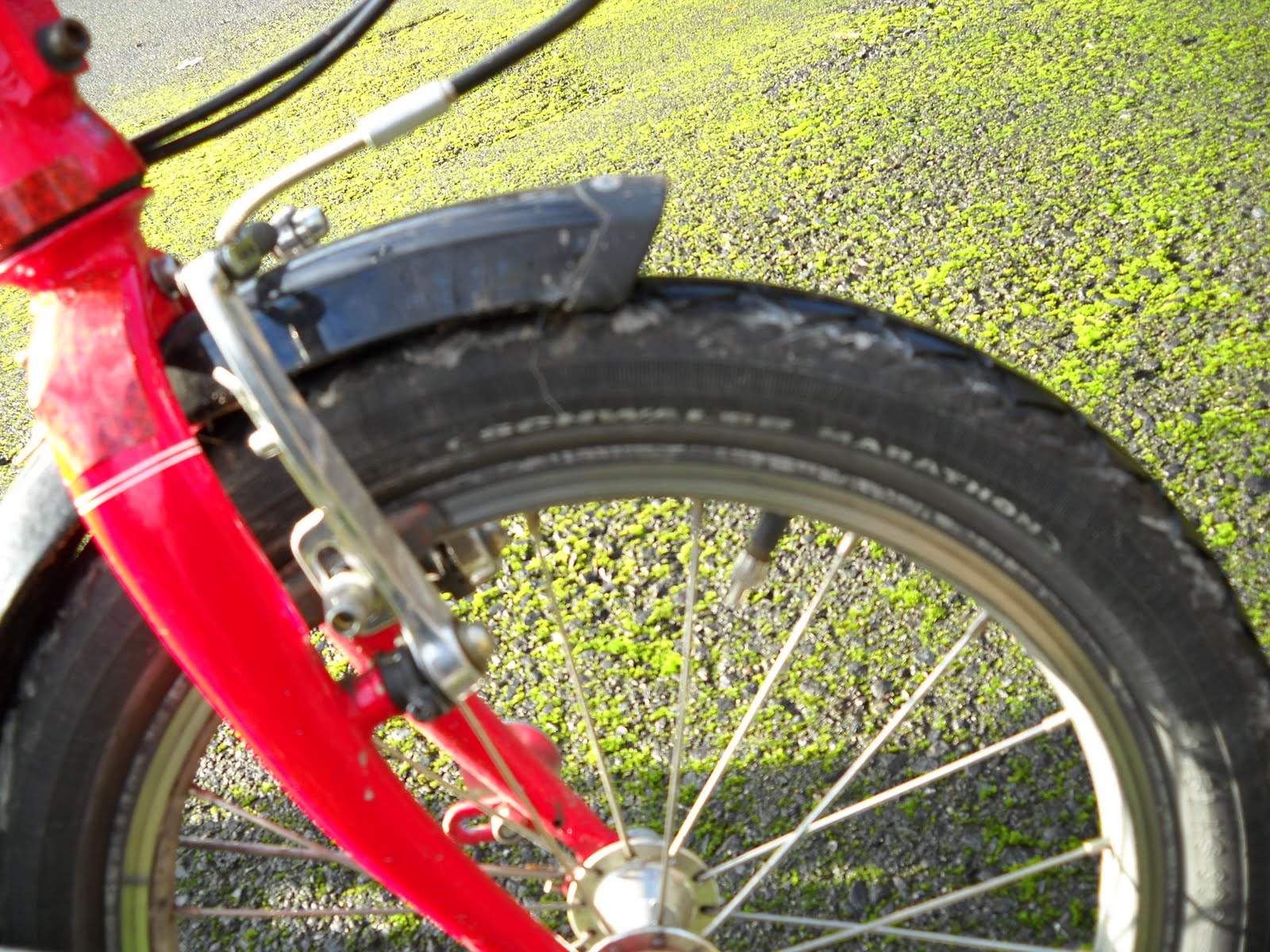
The bike came stock with comfy Schwalbe Big Apple tires but when I finally wore them out I replaced them with even tougher Schwalbe Marathons. Since I ride in all kinds of weather including the rain and the dark, I replaced the stock brake pads with salmon KoolStop brake pads and added some reflective tape to the frame.

I also splurged and replaced the stock plastic pedals with some very nice metal MKS folding pedals.

While the stock Dahon saddle is pretty comfy, all my bikes tend to wind up with WTB saddles. My Curve is no exception.
My bikes also all tend to end up with Ergon grips and my pal Jason gave me a nice Ergons that he'd custom modified (by chopping off part of the right grip) to work with the Dahon's single twist shifter.

I also added a little bell to the bike and like all my bikes, I've got a bunch of lights on it.

While I use the Curve for travel, it's such a fun little bike to ride that it's the bike I ride most often on errands and when I'm just going out to noodle around. Ironically, this little bike is the bike that winds up hauling the most cargo. I have a little folding nylon bag and if I zip out to the grocery store or pick up a book some place, I've found I can carry what I need balanced on the rear rack, in my backpack or in a bag hanging from the front handlebars.

I can't stress enough how fun and zippy a bike with little wheels feels. My other main bike is my Octocog and it has massive 29" wheels that roll over darn near everything. While I love the big wheels on the trails and the wide open road, in an urban, stop-and-go setting, the Dahon with its 16 inch wheels snaps into motion as soon as the light turns green and it is extremely nimble in traffic.

While I find a small 3 speed like the Curve to be fine (I'm 5'6" tall and have decent power in my legs) other folks might be happier on a bike with a bigger frame and/or a greater selection of gear ratios. Dahon makes a wide range of bikes for a wide range of riders.

When I got my Curve, at the time I thought it seemed like a good deal. It turns out I was wrong about that. It turned out to be a great deal. A great deal of fun in shiny red package.

BTW, I have no financial stake in Dahon, but they did publish my poem in one of their catalogs and sent me some schwag.

Keep 'em rolling,

Kent "Mountain Turtle" Peterson
Issaquah WA USA

Tuesday, November 30, 2010

The Trek Belleville: This Is Not A Review


I work at a great little bike shop here in Issaquah called the Bicycle Center. Bicycle Center is a Trek bicycle dealer, so I get to build up, test ride, and work on a whole lot of Trek bikes. We also work on other bikes and over the years I've worked in a range of shops where I've worked on and sold a wide variety of bikes. But I'm certainly not an unbiased reviewer and this is not an unbiased review. Got it? Good!

The Trek Belleville is not a bike for racing around, it's a bike for getting around. The Belleville is a product of Trek's Eco Design effort and I've seen enough behind-the-scenes stuff to know that this isn't just some token corporate green-washing PR thing. For example, when the Bellevilles or any of the other Eco series bikes come into the shop, they are packed not with the industry-standard foam & zip-ties but with string and reusable bags to protect the parts and lots of recycled cardboard. And that's the stuff the customer pretty much never sees. Which, I guess, is why I'm telling you this now. It's a cool facet of these bikes.

By the way, if you need a box to ship a bike somewhere, check your local bike shop. Any shop that deals in new bikes will probably have boxes and packing material they'll be happy to give away. And if your local shop is a Trek dealer, try to get an Eco series box & packing stuff. It's really nice.

The Belleville comes with fenders, racks, chain guard, a kickstand and generator lights. This is not the norm for bikes in the US market, where light weight tends to be a major selling point, shops make money selling accessories and a lot of customers enjoy making choices of what accessories they get. The Belleville is what it is. And what it is, with all that stuff on it and a steel frame, is heavy. Not insanely heavy, but it's sure no Madone!

While the go fast crowd won't have any interest in the Belleville, I also know that the retro & utility bike purists will find nits to pick about this bike. Some will bemoan the lack of a lugged frame, some will wish for a different rake on the front fork, some will complain that the 3-speed hub has too few gears. My main complaints with the bike involve the lack of adjust-ability in the handlebars, the kind-of-weird-looking recycling-friendly seat and the unusual curve of the top-tube on the men's model. But no one bike is perfect for everyone and I think it's wonderful that Trek makes a bike like the Belleville.

With an MSRP of $659.99, I think the Belleville is a very good value for somebody looking for a complete city bike. Here are links to a couple of real reviews of the bike:

Car Free Philly: Original Review & Update


Keep 'em rolling,

Kent "Mountain Turtle" Peterson
Issaquah WA USA


Wednesday, November 24, 2010

Better to Light a Single Candle


The old proverb advises that it is better to light a single candle than to curse the darkness. That's the spirit behind programs like Get Lit and while I've been involved in various organized versions of Get Lit, I also like doing my bit as an individual, one on one. I'm a sucker for a deal on a batch of lights cheap enough that even a poor bike mechanic can afford to give away. Forty lights shipped to my house for about what I'd pay for a single light is a good deal in my book. Yeah, they're cheap and one of them was DOA and I'm not quite sure what I'll do with the blue and green ones (turn signals on my fingers maybe?) but they are light and I'll pack some in my bags to give away to unlit riders and walkers.


Keep 'em rolling,

Kent Peterson
Issaquah WA USA

Tuesday, November 23, 2010

Riding in the Ice & Snow


It snowed last night in the Puget Sound area and everybody freaked out. If you don't have any place you need to go, the smart thing to do when the weather turns bad is to hunker down and stay put. Even if you have perfect control, perfect traction and perfect reflexes, there are a lot of folks out there piloting big metal boxes of momentum down slippery streets and things get real messy, real fast. We closed up the bike shop early and I walked the four blocks to home like I always do.

This morning, however, it's like a holiday. The schools and a bunch of businesses are closed, a lot of folks are out on foot most of those driving seem to be driving quite cautiously. The sky is blue, the sun is bright and the air is cold. Snow is everywhere.


My bike is the one I've built up for days like this, a low-ratio fixed gear with big platform pedals and carbide-studded tires. The tires crunch wonderfully through the snow and the studs grab solidly on the ice. At the bridge over the creek I see a pair of ducks with their down puffed up against the cold.


I puff up my own warm layer, pause to take another picture and see my breath crystallize in the in the blue light of the morning. I roll on toward the grocery store, to the other errands, to the rest of the day.

It's a good day to ride.

Keep 'em rolling,

Kent "Mountain Turtle" Peterson
Issaquah WA USA


Wednesday, November 17, 2010

A Broken Rim Mystery

It was a dark and stormy night...

Really, it was. It was a Monday evening in November. The wind was whipping the orange and yellow leaves off the trees and the wind was howling up the valley. The lights in the shop had flickered ominously several times, but it so far the power was still holding and the phones were still working. It was the kind of night where I'm glad that my current commute is only four blocks long.

One service we don't offer at our bike shop is on the road pick up, but when the call came in the fellow on the other end of the line sounded so soaked, stranded and stuck I told him I'd see what we could do. As luck would have it Chris, one of our off-duty mechanics, lives not far from where this guy was broken down and Chris happened to be home, happened to answer the phone when I called him and happened to have a truck big enough to bring man and bike back into Issaquah on this particular dark and stormy night.


What stranded man and bike wasn't a routine puncture, it was a rim blowout. I've written previously about rim blowouts, but they are usually caused by the rim being thinned by braking. In this case, the rim failed at the rim wear indicator but this bike uses disk rather than rim brakes, so the rim should not be subject to any wear at the rim. The bike's owner tells me that this is the second rim failure he's had on this bike in the year or so that he's owned it. Rather than having his recumbent shop replace the rim again with the same thing, he's opting to have us rebuild the wheel with what we all hope will be a stronger rim. The new rim has no wear indicator, and stronger construction. Since the new rim has a different E.R.D., we're replacing all the spokes as well.


The mystery of why this bike is blowing out rims is still a mystery. I have theory, but I'm posting this story and a couple of photos here in the hopes that folks might say "oh, I've seen this before" or "I bet this is what's going on."

The bike is a Rans Cruz semi-recumbent and it has a Bionix electric rear wheel. The design of the bike puts a lot of weight on the back of the bike. The wheel weighs about 16 lbs and the battery (which the customer took with him and I didn't get a chance to weigh) rides on a rack right above the rear wheel. Most of the rider's weight is carried by the rear wheel and the electric motor puts out a lot of torque.

My best working theory (which is really just a wild-ass guess) is that the combined weight and torque is placing a greater stresses on the rim than what an unassisted rider would generate on a conventional bike. Unsprung weight over the rear wheel means that every bump transfers more pressure via the tire bead to the rim. The wear indicator on the existing rim not only serves no positive function on a bike with disk brakes, the groove of the wear indicator actually creates a stress riser in the rim. Over time, the combined stresses lead to a blowout.

So like a Stephen King mystery that I bothered me a lot when I read it but I still sticks in my head, I have a problem and a theory but no certain solution. We've got a rim and spokes on order and we'll lace 'em up, advise running a bit lower pressure in the tire and hope for the best. I guess that's how life goes. We never get all the answers but we get interesting questions.

Keep 'em rolling,

Kent "Mountain Turtle" Peterson
Issaquah WA USA

Sunday, November 14, 2010

As if you live in the early days of a better nation

When I was a kid, I biked to school. These days, lots of people will tell you that kids don't bike to school because it's too dangerous. While it is true that these are dangerous days, giving in to fear doesn't make things safer. Parents driving their kids to school instead of letting them walk, bike or take the bus puts even more cars on the road. It may be that the greatest risk to a child is being struck by the vehicle of well-intentioned parent dropping their child off at school.

I have to add that "may be" qualifier to this post because I've been unable to find hard data to back up an oft-used quote (I've used it myself) that "Fifty percent of the children hit by cars near schools are hit by vehicles driven by parents of other students." Here is a link to a 2004 article containing that quote, but while it's a good sound-bite, there is no link to data. The people at PolitiFact are are better at digging than I am and they came up empty. The 50% stat may in fact be true or the real number could be higher or lower, but I'm going to stop using that line when I talk to people about safety and cycling. I'll still champion the position that we're safer with fewer cars around schools but I'll manage to work towards that goal without a nifty quote that I can't back up.

While we like to think of ourselves as rational creatures, choosing the wisest course of action based on logic and data, we have big blind spots in our thought processes. The phenomena of illusory superiority (sometimes called the Lake Wobegon Effect) causes us to discount the dangers we add to a situation and amplify the perceived dangers that we think of as "out of our control". A child on a bus is much safer than a child in their parents car (OK, I've got a link for this one!) but because we have this tendency to think of ourselves as above average, we're certainly not adding to the problem by driving to school or work or whatever.

But we are. I read the comments that come into this blog and I try to think about them. I sure don't have all the answers and when somebody disagrees with me, I try to look at their point. Sometimes I wind up changing my view. Sometimes I wind up changing my approach. Sometimes I wind up restating my position or asking for a clarification. Recently, in a comment to a post of mine titled "Life'll Kill Ya" a commenter who owns a company that makes bikes in Portland Oregon "a Platinum-level bike friendly community" concluded his thought-filled comment with the words "if I had my way, I would force my employees to drive cars for their own safety and my peace of mind."

I disagree with that commenter, but I understand his viewpoint. I certainly disagree with his idea of "forcing" people to behave in accordance with his view of risk. I also have to wonder if he "had his way" would that in any way make the streets of Portland safer or better for his employees? I certainly believe his concern is genuine, but I also believe that our actions build our world.

It's natural and good to be concerned for others, our friends, our employees, our kids, but with we can easily over-fear and often we fear the wrong things. I'm not certain of enough my own assessments of risk and reward to compel anyone to do anything my way. But I ride my bike and I'll continue to suggest that riding bikes is a good way to make the world a better place in which to live.

My favorite Glasgow pedestrian, Alasdair Gray, is fond of saying, "Work as if you live in the early days of a better nation." The kids in Oak Cliff are doing just that with bicycles and root beer floats. I think that's something worth doing.


Keep 'em rolling,

Kent "Mountain Turtle" Peterson
Issaquah WA USA

Barb Chamberlain: Bikes Will Save the World


The format of an Ignite presentation is short and simple. Participants are given five minutes to speak on a subject accompanied by 20 slides. Each slide is displayed for 15 seconds, and slides are automatically advanced. In the presentation above, Spokane's Barb Chamberlain fills her five minutes with humor and positive energy to show why she knows that bikes can save the world (or at least make it a better place).

Thursday, November 11, 2010

Rumble Strips Can Be Done Right!

Rumble strips are those milled lines at the edge of the road designed to alert a drowsy or inattentive driver that they are drifting off the road. It's a safety mechanism designed to save lives. Unfortunately, in many locations when rumble strips are placed on the road they effectively make it impossible to safely cycle along the shoulder of the road. In my tour of Washington State a few years ago I'd often see rumble strips that looked like this:


I've seen worse examples, where the rumble strip covers every inch of the width of the shoulder. But things don't have to be this way.

Rumble strips can be built into a road in a way that lets them serve their warning function and keeps the almost the entire width of the shoulder usable for cyclists. Here is a photo from a section of SR-507, also in Washington State:


The rumble strips on SR-507 are built into the fog and center lines, effectively leaving the full width of the shoulder available to the cyclist. In addition, every dozen feet or so there are gaps in the rumble strips enabling cyclists to move from the shoulder to the traffic lane. Much of the time on a country road like this, the shoulder is the best place to ride, but a cyclist might have to merge into the traffic lane to get ready to make a left turn or to avoid some debris and it's good to see a road design that recognizes the legitimate needs of non-motorized road users.

Rumble strips can be done right. A page at www.rumblestrips.com (yes darn near everything has a page on the internet!) has some good information and documents describing how to implement rumble strips in such a way as to enhance the safety of all road users.

Keep 'em rolling,

Kent "Mountain Turtle" Peterson
Issaquah WA USA


Wednesday, November 10, 2010

Bicycle Advocacy: Allies Are More Exasperating Than Enemies.

Last night I left work early and rode into Seattle to hear Mia Birk talk about her wonderful and inspiring book, Joyride: Pedaling Toward A Healthier Planet. I could tell you that Mia is a wonderful speaker (she is) or that her book is a lovely collection of inspiring stories and you should rush out an buy it (it is and you should) or that riding at night in the city is peaceful and liberating and one of the great joys in this world (it is). Since I've just told you those things very briefly, I'll speak now at greater length of controversy, energy, passion and hatred. I'm speaking, of course, of the world of Bicycle Advocacy.

Last night's event was hosted by the Cascade Bicycle Club. Cascade is the largest bike club in the U.S. Cascade members host rides every day and the club does a wide range of things to promote cycling in the Puget Sound area. They work on making trails and streets safer for cyclists, bring great speakers like Mia to our city, lobby for cyclist rights and do a host of other things to make our area a better place to ride.

At the moment a lot of people are very worked up about what the club is doing, what the club should be doing, what certain people are or are not doing and so on. The club Board of Directors and the club's long serving Executive Director, Chuck Ayers, had a dramatic parting a few weeks back which generated a lot of heated discussion, actions and counter-action. I tried to find an unbiased accounting of events to give you some background as to what this is all about, but it's kind of like flipping between FOX News and MSNBC in hopes of finding something "fair and balanced."

This article at Crosscut: Culture clash divides the Cascade Bicycle Club, sums things up pretty well, while my friend Eric over at Tubulocity goes right for the sensational headline with his: Leadership of largest bicycle club in America overthrown in bloodless coup. The Seattle Times take on events is presented in an article titled: Politics, friction reshape influential Cascade Bicycle Club. If you're at all interested in such things I encourage you to follow the links I've posted above and I'm sure if you Google around you'll find some other stories on this topic. And you'll probably shake your head like I did and say "wow, what a mess."

I'm mentioning Cascade's woes because I think they illustrate a truth, something I've discovered in my years of working as a bike advocate in various roles and in various organizations. The truth of the matter is that when you work to promote something you will find that a huge percentage of your energy and time goes not into arguing against your foes, but in discussing technique and focus with your allies. I could list dozens of examples and perhaps if I was getting paid by the word here I would, but I assume that both your attention and my time is finite so I'll stop at a few stories to illustrate my point.

Last night before Mia's talk I saw my friend Brad walking through the bike department of REI. Brad was fired up and he's firmly in the "the board went too far and they are out of touch with the membership and should be recalled" camp. Brad's got a petition and I think if he can get enough signatures he'll show that he's got a point. I also think he's got a right to rabble-rouse. A few minutes later I meet another of my friends, Gary, and Gary clearly stated his view that "your friend Brad is dead effing wrong on this board thing." Gary goes on to express that starting a new board from zero would be a huge effort and you know how hard it is to recruit board members and, well, Gary makes some good points. And that's my point, it's complicated, it's work and it's effort and it's not really making it easier for another cyclist to get to work or making Stone Way any safer. And it's a microcosm of what happens in advocacy groups every day.

When I worked at the Bicycle Alliance of Washington there were countless conversations of the form "I can't believe you are working on X and not Y!" The Alliance had a board member resign when the Alliance backed the county-wide mandatory cycling helmet law. I use a helmet but don't favor helmet laws but that wasn't a personal deal-breaker for my working for and with the Alliance. But friction points abound in the cycling world. Many "vehicular cyclists" argue loudly against bike lanes and paths. People debate the efficacy and value of groups like Critical Mass. Here's an example from the U.K. of one cyclist blasting another's attempt to promote cycling.

In any effort involving more than one person there will be conflicts. It's not at all amazing that a 13,000 member group like Cascade will, it would be astounding if it didn't. What is remarkable is that despite the intensity of views on all sides of this issue, the club still functions. Every day volunteers are out there leading rides. Staff members are still going to work, making things better bit by bit for cyclists in Seattle. Cascade brought Mia Birk here to Seattle to tell us that if we keep at it, bit by bit, things will get better. Even while we put up with the efforts of our friends, who we are sure are misguided. Those friends are just as sure that we're the mistaken ones.

Last year Evergreen Mountain Bike Alliance (the Puget Sound's big mountain bike club) went through its own drama and still managed to open up Duthie Hill, get a ton of trail work done on Grand Ridge and countless other things. We cannot, should not, put aside our passions, for our passions and our beliefs are what drive us. We'll drive our friends crazy when they realize we don't think exactly like them. And they'll drive us crazy in return. But somehow, we'll muddle through. Maybe someone changes someone else's mind or maybe we just disagree. Maybe we'll go for a bike ride or maybe we'll take a break. I don't have the answers. But I do know that very often my allies are more exasperating than my enemies.

Something unites us, a brother-and-sister-hood of the wheel. We balance and wobble and yell at each other but we love something with many spokes. Wheels hold their shape through tension. We do our best to do the same.

Keep 'em rolling,

Kent "Mountain Turtle" Peterson
Issaquah WA USA


Sunday, November 07, 2010

Lighten Up!


In most of the U.S. we set the clocks back an hour last night. I've never been a fan of this biannual assault on circadian rhythms but I figure I'll use the extra pseudo hour I've been given (by the same chrono-criminals who stole it from me last spring!) to once more urge, suggest, cajole and recommend that those of you reading this who have occasion to be out on darkened streets could take a few moments to reflect (pun intended!) on how visible you are to the other creatures of the night.

My wife will tell you that I'm somewhat obsessed with lighting. Over the years, I've collected lots of various lights, some that run on batteries, some that generate light via the rotation of the wheel. I'm not going to get into a discussion of Light A vs Light B, Generators vs Batteries or Reflectors vs Lights here. I am going to say that lights serve two main purposes, allowing you to see and allowing you to be seen. That second purpose allowing you to be seen is extremely important and while reflectors don't do a damn thing in terms of lighting your way they can (sometimes) aid in making others see you.

Bike lights and blinkies keep getting better. LED efficiencies go up every year and today's $10 blinkie is brighter and lasts longer than the blinkie you bought two years ago. When I rode Paris-Brest-Paris in 1999, most of us had lighting systems we home-brewed with big battery packs and spare batteries we sent ahead in drop bags. Today I have a brighter, better light that can run all night on 2 AA batteries. A blinkie like the Planet Bike Super Flash or the PDW RadBot is visible even in daylight and sips power from a pair of AAA cells. Rechargeable batteries are a lot better these days, and I recharge my light batteries with little solar chargers.

While reflectors themselves are not enough, reflective tape on your bike or clothing is an inexpensive way to increase your odds of being seen. Reflective bits on your ankles, pedals and wheels are especially eye-catching because motion increases the odds that they'll intersect and reflect a light source. A reflective sash (see photo above) adds a broad stripe of visibility to any outfit.

Even if you think you are well-lit, please take a moment to revisit your visibility. It gets dark every night and if you have a friend with a car, have them point their headlights at you some night as you ride. What do they see? If no lights are shining on you as you ride through the night, what do people see? Ask yourself these questions now and then. The life you save may be your own.

If you have old lights that you're not using, pass them on to someone who can use them. Every bit can help. If your local community doesn't have a program like Get Lit, you can start one, even if it's just you giving away one light. The dark times are the best times to let your light shine.

Keep 'em rolling,

Kent "Mountain Turtle" Peterson
Issaquah WA USA


Friday, November 05, 2010

What We Do When We Do Our Best

Five years ago today, I wrote these words:
"OK, let's see how this blogging thing goes."
At the time, I had only a vague notion of what I might write next and no idea of what twists and turns might lie on the path ahead. Today, I have only a vague notion of what I might write next and no idea of what twists and turns might lie on the path ahead. But I don't need to know the whole path, heck I don't want to know the whole path. I've got what I need to get going, the reason to turn the pedal over at least one more time. Stick around and I might get around to telling you about it. Maybe. As I said, I'm not really sure where this is going.

I have two very neat machines here. One is simple and amazing. A couple of wheels, some pedals. A bit of chain. A part you sit on and a part you hang on to. Here's the weird thing, though: It only works when it's going. You've got to put some faith into it, roll past a bit of fear and a lot of uncertainty. You give it a little push of your motion, catch your breath when you are sure you are about to fall but still follow it into that fall. And the bike rolls under the very spot you were about to fall into and you learn something magical, something called balance. And your world will never be as small as it was before. You've grown wheels that feel just like wings.

The other machine is complex and amazing. Wires and electrons and keyboards and all the glowing screens in all the coffee shops in all the world. Servers in cold rooms and satellites in space and light running through fibers. An encyclopedia written by everybody with a keyboard, a place where damn near anybody can publish and damn near everybody does. We've built the world's biggest and best copy machine and we mostly use it to forward bad jokes and send pictures of cats doing dumb things. We are the most stupid, cute, wonderful, amazing creatures on earth. If cats invented the internet, they'd be forwarding a billion pictures of us doing dumb things.

I use the internet to do a very little thing, a tiny thing, a trivial thing. I call it Kent's Bike Blog. Note the lack of global scope. I don't write about the entire world, I just write about bike stuff that interests me. I try to keep it to bikes, but I don't always succeed. If I was just writing it for me, I'd write it in a notebook and lock it away, but I write it on the internet so I reckon I must be thinking I have something to say to folks. I try to be somewhat interesting or useful in some way.

I've been quieter here lately for several reasons. One is Twitter, which provides a 140 character outlet for the "hey look at that" pointers that previously might expand to fill blog post. Another reason for silence is that given by David Byrne, "Say something once, why say it again?" I've written a lot of words over the past five years and on some subjects I figure I've said enough. But the final reason is that sometimes you have to be quiet to figure something out. I've been trying to figure out if I've said all I need to say or if maybe the words should go in a book or a tweet or some other venue.

I've written previously about a formative experience I had in the open spaces of Wyoming that showed me that we do indeed get what we need. I was blessed enough to get a reminder a few hours ago from an internet friend, a woman who wrote not just of her fear, but her desire to ride past that fear. She wrote not only to ask for help, but she wrote to help. And Hollie, this may surprise you, but your post really, really, helped me. Thank you.

Hollie reminded me that we pedal forward, not because we know what lies ahead or because we do not fear, we pedal because we love to pedal and we suspect there is something down the trail we need to find.

I've found beauty in quiet places and friends I know only through pixels. I've crashed into gates I didn't see, walked when I couldn't pedal and retreated for home when I know deep down I could have lost two days and kept going. But sometimes you have to stop, be quiet, go home, regroup and refill. And then you get an answer. Not the whole answer, but enough. Just a bit. The thing that brings you back to the only path you can possibly travel.

When we do our best, we seldom have that clean, clear certainty that we are doing our best. We are only doing what we can. I think I have a few more things to say here, things about riding and living and rolling around this beautiful world on two wheels.

For now I'll just say thanks, thanks to Hollie and all the rest of you who read Kent's Bike Blog and help me keep 'em rolling.

Kent "Mountain Turtle" Peterson
Issaquah, WA USA


Friday, October 22, 2010

Ferries, Feet & Folding Bikes: A Car-Free Vacation on Lopez Island, WA


Some people vacation in neon palaces, gamble that something different is something better and roll the dice in towns where the only sure bets are found in casino stocks. Some folks leave cold climes for warm and beaches or dull small towns for exciting big cities. Still others leave exciting big cities for quiet found in small towns.

Christine and I lead small lives in a smallish town where we get around by foot and pedal power. Sometimes we take the bus or some other big machine with a big motor when we are going far or fast, but day to day we do not need to rush. For the past few decades, we haven't owned any motor vehicles and contrary to the questions we're sometimes asked, it's not a hardship. It's a simple life we love.

Each autumn we go elsewhere, not to get away from who we are and how we live, but to live under a slightly different sky, to know a different home for a few days. Autumn is when we met and when we wed and our annual outings remind us how lucky we are to have each other and how little we need to be happy in this world.

This year we go to Lopez Island. We have small bikes that fold up even smaller when they need to go on a bus and a shuttle bus takes us north from Seattle to the ferry terminal at Anacortes, WA. We roll our bikes onto the ferry at Anacortes and sail on still water beneath bright blue October skies to Lopez Island.

Weather is a gamble in October and we've hedged our bets on a cozy cottage, a wonderful wooden octagon in the heart of Lopez Village. This is mid-week and the off-season and the village is tiny. It is perfect for us.

We walk. We ride. We explore. We wander and we wonder. We read books. We buy groceries at the market, cook and eat small meals. We talk and listen. We walk on beaches, gaze at gulls, see deer feasting on October apples. We see the sunlight on the water, hear the water lapping on the shore. We gather shells and memories.

We do not go fast or far, but we go and when it is time, we return home. The bikes fold up, and what we need fits in our backpacks. We pedal and walk and ride the ferry and the bus back to another small town, the one we call our own.

Keep 'em rolling,

Kent "Mountain Turtle" Peterson
Issaquah WA USA


Wednesday, October 06, 2010

Life'll Kill Ya

My Twitter friend Arleigh (aka Bike Shop Girl aka @arsbars) was hit by a car last week. Prior to being wisely "advised not to write, blog, tweet or facebook update until things get settled," she shared these thoughts on Twitter:
"Mentally I am really screwed up. I'm a safe rider and this was a calm afternoon and bike commute. Nothing I could have done different. Scary."
and
"Bicycling, commuting & encouraging others to do the same is my life. I was just hurt badly by that lifestyle..not sure how to swallow that."
I've never met Arleigh in the real world (the one with bikes and cars and roads and traffic) but we've traded bits and bytes and thoughts and pictures and I think of her as a kindred spirit, a fellow rider and a friend. I wanted to write a "it'll be OK, get back in the saddle, keep 'em rolling" kind of thing but as Arleigh noted, things like this are scary. Damn scary.

I've been where Arleigh was, rolling along, then flat on the pavement and then in the back of an aid car. I've had friends die on bicycles. But I've also had friends my age who've died from being sedentary or died at their own hands because they've lost whatever reason they had to live. Too many people die slowly as fear takes the world away from them, bit by bit. It is a scary world but fear is the mind killer. Courage is not the lack of fear, courage is facing the fear and acting anyway.

We can gather stats to rationalize our choices. Here's a lovely excerpt, placing the odds in perspective:

Too Dangerous

The notion that bicycling is too dangerous has been propagated to provide an excuse for those who feel guilty for not cycling to work. About 24 times as many people die on stairs and ladders as die on bicycles. Nonetheless, some motorists have terrible driving habits, especially when late for work. I suggest 1) starting a little early and 2) taking roads generally avoided by the rest of the traffic, 3) obeying all of the traffic laws, and 4) keeping alert at all times. Read my articles on Is Cycling Dangerous? and How to Ride in Traffic.

If the real problem is not that cycling is too dangerous but that you are afraid, remember that fear of doing anything new is quite normal and healthy. While I was a construction worker, I was assigned to working in an area high above the ground with only narrow forms to walk on. For three days I crawled around until I adjusted to the height, and I was only well-adjusted by the end of the week. At that time while we were talking during lunch, I thanked everyone for not laughing at me, because I surely would have quit. But one of the carpenders said, "Hell, we were all crawling around on our first day up here." The way to get over your fear is by gradually acquiring experience by riding on the weekends. Get used to traffic gradually, and get the wobble out of your riding, before you try to ride to work. That's what all of us experienced cyclists once had to do.

The quote above is excerpted from some very good writings on bike safety written by the late Ken Kifer. Ken was a very experienced cyclist who was struck and killed by a drunk driver a few years ago. You can do a lot of things right, heck you can do everything right, and things can go wrong. You can die. Warren Zevon said it best when he observed that Life'll Kill Ya. And back in 1997 America's Finest New Source confirmed that despite all our efforts, the world death rate is holding steady at 100 percent.

I am not trying to make light of the dangers of this world but rather pointing out that we carry on by telling ourselves lies, lies that we are safe. My favorite bike safety website, How to Not Get Hit By Cars, has lots of good information, information that if followed will improve your odds. But you can follow all the advice given there and still get hit. Arleigh was doing everything right and got hit. You can never be 100% safe, but you can be safer if you know the most likely things to fear and you take reasonable precautions.

Here's why I ride, why I have to ride.

Let's say I said "screw it, it's too dangerous" and I got something big, with a motor for all my getting around needs. Heck, as long as I'm being safe, I'll get something with lots of cup holders. I've amplified my mass, I've amplified my speed, I've amplified the danger I pose to others. I haven't improved my reflexes and I've dulled my sense of fear with an illusion of safety. I'm part of the problem now.

I can't do that.

Gandhi advises us to “Be the change you want to see in the world.” I love to ride. I'm one less car in traffic, one more bike in the world. We make the world safer for cyclists by being cyclists. Every man, woman and child on a bike or on foot is taking a small step or a tiny pedal stroke towards the world in which I wish to live. I have to be out there with them.

I may die on a bike today or tomorrow. I know that's a real risk. I take the precautions that I think are reasonable but I do know that in the end, life'll kill me. But I'm not going to waste the life I have stuck in a box or racing around making a world in which I don't wish to live.

I'll be out there, rolling. Arleigh, I hope to see you out there too real soon. Heal up, Bike Shop Girl.

Keep 'em rolling,

Kent "Mountain Turtle" Peterson
Issaquah WA USA

Thursday, September 30, 2010

Brooks Saddles and Saddle Position

I've often said that if there was one perfect bicycle saddle we'd all be riding it. The truth of the matter is bikes are different, riders are different, riding positions are different, riding styles are different and guess what? Different saddles work better or worse for various folks. That said, if you hang out with high mileage folks you'll find a lot of them who swear by Brooks saddle. You'll probably find some that swear at Brooks saddles as well. As near as I can tell, neither group is 100% right or wrong.

Brooks are tensioned leather saddles. Sheldon Brown has a great article describing the great comfort virtues of leather saddles here. Sheldon notes, "A leather saddle, like a good pair of shoes or a baseball glove, softens with use, and molds itself to fit a particular person's shape." The unique comfort factor is what makes the saddle worth the expense, weight and break-in period. However, if you're a vegan, that dead cow thing may be a deal breaker for you. I totally expect some entrepreneurial vegan to start a company making a Brooks-style saddle made of tensioned rattan (or some other sustainable, eco-vegan substance) any day now. It's an untapped market.

What prompted me to write this piece, despite Sheldon's excellent article on leather saddles and his wise words on saddles in general, is that I wanted to call attention to the issue of saddle set-back. One of the virtues of Brooks saddles is their classic design, they have basically remained unchanged for decades. And there, my friends, literally, is the rub.

Brooks saddles were designed when bikes had much slacker seat tube angles than what is common today. My 1972 Peugeot PX-10 was considered "racy" in its day and it had a 72 degree seat tube angle. It was easy to get a Brooks saddle back far enough in relation to the bottom bracket for comfortable riding. A modern bike, say a Surly Long Haul Trucker, in the same 52 cm size as my PX-10 has a 73.5 seat tube angle. Basic trigonometry tells us that given the same seat post but a steeper seat tube angle, the clamp area is going to be further forward on the modern bike. Modern saddles have longer rails to address this issue but the classic design of the Brooks keeps it from moving back. And if the saddle is too far forward, you'll tend to sit on the metal frame rather than the tensioned leather and wonder why anyone could ever think a Brooks saddle is comfortable.

There are some solutions out there. Velo Orange makes the Grand Cru Seat Post specifically with this problem in mind. A Brompton Saddle Adapter Pin used with a straight post and a seat clamp allows even more adjustment but it's a more complex solution. Sella Anatomica makes a couple of changes to the classic Brooks design, adding a cutout to the leather and longer rails to address the set-back issue. Like Brooks saddles themselves, the Sella Anatomica saddles have received mixed reviews.

A comfortable saddle is key to enjoying your bicycle riding and a Brooks or other leather saddle might be just right for you. If you can get it on the right spot on your bike.

BTW, I've logged thousands of miles on Brooks saddles, having ridden them on PBP, BMB and various other brevets and tours. These days, my butt is totally happy on WTB saddles but your mileage may vary.

Keep 'em rolling,

Kent "Mountain Turtle" Peterson
Issaquah WA USA


Thursday, September 16, 2010

What We Wear Is What We Say


I normally don't think much about fashion, but William Gibson's brilliant novel Zero History has got me thinking about the functions of clothing and how it influences our experiences. When asked in a WIRED interview if he had ever wanted to wear a uniform, Gibson notes:
“When was I last out of one?” Gibson wrote. “The extent to which we are all of us usually in uniform brings to mind [Brian] Eno’s definition of culture: Everything we do that we don’t really need to. Pajama bottoms beneath a raincoat? Out of uniform. Jeans with one leg cut off? Out of uniform. Contracultural apparel disturbs us. Countercultures are intensely cultural. Bohemias have dress codes as rigid as those of merchant banks. We all read uniforms, constantly, whether we’re aware of it or not.
People who ride bicycles generally wear clothes and those clothes, for better or worse, are read constantly. Our clothes make statements and if you chose not to wear clothes you're really making a statement. Even when we think we're not making a statement ("I dress for function, not fashion") we're stating something. The people behind Momentum Magazine think a lot about fashion because they understand something of the power of fashion in our lives. "Normal" looking clothes can make cycling appear normal, fun clothes highlight fun, and so on.

My family and friends can attest to the fact that I'm not exactly the guy people look to for fashion advice. My main criteria for clothing selection has to do with how many pockets an item has and how well the fabric hides grease stains. My clothes project a certain Red Green aesthetic ("if the women don't find you handsome, they should at least find you handy") and strangers have been know to pick me out of a crowd when they are looking for someone who might be carrying a metric allen wrench.

On the Tour Divide this past summer, my local college jerseys (courtesy of Adrenaline Promotions) proved to be great conversation starters and I think the real cowboys in Wyoming (the ones who drive pickup trucks) were more inclined to think kindly of a biker in a Wyoming Cowboys jersey than if I'd been wearing the latest Euro-team kit. On my 2002 tour to Minnesota I crossed paths with a couple who credited their USA garb with making their trip much safer and more pleasant. There's probably some truth in their belief that even the worst bike-hating driver would think twice before honking at, buzzing by, or running down Old Glory.


This is probably about as much as I'll post on fashion, but there are many sites devoted entirely to what people wear while riding. A couple of interesting bike fashion sites are Velocouture and Copenhagen Cycle Chic.

Keep 'em rolling,

Kent "Mountain Turtle" Peterson
Issaquah WA USA

Monday, September 13, 2010

The Burley Travoy Trailer: A Review


"Clever!" "Neat!" "I want one!" These are the kind of things people say when they first encounter the Burley Travoy. First off, let me get the disclaimer stuff out of the way. I get no kickback from Burley for this review and they didn't give me the trailer or anything. We have them for sale at the shop where I work, the Bicycle Center in Issaquah, and if we didn't think it was a good product we wouldn't bother having it in our store. And if you buy it from us, yep that does help keep me employed. Similarly, if you buy it from your local bike shop, you're helping keep those folks employed. And if you can't find one locally and buy it from Amazon using one of the links on this blog, a small percentage of your purchase price goes to me. We all clear on that? Good! On with the review.

When we got the Burley Travoy in the shop, I was one of those people saying "Clever, neat, I want one!" Burley describes the Travoy as a commuter trailer but I think it's better described as an errand trailer. While most bike commuters probably don't need to carry a trailer load of stuff on a daily basis, almost every cyclist encounters situations where the ability to carry large or awkward things would come in handy. While something like an XtraCycle, a Big Dummy or a Trek Transport can carry huge loads, many cyclists don't have the space or cash to devote to such large and lovely machines. If I was regularly hauling things like cylinders full of welding gas (hi Matt!) and didn't live in a second floor walk-up apartment, I'd totally be one of those cargo cult cyclists hauling hundreds of pounds of stuff on my big, long bike.

The Burley Travoy is designed to carry loads of up to 60 lbs (27 kg) and it's designed to carry stuff, not people. The Travoy is light (just under 10 lbs) and it folds up for storage. Folded, the Travoy fits in it's own cargo bag. Folding and unfolding is a very quick process -- the Travoy folds in thirds with a twist of the handle/latches and the wheels pop on and off with a push of a button. The Travoy can also function as a hand cart and it is narrow enough to roll through doorways.

The Travoy has many nice, clever touches. The small hitch mounts securely to the bike and a simple latch mechanism connects the trailer to the hitch. Spare hitches may be purchased for $30 so you can easily share the trailer between multiple bikes. Burley also makes a variety of bags that can be used with the Travoy and the trailer has many tie-down points. As a test, I strapped my folded Dahon D3 to the trailer as cargo and it worked fine. I also used the Dahon as the towing bike for the trailer. The stock hitch isn't sized for the large diameter seatpost of the Dahon but replacing the stock bolts with longer ones solved that problem. With a pair of folding bikes and this trailer you could, for example, meet a friend some place and then you both could ride off into the sunset. (Maybe I'm the only one who does things like that, but a trailer like this opens up interesting car-free possibilites. If I was younger and single that would totally be how I would date!)

The Travoy tows wonderfully. It tracks nicely behind the bike and handles well both empty and loaded. On the trip to the Trader Joe's a few miles from my house I get a mix of paved and gravel riding and if I'm in the mood I can get a bit of trail riding in as well. The Travoy handled the bumps and rough stuff well. 12" pneumatic tires and a flexy material near the hitch do a good job of damping vibration. What I think of as a big load of groceries fits easily into the Travoy bag.

There's a lot of plastic on the Travoy, but the trailer seems very solid. The latches all work smoothly and for it's intended use as an urban errand trailer, I can't really come up with anything I'd change about the design. If I was going to go on a cross country or round the world tour, I'd probably want something with beefier wheels, more metal and less plastic. Burley, if you're reading this and need a field tester for an adventure trailer with a design like the Travoy, let me know.

This isn't a long term test, we just got this trailer into the shop. So far, I'm very impressed. I've included some videos Burley made showing the Travoy in action and the link to Amazon includes some reviews there. If anybody out there has anything they wan't to add about the Burley, feel free to use the comment form here. If you're in Issaquah, stop by the Bicycle Center and check out the Travoy for yourself.

Keep 'em rolling,

Kent "Mountain Turtle" Peterson
Issaquah, WA USA


Thursday, September 09, 2010

The Gift of What You Notice More


Dar Williams writes about "the gift of what you notice more" in her song The Blessings. I've been thinking of blessings, the gifts we notice more, in relation to time and the pace at which we live our lives. It's a theme I've often revisited on this blog, from Bogart's observation that the world is three drinks behind to my own appreciation of life at twelve miles per hour. As time keeps on slippin', slippin', slippin' into the past (Steve Miller writes a catchy song, but he's wrong about time) I'm learning to slow even more. Sometimes twelve miles per hour is too hasty.

For estimating purposes, while biking in the city, I use the figure of ten miles per hour and then add my fifteen minute flat tire buffer. In a vast majority of the cases, I wind up going faster than ten miles per hour and I don't have a puncture enroute and thus I give myself the greatest luxury, the thing money can't buy. Time.

The benefits of slack time manifest in myriad ways. Traffic is thicker than usual? No worries, I've got time. At the coffee shop a half hour before I told my buddy I'd be here? Great, that's why I have a novel and notebook in my pack. Wonder where this side road leads? I'll check it out, I've got time.

My favorite thing about the time I gain by going slow (think about that one for a bit) is the gift of what I'm free to notice. What prompted me to write this was the Leatherman Mini Tool I found on yesterday's ride to Seattle. Like Thoreau with his arrowheads, I often find things. My wife has often expressed the opinion that "you are the findingest fellow I know." She also sarcastically observed as I showed here the little Leatherman "yeah, 'cause you don't have enough tools!" It's true, over the years I've found what I need and much, much more.

While sometimes these gifts are things I hold in my hand, as solid and strong as a real steel tool made in Portland, OR or Duluth, MN (my favorite found 6-inch wrench was forged at the Diamond Tool and Horseshoe plant that I used to bike commute past back in Duluth), often the blessing is a stranger I have the time to meet, a view I have the time to notice, or a tiny creature scurrying across the trail. It's a beautiful world and the time we spend here is a blessing. It's a lesson I keep relearning, very slowly.

Wednesday, September 08, 2010

Mark Ronson: The Bike Song


This song and video are very well done and the refrain "I'm going to ride my bike until I get home" has completely embedded itself in my skull.

Keep 'em rolling,

Kent

Monday, September 06, 2010

DIY: Inner Tube Rack Strap

I enjoy Roy Doty's Wordless Workshop cartoons. Roy is a master of explaining a problem and a solution without using words. I'm way more wordy than Roy and anyone who doubts that can look at this post as proof. I can't even post a super simple Do-It-Yourself project without having some kind of wordy intro!

I patch my own tubes but I still wind up with a surplus of used tubes. A lot of bike shops have the same problem and although many tubes in the Seattle area wind up getting recycled into cool Alchemy Goods products, you can probably get used tubes just for asking. And, unfortunately, I manage to find discarded bike tubes along the roadside and bike paths around here.

So here's a quick, easy and cheap way to re-purpose a bike tube. One 700c tube plus a couple of buckles from REI or a craft store and a couple of zip ties (total cost, less than two bucks) will yield a pair of strong and stretchy rack straps or a belt or what have you. The pictures tell the story.


Keep 'em rolling,

Kent "The Mountain Turtle" Peterson
Issaquah WA USA